UFO/UAP Case file
The Report That Outlived the Night: The 1976 Tehran F-4 Encounter
Two Iranian fighter crews chased a brilliant object over the capital and reported their instruments failing as they closed in. The only hard artifact is a single US cable that relays their account and rates it a classic, and fifty years on the central claim still cannot be tested.
- Case type
- UAP
- Status
- Unexplained
- Event date
- September 19, 1976
- Location
- Tehran, Iran (object reported over the capital; intercepts launched from Shahrokhi Air Base near Hamadan) - Iran
- Evidence
-
- Testimonial
- Radar
- Official record
The open question Were the crews' proximity-correlated systems failures an effect of the encounter or a coincidence of known equipment faults, and is there any way left, fifty years on, to decide?
The thing most people get wrong about the Tehran case is the part they find most convincing. They will tell you that on a September night in 1976 a UFO outflew the Iranian Air Force, knocked out the weapons of an American-built fighter, and that the United States government later confirmed it in a declassified document. The last clause is the load-bearing one, and it is not quite true. There is a declassified document. It is real, it was distributed across the top of the US national-security system, and a US officer attached to it an evaluation calling the case a classic. But that document is a relay, not an investigation. It carries the Iranian crews’ own account up the American chain of command and rates the account as worth studying. It does not certify what was in the sky.
That distinction is the whole of this story. What two F-4 crews reported that night is genuinely strange and genuinely hard to explain away. What can be documented about it is thinner than the legend, and the single most important claim in the case cannot be tested at all. As always, we keep three things apart: what the record says, what the evidence shows, and what is still only a hypothesis.
The documented account
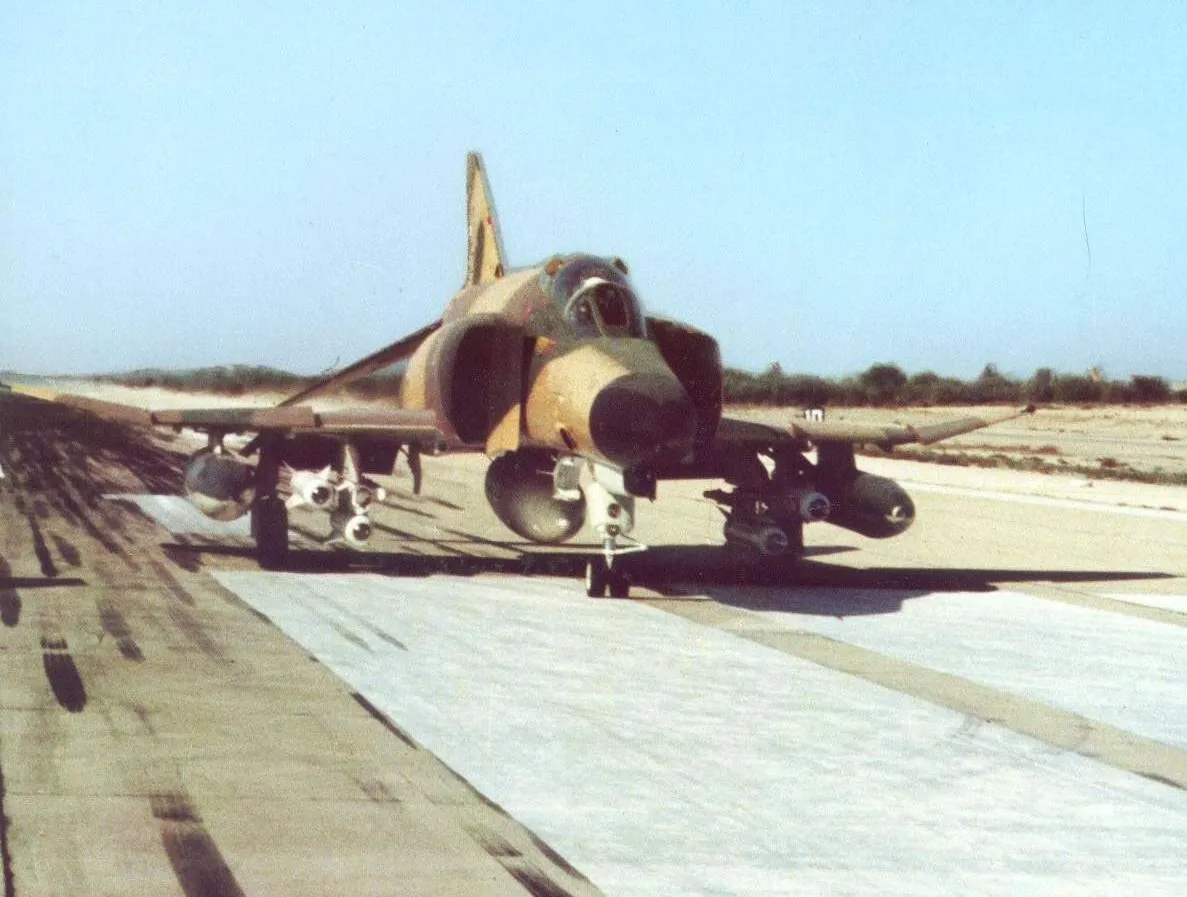
The setting was the Imperial State of Iran under the Shah, a close US client and a major operator of the McDonnell Douglas F-4 Phantom II. That alliance is the reason a US Defense Information Report exists at all. The aircraft were flown by the Imperial Iranian Air Force, and the intercepts launched from Shahrokhi Air Base near Hamadan, west of Tehran.
What follows is the chronology as relayed in that report, the contemporaneous record. The times are local and in the early morning hours of September 19, 1976.
It began with phone calls. Around half past midnight, the air force command post in Tehran took a series of calls from civilians in the Shamiran district north of the city (some accounts render the name “Shemiran”), reporting a bright, unusual object in the sky. The duty officer, a general serving as assistant deputy commander of operations, first told the callers it was likely a star. Then he went outside, looked for himself, and reported seeing a very bright object.
A first F-4 was scrambled. As relayed in the report, the crew tracked the object visually from a great distance and, on approaching to about 25 nautical miles, lost all instrumentation and UHF and intercom communications. The pilot broke off. As the aircraft turned away from the object, its systems came back.
A second F-4 went up behind it, flown by Maj. Parviz Jafari, with a weapons officer in the back seat. (The report itself refers only to “the backseater”; the name Jalal Damirian comes from later interviews, not the document body, and the first jet’s pilot is similarly named only in secondary accounts, as Lt. Yadollah Nazeri.) The second crew’s back-seat radar acquired a lock at about 27 nautical miles. The return was, in the document’s own words, comparable to that of a 707 tanker, and the rate of closure was given as 150 nautical miles per hour. As the F-4 closed, the object moved away and held the separation.
Then the account turns. The report describes a bright object detaching from the primary object and coming toward the F-4 at high speed. The pilot moved to fire an AIM-9 Sidewinder. At that moment, by the relayed account, his weapons control panel went off and he lost UHF and interphone communications. No missile was fired. There was no contact and no damage; the attempt was aborted as the systems dropped. The smaller object then returned to the primary.
The report then describes a second bright object coming out of the primary and descending toward the ground, where it appeared to come to rest, throwing off a very bright light over an area of perhaps one to two miles. As before, the F-4’s instruments and communications recovered as it ceased closing on the object. A civil airliner in the same airspace reportedly lost communications in the same window. Near dawn, on a final approach, an F-4 crew reported a cylinder-shaped object with bright steady lights at each end and a flashing light in the middle.
The next day, a search went to the area where the object had seemed to settle. No physical landing trace was found. What the search did pick up, in the document’s words, was a very noticeable beeper signal near a house whose residents reported a loud noise and a very bright light like lightning the night before. That beeper becomes a disputed point later; for now it is simply what the record says.
The documentary trail is the reason this case is anchored at all. A US Air Force officer attached to the embassy, Lt. Col. Olin R. Mooy, was present for or took notes from the air force’s debriefing of the crews. Those notes were worked into a DIA Defense Information Report, a teletype intelligence cable, and disseminated widely: recipients cited across sources include the White House, the Secretary of State, the Joint Chiefs of Staff, the CIA, the NSA, and the DIA, along with several military commands. The breadth of that distribution is real, and it is part of why the case is taken seriously. It is not evidence that any of those agencies reached a conclusion. The report was later released under the Freedom of Information Act, with the date August 31, 1977 cited as its clearance.
The report carried an evaluation. It rated the report’s value as “High (Unique, Timely, and of Major Significance),” and it included the line that has become the case’s signature: “An outstanding report. This case is a classic which meets all the criteria necessary for a valid study of the UFO phenomenon:”. The colon is not a typo. It runs straight into a list of criteria, reproduced below. This is the point to hold onto: that sentence is an assessment of the report, of its completeness and intelligence value, and not a verdict by the US government on what flew over Tehran.
A note on what is firm and what is not, even within the record. The exact date the report was filed is given variously as September 22, 23, or 24, and we say only that it was filed within days of the event. Any specific control number, and the attribution of the evaluation to a particular analyst (the name Maj. Roland B. Evans appears in secondary sources), are not visible in the readable body text and are left attributed rather than asserted. The roughly 70-mile distance at which the first crew is said to have picked up the object visually is widely repeated but could not be confirmed in the readable text, so we mark it as reported.
The evidence
The case’s documentary strength is the US cable. Its phenomenological strength is claimed multi-channel correlation: trained military witnesses, an airborne radar lock, and repeated electromagnetic effects on more than one aircraft, all in the same window. Its weakness is that essentially all of it traces back to the Iranian crews’ own accounts, relayed once through Mooy and the DIA, and elaborated far more vividly decades later by the lead pilot. Those are two different evidentiary tiers, and we will keep them apart.
The DIA criteria. The evaluation listed why the report qualified as a textbook case. There are six lettered items, not the five that some popular accounts give. As the document has them: (a) the object was seen by multiple witnesses from different locations (Shamiran, Mehrabad, and the dry lake bed); (b) the witnesses were credible, an air force general, qualified aircrews, and experienced tower operators; (c) “Visual sightings were confirmed by radar”; (d) similar electromagnetic effects were reported by three separate aircraft; (e) there were physiological effects on some of the crew, namely loss of night vision from the brightness; and (f) the object showed “an inordinate amount of maneuverability.” This is the DIA’s checklist for why the report was worth filing and studying. It is not the DIA’s finding that an unidentified craft was present, and the radar confirmation it cites is the airborne lock, not a ground or tower radar.
The visual channel. The first contact at the command post was a very bright light. The duty general’s own first look, in the relayed account, resembled a very large star. The far more vivid description, of an object flashing intense red, green, orange, and blue lights, so bright the pilot could not make out a body or structure, comes from Gen. Jafari’s own testimony in 2007, thirty-one years after the event, at the National Press Club and later in journalist Leslie Kean’s 2010 book. It is a first-hand account, but it is a late one, and the diamond shape sometimes attributed to the craft belongs to that later tier, not to the 1976 cable.
The radar channel. A single radar acquisition appears in the document: the second F-4’s airborne lock at about 27 nautical miles, with a return comparable to a 707 tanker and a closure of 150 nautical miles per hour. There is no preserved radar tape. This is the crew’s account as relayed. There is no ground-radar or tower-radar correlation in the document, despite how often the case is described that way, and we will not assert one.
The electromagnetic channel, the signature feature. Both F-4s reportedly lost instrumentation and communications as they closed on the object, and recovered as they withdrew. The second jet reportedly lost its weapons control panel at the instant the pilot tried to fire. A nearby airliner reportedly lost its radio. The correlation of these failures with proximity, and their recovery on withdrawal, is the detail proponents lean on hardest. It is also the claim that cannot be tested, because no instrumentation survives to test it. The hardest skeptical counter here is not physical but documentary, and it is addressed in the next section.
What did the people who studied it conclude? The DIA rated the report highly and called it a classic worth studying. It offered no identification and asserted no extraordinary craft. Proponents, in the NICAP research tradition and including Kevin Randle’s 2016 analysis and Kean’s book, argue that the multi-witness, multi-aircraft, instrument-correlated character of the night resists any single mundane explanation. Skeptics, principally Philip J. Klass, James Oberg, and Brian Dunning, argue that the core was a celestial misidentification compounded by pre-existing aircraft faults, with the most dramatic elements accreting through later retellings. Both readings are laid out below as what they are: hypotheses.
Hypotheses and open questions
Everything in this section is a hypothesis. None has carried the day.
The bright object was Jupiter. Klass and Oberg argued that the steady, intensely bright light that started the night was the planet Jupiter, well placed and brilliant in September 1976, which fits the duty general’s “very large star” description. Dunning adds that the F-4s were vectored toward northern Tehran rather than toward a bearing locked to the light, and on arrival saw the light roughly where Jupiter would have been. He allows that this explains some percentage of the night, not necessarily all of it. Against the hypothesis: a planet does not pace a jet, detach sub-objects, or sit at a 27-mile radar lock. The honest reading is that a bright planet plausibly seeds the initial sighting and some of the visuals, and does not by itself account for the radar lock or the systems failures.
The falling lights were meteors. Dunning, citing Gary Kronk’s catalog of meteor showers, notes that September 19 falls near the maxima of two minor showers, providing expected fireball activity. This is a plausible source for the “object descended to the ground” element and for stray falling lights. It cannot account for a sustained, paced, instrument-correlated object, because meteors last seconds.
The systems failures were pre-existing aircraft faults. This is the strongest deflation of the case’s signature feature, and it is worth stating carefully. Dunning reports, attributing US contractors at Shahrokhi, that the second F-4 had a long history of intermittent electrical outages the air force never fixed, and that the base kept poor maintenance records; one Westinghouse technician’s claim is that only the second jet was actually sent for maintenance, which complicates the tidy picture of both fighters failing near the object. If true, a malfunction near the object would be coincidence, not effect. But this is itself second-hand testimony from un-named contractors, relayed by a skeptic, and it is not in the primary document and cannot be independently verified. It carries about the same evidentiary weight as the claim it rebuts. We present it as a competing claim, not as a fact.
The radar was misread. Klass suggested an F-4 radar in manual-track mode, or locked onto a return at the celestial bearing, could present a fixed or anomalous target that a stressed night crew read as a maneuvering craft. This is speculative, no tape exists either way, and it coexists with the equipment-fault idea rather than standing apart from it.
The next-day beeper. Klass, working from Mooy, argued that the beeper picked up during the search came from a C-141 transport’s ejectable crash beacon, of a type that had reportedly been shaken loose by turbulence over the mountains north of Tehran. Here the dossier resolves a long-running dispute in the document’s favor: the report names no C-141. It records only “a very noticeable beeper signal.” The C-141 identification is Klass’s external inference layered on top. The opposite inference, that the beeper was a trace of the object, is equally unsupported by the document. The defensible statement is the narrow one: the record describes a beeper signal near a house and attributes it to nothing.
Narrative accretion. Skeptics note that much of the vivid modern version traces to interviews collected long after the event, including accounts gathered by a National Enquirer reporter and, above all, to Jafari’s own 2007 testimony, rather than to the spare 1976 cable. Against this: the contemporaneous cable does already contain the core, the two intercepts, the instrument loss, the radar lock, the detaching object, and the descending light. It is not invention. But the texture, the missile attempt framed as a near-firing, the failed ejection seat, the diamond shape, is strongest in the late accounts and weakest in the document.
A genuinely unidentified phenomenon. Taken at face value, proponents argue, the combination of credible military witnesses, a radar lock, repeated proximity-correlated systems failures on more than one aircraft, and detaching sub-objects is not cleanly explained by any single mundane cause. This is the strongest reading if the testimony is accurate and complete and the electromagnetic effects were real effects. It is the weakest if the documentary chain is as thin as the skeptics argue and the failures were coincidental faults.
What remains unknown
Strip the case down to what the contemporaneous US document supports, and a hard kernel survives. Experienced military aircrew reported a brilliant aerial object. The second crew got a radar lock with a large return. A bright sub-object reportedly detached and approached. And across more than one aircraft, in the same window, instruments, communications, and on one jet the weapons panel were reported to fail as the aircraft closed and to recover as it withdrew. That is what the cable carries, and the cable is a relay of the crews’ account, taken down by a US officer and rated highly by a US analyst, not an independent investigation.
Everything that would let us test the central claim is missing. There is no radar tape, no recorder data, no preserved instrumentation. The reconstruction is testimonial, relayed once and then greatly elaborated decades later by the lead pilot. The brightest light of the night may well have been a planet. The systems failures may have been an effect of something in the sky, or they may have been a chronic electrical fault on a poorly maintained jet, and the two accounts that bear on it are each as thin as the other.
So we will not tell you a UFO defeated the Iranian Air Force, because the record describes an aborted weapons attempt and a string of systems failures, no shot fired and no damage done. We will not tell you the United States confirmed a UFO, because the document evaluates a report, not an object. We will not tell you it was Jupiter and faulty wiring, because that explanation rests on un-named contractors and cannot account for every channel either. The genuinely open question is narrow, and it is worth stating plainly: were the correlated systems failures an effect of the encounter, or a coincidence of known equipment faults, and is there any way left, fifty years on, to decide?
That, and not the alien craft, is the mystery the documents actually pose. Of the named participants, only Gen. Parviz Jafari, the second pilot and the case’s principal modern witness, is confirmed to have died; Leslie Kean reported his death in early April 2018. The status of the others is not publicly established. The men involved were public officials acting in an official capacity, in an incident now half a century old, in a state that no longer exists. The file, like the question at its center, is still open.
Sources
Primary / official
- DIA Defense Information Report on the Tehran incident, full transcribed text (NICAP)
- The Black Vault, “The 1976 Iran Incident” case file (scanned document)
Secondary / contextual
- Kevin Randle, “A Different Perspective: Tehran, September 18, 1976” (2016)
- Brian Dunning, Skeptoid #315, “The Tehran 1976 UFO”
- Patrick Gross, “UFOs at close sight: The Tehran case of 1976”
- Wikipedia, “1976 Tehran UFO incident”
- Leslie Kean, public statement on Gen. Parviz Jafari’s death (April 12, 2018)
- Metabunk, “The 1976 Iran F4 UAP/UFO case”
- Enigma Labs, “Tehran Incident”
- Enigma Labs, “General Parviz Jafari”