Maritime Mysteries Case file
Two Pieces on the Abyssal Plain: The Loss of USS Scorpion, 1968
A US Navy nuclear attack submarine was lost with all 99 crew in deep water southwest of the Azores in May 1968. The Navy's own Court of Inquiry concluded the certain cause could not be ascertained, a separate Navy engineering panel reached a different conclusion, and fifty-seven years later the responsible bodies still do not agree on which failure killed her.
- Case type
- Maritime
- Status
- Unexplained
- Event date
- May 22, 1968
- Location
- Eastern North Atlantic, about 400 nautical miles southwest of the Azores - North Atlantic Ocean
- Evidence
-
- Official record
- Instrumental
- Physical
- Testimonial
The open question What sank USS Scorpion in deep water southwest of the Azores in May 1968, and why have the Navy and independent analysts been unable to agree on a cause?
On the night of 21 to 22 May 1968, somewhere in the eastern North Atlantic about four hundred nautical miles southwest of the Azores, the United States Navy nuclear attack submarine USS Scorpion ceased to exist. She was nearing the end of a six-month deployment with the Sixth Fleet in the Mediterranean and was due home at Norfolk five days later. Her last operational transmission had been sent the night before, reporting that she was closing on a Soviet naval group to begin a routine surveillance task and would then head west. She was never heard from again. Distant hydrophones of the Atlantic acoustic surveillance system recorded what was later identified as the sound of her destruction. Five months after the loss, an oceanographic research ship located her wreck on the abyssal plain in roughly ten thousand feet of water. Ninety-nine men were aboard. None were recovered.
It is important to be exact about what is and is not the open question here, because the popular memory of this case reaches for the Cold War thriller. That a US Navy submarine was lost at sea in 1968 is, on the larger arc of Cold War submarine operations, a documented fact alongside two other submarines lost the same year. The Israeli Dakar and the French Minerve were both lost in the Mediterranean in late January, days apart, and the Soviet K-129 went down in the Pacific in March. The genuine open question for Scorpion is narrower and harder: which specific failure ended her, and why the people who investigated it most closely could not agree on the answer. On that question the official record is split. A US Navy Court of Inquiry concluded publicly that the certain cause could not be ascertained from the available evidence. A separate Navy Structural Analysis Group, reporting in 1970, reached a different conclusion that the Court of Inquiry did not adopt. The classified portion of the Court of Inquiry, declassified beginning in 1993, recorded yet another reading. Independent analysts in the decades since have argued for different mechanisms again. Fifty-seven years on, no single explanation has become the broadly accepted official answer, and the Navy’s public position remains that the cause is undetermined. We keep three things separate, as always: what is documented, what the evidence shows, and what is still only a hypothesis.
The documented account
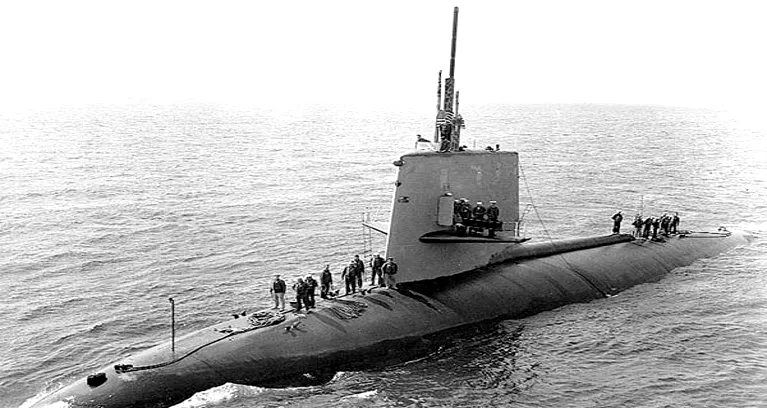
USS Scorpion (SSN-589) was a Skipjack-class nuclear-powered attack submarine of the United States Navy, commissioned in July 1960 and home-ported at Norfolk, Virginia. She was about 252 feet long and displaced roughly three thousand long tons submerged, operated by a crew of about ninety-nine officers and enlisted. Her commanding officer at the time of loss was Commander Francis A. Slattery, who had taken command in late October 1967.
On 15 February 1968 Scorpion sailed from Norfolk for a six-month deployment with the United States Sixth Fleet in the Mediterranean. She touched at Rota, Spain, in early March, passed through the Strait of Gibraltar, and operated with Sixth Fleet units into May. On 16 May she departed the Mediterranean for home, dropping two men at Rota on the way out. En route across the Atlantic she was assigned to observe Soviet naval activity in the area of the Azores, a routine Cold War intelligence task for a US attack submarine of that period.
Her last operational message was sent on the night of 20 to 21 May 1968, transmitted via the US Navy communications station at Nea Makri in Greece and relayed to Commander Submarine Force Atlantic at Norfolk. Slattery reported that he was closing on a Soviet group consisting of a submarine and oceanographic vessels at a speed of 15 knots and a depth of 350 feet to begin surveillance, and would head west afterward. The dossier on this case notes that the exact verbatim wording of Slattery’s message has not been confirmed against the Court of Inquiry exhibits in this work, and we report the substance as relayed by the standard secondary sources, not as a primary-confirmed quotation.
Scorpion was lost on or about 22 May 1968. The hydrophone arrays of the Atlantic Sound Surveillance System recorded acoustic signatures consistent with the destruction of a submarine in that area at that time. The published acoustic timeline, derived from a later reanalysis by Bruce Rule discussed below, places the initial event at approximately 18:20 hours Zulu on 22 May, with a separate, longer signature consistent with hull collapse recorded about twenty-two minutes later. We say “on or about 22 May” rather than fixing the loss to a single date, because the last operational transmission was on 20 to 21 May and the acoustic destruction signature was on 22 May, and reputable sources frame the loss as the night of 21 to 22 May 1968.
Scorpion was due at Norfolk at 1300 local time on 27 May 1968. When she did not arrive, the Navy declared her overdue and mounted a large-scale air and sea search of the eastern Atlantic. On 5 June 1968, with no contact recovered, the Navy publicly announced that she was presumed lost. (Some sources give 6 June for the announcement; the standard naval-history references give 5 June.) She was struck from the Navy list on 30 June 1968.
The search continued through the summer and into the autumn, supported by the Navy’s Special Projects office under Dr John P. Craven, who used Bayesian reasoning over the acoustic record and other inputs to refine the probable position of the wreck. In late October 1968, the Navy’s oceanographic research ship USNS Mizar, equipped with towed cameras and sonars, located sections of the hull on the abyssal plain about four hundred nautical miles southwest of the Azores. The depth at the wreck site is variously reported between roughly ten thousand and eleven thousand feet, in the order of three thousand to three thousand three hundred metres. The wreck lay in at least two main pieces, with the sail detached, the operations compartment largely destroyed, and the engine room telescoped approximately fifty feet forward into the hull, consistent with collapse from hydrostatic pressure on the way down. The bathyscaphe Trieste II was subsequently dispatched to photograph the site; in 1986 the Woods Hole Oceanographic Institution’s submersible Alvin returned higher-resolution imagery, a substantial part of which the Navy released in 2012.
A US Navy Court of Inquiry chaired by Vice Admiral Bernard L. Austin, US Navy (Retired), the same officer who had chaired the Thresher inquiry in 1963, convened in 1968. The court adjourned in late July 1968 without the wreck, then reconvened in early November 1968 after Mizar’s find. Its findings were released on 31 January 1969. The standard wording of the public finding, as reported in the secondary record and not quoted here as a primary-confirmed verbatim, is that the certain cause of the loss of Scorpion cannot be ascertained from any evidence now available. The Chief of Naval Operations concurred. A classified portion of the same report was not released at the time and was declassified in stages beginning in 1993; it has been reported as recording a most-likely cause of an explosion of large charge weight external to the pressure hull, and, in a separate elaboration, a most-probable scenario of a runaway Mark 37 torpedo. We attribute these readings as reported through the secondary record, not as primary-confirmed quotations.
Separately, a Navy Structural Analysis Group, drawing on submarine-design, structures, and underwater-explosions specialists, examined the same wreckage and acoustic data and reported on 29 January 1970. The standard summary of its conclusion, again as reported and not quoted here as a primary verbatim, is that Scorpion was lost because of a violent explosion of the main storage battery. The Court of Inquiry did not adopt the Structural Analysis Group’s reading. The Navy’s public position on the cause has not been changed since the 1969 finding.
The wreck site is a United States Navy war grave. The reactor compartment and two Mark 45 nuclear-armed torpedoes remain at the site, and the Navy periodically monitors it for environmental disturbance. The Navy does not permit visitors to the wreck.
The evidence
The Scorpion’s evidentiary record is unusually deep for a submarine loss in which no one survived. There is a sustained hydrophone record of the loss event itself, extensive deep-sea photography of the wreck from Mizar in 1968, Trieste II in 1969, and Alvin in 1986, the documents of the Court of Inquiry and the Structural Analysis Group, the testimony taken by the Court of Inquiry, and a body of declassified material released in stages from 1993 onward. The central weakness is the weakness every deep-water all-hands loss shares: there was no survivor, no recovered remains, no recovered logs, and nothing recovered from the boat herself. Every theory of the initiating failure is inferred from the acoustic record and the wreck’s posture on the bottom, not observed. With that understood, here is what each channel of the record shows and where it stops.
The acoustic record. The Atlantic Sound Surveillance System recorded the destruction of Scorpion. The most influential modern reanalysis of those hydrophone signals is by Bruce Rule, a former lead acoustic analyst for the Office of Naval Intelligence. His published figures, available through the Station HYPO naval-history blog and a text mirror of his work, identify two acoustic events about half a second apart at 18:20:44Z on 22 May 1968, each estimated in his analysis at roughly the equivalent of twenty pounds of TNT and read by him as contained within the pressure hull. A third, longer signature follows at 18:42:34Z, about twenty-two minutes later, which Rule reads as the pressure-hull collapse at a depth in the order of fifteen hundred feet. What the record shows in firmer terms is the timing of the initial event and the collapse, which are both reasonably well fixed. The energetic character of the first event, small, brief, paired, and below the warhead-detonation range, tells against a large external warhead and toward a contained internal event. The limit is that the same hydrophone record has been read more than one way. The Court of Inquiry’s classified section, as reported, read it as consistent with an external charge of significant weight. The 1970 Structural Analysis Group read it as consistent with a battery explosion. Rule reads it as paired internal hydrogen ignitions. Ed Offley’s later thesis reads it as an external torpedo strike. The acoustic record narrows the field. It does not, on its own, name the failure. Rule’s specific figures should be read as one analyst’s interpretation, not as a Navy finding.
The wreck. The wreck lies in at least two main pieces on the abyssal plain in roughly ten thousand feet of water about four hundred nautical miles southwest of the Azores. The sail is detached. The operations compartment is largely destroyed. The engine room has telescoped about fifty feet forward into the hull. The imagery from Mizar in 1968, Trieste II in 1969, and Alvin in 1986 documents this posture in increasing resolution. What it shows is severe damage consistent with hull collapse from hydrostatic pressure after the boat had sunk past her crush depth. The limit is decisive and the same limit that defeats the other readings. Collapse damage overwrites the evidence of the initiating failure. The wreck cannot, by itself, distinguish between an internal explosion that opened the hull, an external explosion that did, a slow flooding casualty that put the boat below her crush depth, or a torpedo strike. In every one of those cases the boat would then have collapsed under pressure on the way down, and that collapse is what the imagery records. The Court of Inquiry, the Structural Analysis Group, and every later analyst looked at substantially the same imagery and reached different conclusions.
The last transmission and the operational pattern. Scorpion’s last message reported a routine Cold War surveillance task on a Soviet naval group and a normal operational state. No distress traffic was ever received. What this shows is that the boat was operating normally about a day before her loss, on a tasking that placed her in the right general area at the right time, and that whatever ended her left no time to transmit. The limit is that the message tells us nothing about her state at the moment of loss. The tasking is significant only as a placement fact.
The Court of Inquiry record. The Court of Inquiry under Vice Admiral Austin took testimony from Navy personnel, including Vice Admiral Arnold F. Schade, then Commander Submarine Force Atlantic, evaluated the hydrophone record and the Mizar imagery, and produced its Findings of Fact, Opinions and Conclusions with both a public and a classified portion. What the record shows is the formal Navy reconstruction of the loss. The public statement, as reported, recorded the cause as unascertainable. The classified portion, declassified in stages from 1993, recorded a most-likely cause and elaborated a most-probable scenario as discussed above. The limit is that the public and classified findings sit in tension with one another. The most-likely-cause framing in the classified annex is, on its face, a probable-cause statement made by a court whose public conclusion was that the cause could not be ascertained. Treating the secret annex as the answer overstates the court’s own stated confidence. The annex also pre-dates the 1986 Alvin imagery and the later acoustic reanalysis. We use the standard summaries of the public finding and the classified annex throughout this article as reported, not as confirmed verbatim primary text.
The Structural Analysis Group report. The Structural Analysis Group, reporting in January 1970, recorded an engineering finding that pointed at the main storage battery as the initiating event, citing physical evidence of severe damage in the battery well. What it shows is a Navy engineering reading at variance with the Court of Inquiry’s most-likely external-charge framing. The limit is that the Structural Analysis Group’s report is not the Court of Inquiry’s finding. The Court of Inquiry did not adopt it, and the public Navy record remains that the cause is undetermined. The Structural Analysis Group’s wording is reported here through the secondary record and not quoted as primary-confirmed verbatim.
The Mark 37 design record. Independent of the Scorpion loss, the Mark 37 acoustic-homing torpedo had a documented design issue with its silver-zinc activation battery, in which a thin foil diaphragm separating the battery from its electrolyte cell could rupture under shock or vibration and inadvertently activate the weapon. This is documented in the public-history literature, and reports of an April 1968 vibration test that produced a battery explosion are part of that record. What it shows is a documented capability for a Mark 37 in a tube to begin its activation cycle without command. The limit is that this is capability evidence and not event evidence. That the failure mode existed is documented. That it actually happened aboard Scorpion on 22 May 1968 is the inference of those who hold the hot-run reading, not a finding.
The thread running through all of this is the same. The record establishes a normally operating submarine that ceased transmitting, a paired hydrophone event followed about twenty-two minutes later by a hull collapse, a wreck on the abyssal plain whose damage is consistent with collapse under pressure, a Court of Inquiry that publicly recorded the cause as unascertainable, a classified annex with a different framing, and a Structural Analysis Group that pointed in yet another direction. The strongest single piece of evidence in this case is the official record’s disagreement with itself.
The theories
Everything in this section is a hypothesis. The most important fact about it is that the Navy and independent bodies that examined the loss most carefully did not agree. None of what follows has been established as the answer, and none should be read as the answer here. The hypotheses are ordered by their place in the documented record, not by likelihood, and the cause remains officially undetermined.
A hot-running Mark 37 torpedo. The reading is that a Mark 37 acoustic-homing torpedo in a tube was inadvertently activated by shock or vibration that ruptured the battery-foil diaphragm, the weapon began its propulsion cycle within the boat, the crew detected the hot run and ordered the standard 180-degree turn intended to trigger the weapon’s anti-circular-run fail-safe, and the torpedo either detonated within the boat or, having armed, homed on Scorpion’s own noise and struck her. The classified portion of the Court of Inquiry, declassified in 1993, has been reported as identifying a runaway Mark 37 as the most probable scenario. Dr John P. Craven, who led the Special Projects search, publicly advanced this reading in his later writing. Sherry Sontag and Christopher Drew, in Blind Man’s Bluff (1998), present an on-board torpedo explosion as the most likely cause based on previously unreported defect evidence. In its favour are the documented Mark 37 design issue, the consistency of an internal small-charge event with the paired acoustic signature, and the classified-annex framing. Against it stand the points that the Court of Inquiry’s public finding was not this, that the Structural Analysis Group rejected the external-charge reading and pointed elsewhere, and that the wreck imagery does not show a clear external warhead impact. Most importantly, the hot-run reading is itself a probable-cause inference, not an established fact.
A main storage battery or hydrogen explosion. The reading is that hydrogen outgassed from the main storage battery in the battery well accumulated and ignited, or that the battery itself failed violently, producing the initiating explosion or explosions and the loss of the boat. This is the reading advanced by the Structural Analysis Group in its January 1970 report, on the basis of physical evidence of severe damage in the battery well, and reaffirmed in our own time by Bruce Rule’s acoustic reanalysis. In its favour are the Structural Analysis Group’s direct physical evidence, Rule’s energy and timing analysis, and the absence in the acoustic record of a signature on the scale of a torpedo warhead. Against it stand the points that the Court of Inquiry did not adopt this reading and that the same physical evidence is read by Sontag, Drew, and Craven as consistent with a torpedo event rather than an initiating battery event. The Bruce Rule figures cited above should be read as one independent analyst’s reading of the hydrophone record, not as a Navy finding.
A structural, mechanical, or flooding casualty. The reading is that a structural, mechanical, or systems failure, often discussed as a flooding casualty from a faulty seawater valve, a propeller-shaft seal failure, or a trash-disposal-unit problem, caused progressive flooding, loss of depth control, and a descent past crush depth. Vice Admiral Arnold F. Schade testified before the Court of Inquiry, by the standard accounts, that he believed the loss began with a flooding casualty at an undetermined depth that exceeded the boat’s crush depth. The full court did not accept that sequence as probable. Stephen Johnson, in Silent Steel (2006), develops a related reading in which Scorpion had not received a full SUBSAFE overhaul of the kind instituted after Thresher, with documented maintenance shortcuts on her 1967 work. In its favour are Schade’s testimony, the documented SUBSAFE shortfalls, and the plausibility of a mechanical failure at depth. Against it stands the point that a slow-flooding sequence does not fit the paired, sharp acoustic signature recorded by the hydrophone arrays.
A Soviet attack. This is the most aggressive of the proposed mechanisms and the one that must be handled most carefully. The reading is advanced principally by the journalist Ed Offley in Scorpion Down: Sunk by the Soviets, Buried by the Pentagon (2007). Offley argues that the Soviet Navy deliberately destroyed Scorpion, in one version of his argument as retaliation for the Soviet K-129 submarine lost in the Pacific in March 1968, with targeting enabled by intelligence compromised through the Walker spy ring and the capture of USS Pueblo in January 1968, and a mechanism involving an air-dropped weapon. Offley further argues that the United States and the Soviet Union tacitly agreed to suppress the truth about both losses. The United States Navy has never accepted or confirmed this thesis. We attribute it strictly to Offley by name. We do not name any Soviet vessel, helicopter, or individual as Scorpion’s attacker, because Offley’s own framing names a navy as a class rather than identifying a single confirmed unit, and because no document has emerged from Soviet or post-Soviet archives confirming such an action. The K-129 retaliation framing is Offley’s reconstruction and not an established history; the Walker and Pueblo intelligence losses are documented historical facts in their own right, but their use as evidence of a planned attack on Scorpion is Offley’s inference, not a documented link. The Structural Analysis Group, the Bruce Rule acoustic analysis, and Stephen Johnson’s monograph all read the evidence as inconsistent with an external warhead detonation against the hull. We report Offley’s thesis as a named author’s contested reconstruction. We do not adopt it, and the Navy does not.
An inboard mechanical failure such as a trash-disposal-unit casualty. A narrower reading within the broader mechanical category, often discussed in popular accounts as a “trash compactor” or trash-disposal-unit flooding casualty, holds that a specific inboard failure admitted seawater and initiated a flooding cascade. Schade’s flooding-casualty framing sits in this register, and Johnson’s work discusses trash-disposal-unit vulnerabilities of submarines of the period. In its favour is the documented vulnerability of the equipment of that era. Against it, again, stands the point that the acoustic signature does not fit a slow-flooding casualty. Most rigorous treatments fold this into the broader structural and mechanical reading rather than treating it as a separate hypothesis.
What remains unknown
The honest residue of this case is this. A nuclear-powered attack submarine of the United States Navy, returning home from a routine deployment, ceased transmitting and then ceased to exist within the span of about twenty-two minutes, with all ninety-nine of her crew, in roughly ten thousand feet of water on the abyssal plain southwest of the Azores. The hydrophone record fixes the timing of the destruction with reasonable confidence. The wreck on the bottom records the collapse of the hull under pressure after the sinking. Which failure ended her, and which failure she was already suffering when the hydrophones recorded the first event, has never been agreed.
The Navy’s Court of Inquiry concluded publicly that the certain cause could not be ascertained from the available evidence. The classified portion of that same inquiry, declassified beginning in 1993, has been reported as recording a different and more specific reading, a most-likely external charge and a most-probable runaway Mark 37 torpedo scenario, which the public finding did not state. A separate Navy Structural Analysis Group, in 1970, pointed at the main storage battery. Vice Admiral Schade, before the court, advanced a flooding casualty. In our own time, Sontag and Drew and Craven have read the record for the Mark 37 torpedo, Bruce Rule’s independent acoustic reanalysis points to the battery, Stephen Johnson points to a maintenance-driven mechanical chain, and Ed Offley argues for a Soviet attack the Navy has never accepted.
So we will not tell you the boat was destroyed by her own torpedo, because the only court that ever sat publicly recorded that the cause could not be ascertained, and the classified reading that has been described as pointing that way is itself a probable-cause statement that the same court declined to put on the public record. We will not tell you it was the battery, because the Navy did not adopt that reading either, and the analysts who hold it are reading the same evidence that other analysts read for a torpedo. We will not tell you it was a flooding casualty, because the full Court of Inquiry declined to accept Schade’s flooding sequence as probable. And we will not tell you the Soviet Navy sank her, because that thesis is one named author’s contested reconstruction, no document supports it, the Navy has never confirmed it, and naming a perpetrator on that basis would be exactly the move this publication does not make.
What we can tell you is the unusual thing the file does offer. This is not an undocumented loss. The Navy mounted a long search, located the wreck, examined the hydrophone record, took testimony, and produced two formal reports. Those reports disagree with one another, and their disagreement has not been resolved in fifty-seven years. The most authoritative public position the United States Navy has ever taken on the loss of USS Scorpion is that the cause is undetermined. The wreck is a war grave. The file is open.
Sources
Primary / official
- US Navy, Court of Inquiry, Findings of Fact, Opinions and Conclusions, Loss of USS Scorpion (SSN-589) (convened 1968; public release 31 January 1969; classified portions declassified beginning 1993), as held by the National Archives and reproduced through the Naval History and Heritage Command
- US Navy, Structural Analysis Group, Report on the Loss of USS Scorpion (SSN-589), 29 January 1970, as held in Navy records and cited in the analyses below
- Naval History and Heritage Command, “Scorpion VI (SSN-589),” Dictionary of American Naval Fighting Ships entry
The exact wording of the Court of Inquiry’s public finding, of the classified portions declassified beginning in 1993, and of the Structural Analysis Group’s conclusion is paraphrased and attributed as reported through the secondary record throughout this article rather than quoted verbatim. The primary documents are the records above and should be consulted directly for their precise language.
Secondary / contextual
- US Naval Institute, Naval History magazine, “The USS Scorpion: Buried at Sea” (February 2025)
- US Naval Institute, Naval History magazine, “1968: The Year of Lost Submarines” (April 2025)
- US Naval Institute, Proceedings, “Nobody Asked Me, But … Let’s Resolve the Scorpion Mystery” (June 2009)
- US Naval Institute, Proceedings, “Real Story of Scorpion?” (June 1999)
- Navy Times, “The last secret of the Scorpion” (22 May 2019)
- Station HYPO, “Why USS SCORPION (SSN-589) Was Lost on 22 May 1968” (22 May 2025), relaying Bruce Rule’s acoustic analysis
- Bruce Rule, “Why the USS SCORPION (SSN-589) Was Lost on 22 May 1968” (text mirror)
- Bowfin Pearl Harbor Base, “57th Anniversary USS Scorpion (SSN 589)” (22 May 2025)
- GlobalSecurity, “USS Scorpion (SSN-589)”
- Warfare History Network, “The USS Scorpion’s 1968 Nuclear Submarine Disaster”
- Sherry Sontag and Christopher Drew, with Annette Lawrence Drew, Blind Man’s Bluff: The Untold Story of American Submarine Espionage (PublicAffairs, 1998).
- Stephen Johnson, Silent Steel: The Mysterious Death of the Nuclear Attack Sub USS Scorpion (Wiley, 2006).
- Ed Offley, Scorpion Down: Sunk by the Soviets, Buried by the Pentagon: The Untold Story of the USS Scorpion (Basic Books, 2007). The Soviet-attack thesis discussed in this article is attributed strictly to this book; the United States Navy has never accepted or confirmed it.
- John P. Craven, The Silent War: The Cold War Battle Beneath the Sea (Simon & Schuster, 2001).
- Wikipedia, “USS Scorpion (SSN-589)”