Maritime Mysteries Case file
The SS Marine Sulphur Queen, 39 Lost, Four Scenarios Live
A T-2 tanker converted to carry molten sulfur sailed from Beaumont in February 1963 and vanished in the Gulf of Mexico west of the Florida Keys with all thirty-nine crew. The US Coast Guard's Marine Board could not determine the cause and listed four possible scenarios it declined to rank. Eight years later, the Second Circuit found the vessel unseaworthy but denied punitive damages on the ground that no one knows how the ship was lost.
- Case type
- Maritime
- Status
- Unexplained
- Event date
- February 4, 1963
- Location
- Gulf of Mexico, last reported position 25°45′N 86°00′W (approximately 200 nautical miles west of Key West, Florida) - Gulf of Mexico - United States
- Evidence
-
- Official record
- Physical
- Testimonial
The open question What happened to the SS Marine Sulphur Queen between her last radio message at 0125 EST on 4 February 1963 in the Gulf of Mexico west of the Florida Keys, and the certainty of her loss days later when she failed to arrive at Norfolk and only three positively identified pieces of debris were eventually recovered?
On 17 March 1964, the Commandant of the United States Coast Guard approved the Marine Board of Investigation’s report on the loss of the SS Marine Sulphur Queen. The Board, having heard testimony through 1963, recorded that in the absence of survivors or physical remains the exact cause of the loss could not be determined, and listed four possible causes it explicitly declined to rank. Eight years later, on 25 April 1972, the United States Court of Appeals for the Second Circuit, ruling on appeal from a Jones Act and Death on the High Seas Act limitation petition, found the vessel unseaworthy on the day she sailed. It denied punitive damages on the ground that “no one knows how the ship was lost”. Two unrelated branches of the federal government, eight years apart, agreed on the same point. Between those two acts, the case is built.
The vessel was a wartime-emergency T-2 tanker converted to a molten-sulfur carrier in 1960. She left Beaumont, Texas, on 2 February 1963, bound for Norfolk, Virginia, with a cargo of 15,260 long tons of molten sulfur held at approximately 255 °F and a crew of thirty-nine. At 0125 EST on 4 February 1963 she transmitted a routine personal radiogram from a position of 25°45′N 86°00′W, in the Gulf of Mexico roughly two hundred nautical miles west of the Florida Keys. There was no distress call. She did not arrive at Norfolk at the scheduled time of noon EST on 7 February. On 20 February a US Navy vessel recovered a stencilled life preserver and a foghorn cone about twelve nautical miles southwest of Key West. A small further debris field was identified during a follow-up search. The hull has never been positively located. No bodies were ever recovered.
This article keeps three things separate, as always: what the record documents, what the evidence shows, and what is still only a hypothesis. The Bermuda Triangle framing, applied to this case almost a year after the loss by Vincent H. Gaddis’s February 1964 Argosy article and again in 1974 by Charles Berlitz’s book, is treated here as named-provenance cultural overlay rather than evidence. It is worth noting at the outset that the last reported position was in the Gulf of Mexico west of the Florida Keys, outside the conventional Bermuda Triangle. The Triangle frame is a question the case attracts, not a question it answers.
The vessel and the cargo
The Marine Sulphur Queen began as the SS Esso New Haven, a Type T2-SE-A1 tanker built at Sun Shipbuilding and Drydock Co., Chester, Pennsylvania, during the Second World War emergency tanker programme. Her keel was laid on 2 December 1943 and she was launched on 8 March 1944, yard number 407, official number 245295. She was delivered to Esso Standard Oil Company on 27 March 1944. Her registered dimensions were 504 feet length, 68.2 feet beam, and 39.4 feet moulded depth, with 10,642 gross registered tons and 6,419 net registered tons.
The T2-SE-A1 class is the structural context for half of this case. By 1947 the class had accumulated a documented record of brittle-fracture hull failures. The two touchstones are the SS Schenectady and the SS Esso Manhattan, both lost or nearly lost in calm weather and within months of each other in 1943. On 16 January 1943 at Swan Island fitting dock in Portland, Oregon, the Schenectady cracked almost in half while moored, in calm water, with a sound audible at a mile. The Coast Guard’s original report identified faulty welding as the cause. Later metallurgical work pointed to brittle fracture in low-grade plate steel at low temperature as the underlying mechanism. On 29 March 1943 the Esso Manhattan broke in half entering New York harbour in fine weather and slight sea. Inspection of the two halves ruled out an explosion. The break was a hull-girder failure. The US General Accounting Office’s 15 July 1946 report, titled “To Inquire into the Design and Methods of Construction of Welded Steel Merchant Vessels”, formalised the concern. Design responses included rounded hatch corners and crack-arresting straps.
In 1960 the Esso New Haven was withdrawn from oil service and converted at the Bethlehem Steel Co. yard at Sparrows Point, Maryland, into a carrier of molten sulfur. The conversion did not leave a tanker. It gutted the transverse bulkheads in the centreline cargo tanks and installed an independent welded steel sulfur tank, 306 feet long, 30 feet 6 inches wide, and 33 feet high, divided internally into four cells. The new tank stood off the original hull, with about two feet of clearance at the sides and bottom and three feet between its top and the weather deck. That clearance is the void space the case will return to. Heating was by a steam coil system that maintained the sulfur at approximately 255 °F. The vessel was renamed Marine Sulphur Queen, registered to Marine Sulphur Transport Corporation, and operated under demise charter by Marine Transport Lines, Inc. of New York.
By early 1963 she had made sixty-three voyages in the Beaumont to Norfolk molten-sulfur trade. The route ran from the Sabine Pass out into the Gulf of Mexico, around the western tip of Cuba, through the Straits of Florida, and north along the Atlantic coast to Norfolk.
The voyage and the loss
The Marine Sulphur Queen departed Beaumont, Texas, on 2 February 1963. Captain James V. Fanning radioed that the vessel had cleared the Sabine Bar Sea Buoy at 1900 CST. Some accounts give 1830 CST; the time will be settled by the Marine Board record. Her estimated arrival at Norfolk was noon EST on 7 February 1963.
At 0125 EST on 4 February 1963 the vessel transmitted what would become her last radio message: a routine personal radiogram from a member of her crew. The transmission carried a position of 25°45′N 86°00′W. That position is in the Gulf of Mexico, approximately two hundred nautical miles west of the Florida Keys, consistent with an average speed of about 14.5 knots along the planned track. No distress signal was sent, and none was ever received.
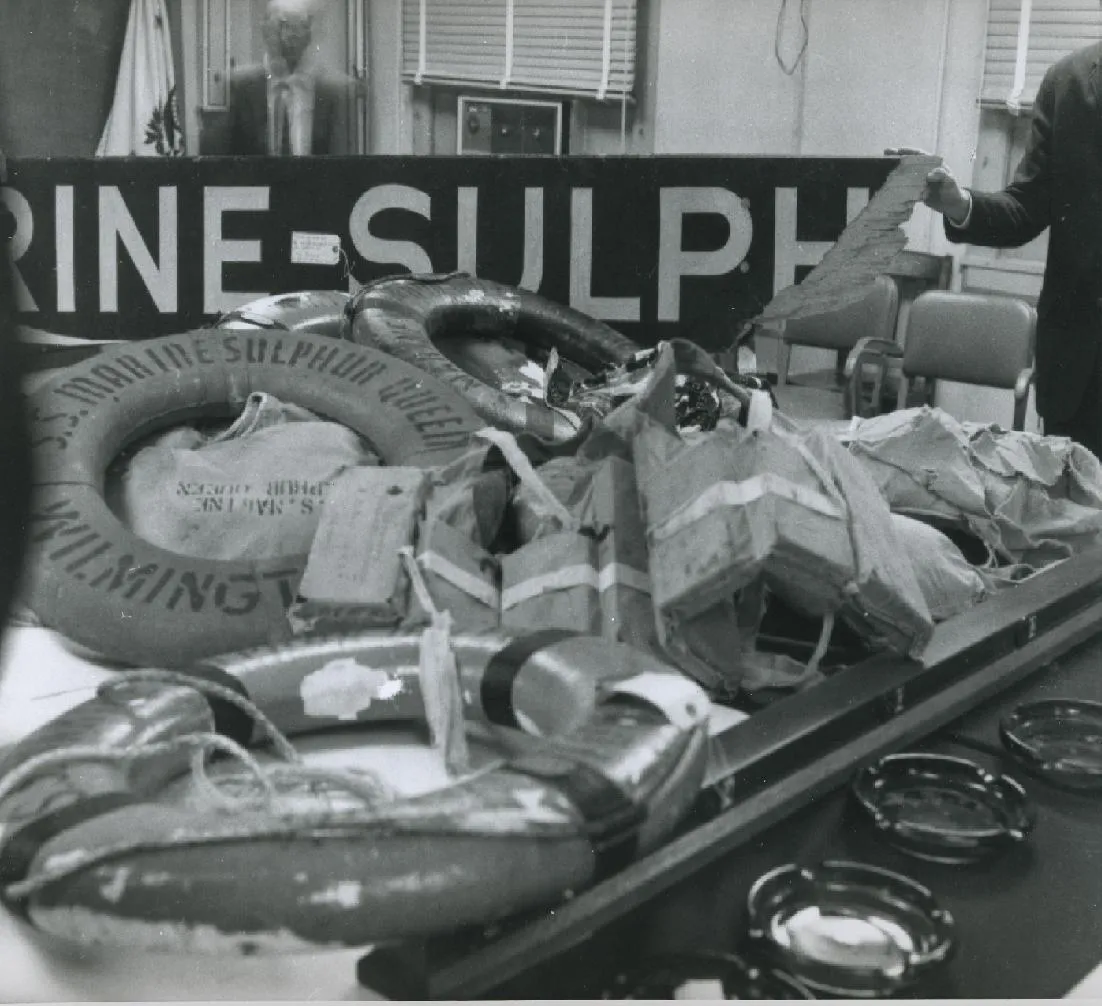
The vessel did not arrive at Norfolk. She was listed as missing on 6 February and reported overdue at 2100 EST on 7 February. The Coast Guard’s broad air-and-surface search began at 0600 on 8 February 1963 and ran for five days, covering 348,400 square miles in 83 sorties. Nothing was located. The initial search was suspended on 13 February. On 20 February 1963 a US Navy vessel recovered a stencilled Marine Sulphur Queen life preserver and a foghorn cone approximately twelve nautical miles southwest of Key West, Florida. A targeted US Navy underwater search ran from 20 February to 13 March 1963 across roughly 60,000 square miles, identifying additional debris from the vessel, including life jackets, life rings, name boards, and ship’s equipment. The Coast Guard search was discontinued on 14 March 1963.
What is in the record stops there. The wreck has never been positively identified. No fire residue, oil slick, or hull fragment large enough to confirm a structural failure was ever recovered. No bodies were ever recovered.
The crew
The vessel sailed with thirty-nine men. The dossier preserves two names from that complement. Her master was Captain James V. Fanning of Beaumont, Texas. One assistant engineer, Adam Martin, is attested in the surveyed secondary record. Contemporaneous Texas press reported the rest of the crew as drawn largely from the Beaumont and Galveston area.
The full thirty-nine-name roster, with rank, age, role, and home port, is held in the US Coast Guard Marine Board of Investigation casualty list and in the Beaumont Enterprise’s February and March 1963 coverage. The discipline of a roll-call is that the names are right and come from the primary record, so we do not assemble it from secondary fragments here. Descendants are likely living. They are not named or pursued.
The evidence
The evidentiary record on the Marine Sulphur Queen is unusual in maritime mysteries of this era because it is bracketed by two formal institutional findings. There is the Coast Guard Marine Board of Investigation’s report of 17 March 1964 on the loss itself. There is the Second Circuit’s decision of 25 April 1972 on the civil liability that followed. Between them sit the operational deficiencies the Board recorded, the small physical debris field positively recovered, the structural history of the T-2 class, and the weather on the Gulf the night the radio fell silent. None of those channels, on its own, names the failure.
The USCG Marine Board of Investigation report. The Board, convened in 1963 with hearings through that year, recorded that in the absence of survivors or physical remains the exact cause of the loss “could not be determined”. It then listed four possible causes:
“a. An explosion may have occurred in the cargo tanks. b. A complete failure of the vessel’s hull girder may have caused it to break in two. c. The vessel may have capsized in synchronous rolling. d. A steam explosion may have occurred as the result of a rapid filling of the void space with water.”
The Board declined to assign an order of probability to those four. The report was approved by the Commandant of the Coast Guard on 17 March 1964. The wording is reproduced through the Wikipedia summary of the report; the verbatim text should be confirmed against the PDF hosted at the Coast Guard’s document portal.
The operational deficiencies. The Board documented a register of operational and material problems that the appellate court would later treat as evidence of unseaworthiness. Recurring fires beneath and along the sides of the sulfur tanks were frequent enough that the ship’s officers had stopped sounding the fire alarm. On one earlier voyage the vessel had reportedly sailed from a New Jersey harbour with a fire still burning. Caked sulfur had been found blocking equipment and had shorted an electrical generator. Crew testimony described extensive corrosion, inoperable temperature gauges, a ruptured steam coil, and worn packing around the screws. A scheduled January 1963 drydock inspection had been postponed by the owners because cargo deliveries were behind schedule. Time magazine carried much of this register on 8 March 1963 under the title “Investigations: The Queen with the Weak Back”. The Board recommended that no remaining T-2 tanker be converted to a sulfur carrier without explicit consideration of the original hull structure.
The physical recovery. The material positively tied to the casualty is small. A stencilled life preserver and a foghorn cone were recovered approximately twelve nautical miles southwest of Key West on 20 February 1963. Additional life jackets, life rings, name boards, and ship’s equipment were identified during the 20 February to 13 March US Navy follow-up search. No fire residue, oil slick, or hull fragment large enough to confirm a structural failure was located. No bodies were recovered. The wreck has never been positively identified.
The T-2 structural record. The class accumulated eleven serious hull-fracture incidents during the Second World War, including the Schenectady (16 January 1943) and Esso Manhattan (29 March 1943) cases documented in the Coast Guard record, the aukevisser.nl tanker archive, the TWI Global case notes, and the UNC Charlotte ASCE failure case studies. The 1946 GAO report formalised the concern. The 1960 sulfur conversion, in the Second Circuit’s reading, sat on top of that hull history in a geometry that mattered: a narrow, high tank centred on the original hull raised the centre of gravity and degraded recovery in heavy seas. The trial court in In re Marine Sulphur Transport Corp. discussed earlier deficiencies in inspection and maintenance.
The weather. Conditions on the morning of 4 February 1963 in the area of the last reported position, on the Coast Guard record as summarised in the secondary literature, were rough, with nearly-following sixteen-foot seas and northerly winds of twenty-five to forty-six knots in a winter storm system. The figure is reported here as summarised and should be confirmed against the full Marine Board record.
The Second Circuit decision. The civil litigation reached the Second Circuit on 25 April 1972. The court found the vessel unseaworthy on the day she sailed, citing the structural inadequacy of the sulfur-tank conversion (the narrow cargo bed produced an undesirably high centre of gravity and poor recovery in heavy seas) and inadequate inspection and maintenance. It denied punitive damages. The reason it gave for that denial is the line that closes the institutional record on the cause: “no one knows how the ship was lost”. The court let the civil case turn on what the conversion and the maintenance regime did to a T-2 hull, not on what specifically ended this voyage.
Hypotheses and open questions
Everything in this section is a hypothesis. The Marine Board listed four possible causes and declined to rank them. Nothing that follows is the answer. The four are presented in the Board’s own order, followed by the Bermuda Triangle cultural overlay and a note on the absence of evidence for sabotage or attack.
A cargo tank explosion. This is the first of the Coast Guard Marine Board’s four listed scenarios. The theoretical basis is that molten sulfur held in heated steel tanks at approximately 255 °F poses combustible-vapour and hydrogen-sulfide risks if water or contamination enters the system, and that the documented recurring fires beneath the tanks and the broader history of fire incidents aboard the vessel speak to a chronic ignition risk. Against the reading sits the absence of any oil slick, smoke plume, or fire-damaged debris in the surveyed record, and the fact that the limited debris field positively identified was not characterised as fire-damaged. The Board listed this scenario without ranking it.
A complete hull-girder failure. This is the second of the Board’s four scenarios. The theoretical basis is the T-2 class’s documented brittle-fracture record, the 1960 conversion’s effect on load distribution, the trial and appellate findings of unseaworthiness, the postponement of the January 1963 drydock inspection, and the crew testimony of extensive corrosion. Against the reading sits the point that a sudden break in two would normally be expected to produce a substantial floating debris field within hours, and the recovered material was small in volume and geographically concentrated. That is not dispositive in either direction. It is consistent with a rapid sinking, which any of the four scenarios would produce. The Board listed this scenario without ranking it.
Capsizing in synchronous rolling. This is the third of the Board’s four scenarios. The theoretical basis is that a vessel’s natural roll period can match the encounter period of the seaway, producing progressively larger roll amplitudes and potentially a capsize. The sixteen-foot following seas reported in the surveyed record on the morning of 4 February would in principle support such an interaction, given the converted vessel’s raised centre of gravity. Against the reading sits the point that synchronous rolling capsize of a tanker in sixteen-foot seas is recordable but not common. The Board listed this scenario without ranking it.
A steam explosion from rapid void-space flooding. This is the fourth of the Board’s four scenarios. The theoretical basis is structural. The two-to-three-foot void space between the heated sulfur tank at approximately 255 °F and the original tanker hull would, if breached and rapidly filled with seawater, produce flash steam at a volume capable of catastrophic effect. The reading presupposes a primary hull breach from another cause and treats the steam event as the failure that finished the vessel. The Board listed this scenario without ranking it.
The Bermuda Triangle framing. In February 1964, eleven months after the loss, Vincent H. Gaddis’s article “The Deadly Bermuda Triangle” appeared in Argosy magazine, coined the phrase, and used Marine Sulphur Queen as a case study. Charles Berlitz’s 1974 book The Bermuda Triangle placed the case at the centre of the legend. Both post-date the loss and are reported here as named-provenance cultural overlay, not evidence. The geographic point is worth a line. The last reported position (25°45′N 86°00′W) is in the Gulf of Mexico west of the Florida Keys, outside the conventional Bermuda Triangle. Lawrence David Kusche’s 1975 The Bermuda Triangle Mystery: Solved reviewed the case and concluded that the documented structural and operational evidence was sufficient explanation. Kusche’s reading is responsible scepticism. It does not, on its own, rank the four Coast Guard scenarios or name the failure.
Acts of war, terrorism, or sabotage. No evidence in the surveyed record. Recorded for completeness only.
What remains unknown
The honest residue of this case is this. A US-flagged tanker of a class with a documented brittle-fracture history, converted in 1960 to a cargo trade it had not been designed for, operating with documented fires, postponed drydock, and extensive corrosion, sailed in winter Gulf weather and ceased transmitting after a routine personal radiogram at 0125 EST on 4 February 1963. She was carrying 15,260 long tons of molten sulfur at approximately 255 °F in one continuous welded tank divided into four cells, and thirty-nine men. No distress signal was sent. A small debris field was recovered twelve nautical miles southwest of Key West sixteen days later. The wreck has never been positively located. No bodies were recovered.
The Coast Guard recommended that no other T-2 be converted to the sulfur trade. Lawrence David Kusche, reviewing the file in 1975, held that the documented structural and operational record was sufficient explanation without ranking the four scenarios.
Sixty-three years after the loss, all four scenarios are still live. The wreck has not been found. The institutional record stands. The case is the case of a tanker whose own hull class had a brittle-fracture history, whose conversion is on record as unseaworthy, whose operational state was on record as poor, and which vanished without a signal anyway, and the most authoritative thing two unrelated branches of the federal government have ever said about how she was lost is that they do not know.
Sources
Primary / official
- US Coast Guard, Marine Board of Investigation Report on the Loss of the SS Marine Sulphur Queen, Commandant’s action approved 17 March 1964
- United States Coast Guard, Proceedings of the Marine Safety Council, Vol. 21 No. 7 (July 1964), CG-129
- In re Marine Sulphur Transport Corp., 312 F. Supp. 1081 (S.D.N.Y. 1970), Justia summary
- Time magazine, “Investigations: The Queen with the Weak Back,” 8 March 1963
- US Deadly Events, “1963-Feb 4, SS Marine Sulphur Queen disappears,” contemporaneous-record summary
- US General Accounting Office, “To Inquire into the Design and Methods of Construction of Welded Steel Merchant Vessels,” 15 July 1946.
- Beaumont Enterprise, contemporaneous coverage, February to March 1963 (including the casualty roll-call).
- Galveston Daily News, contemporaneous coverage, February to March 1963.
- Norfolk Virginian-Pilot, contemporaneous coverage, February to March 1963.
- Washington Post, “Tanker Lost in Atlantic; 39 Aboard,” 9 February 1963; “2.5 Million Is Asked in Sea Disaster,” 19 February 1963; “10-Year Rift Over Lost Ship Near End,” 4 February 1973.
- New York Times, multiple articles 11 February 1963 to 4 June 1969.
The verbatim wording of the Marine Board’s four-cause finding is reproduced in this article from the Wikipedia summary of the report and should be confirmed against the Coast Guard PDF for the primary record. The Second Circuit’s “no one knows how the ship was lost” line is reported through the Justia summary of In re Marine Sulphur Transport Corp. and the Wikipedia citation of the Washington Post’s contemporaneous coverage of the appellate decision.
Secondary / contextual
- Wikipedia, “SS Marine Sulphur Queen”
- Wikipedia, “SS Schenectady”
- Wikipedia, “List of Type T2 tankers”
- TWI Global, “Schenectady T2 tanker” case note
- UNC Charlotte ASCE Failure Case Studies
- Aukevisser.nl tanker registry, Esso New Haven page
- Aukevisser.nl tanker registry, Esso Manhattan page
- Mike Cox, “The Vanishing of Marine Sulphur Queen,” Texas Escapes
- Peter Thompson, “How Much Did the Liberty Shipbuilders Learn?”, Journal of Political Economy (2001).
- Lawrence David Kusche, The Bermuda Triangle Mystery: Solved (Harper and Row, 1975), chapter on Marine Sulphur Queen.
Cultural overlay (named provenance, not evidence)
- Vincent H. Gaddis, “The Deadly Bermuda Triangle,” Argosy, February 1964.
- Charles Berlitz, The Bermuda Triangle (Doubleday, 1974).