Aviation Mysteries Case file
The Light Over the Philippine Sea: Flying Tiger Line Flight 739, 1962
A chartered airliner carrying 107 people, most of them US Army soldiers bound for Vietnam, vanished over the western Pacific in 1962, leaving no distress call and no wreckage. The one thing the record holds is an explosion five men on a tanker watched fall into the sea, and a federal board that wrote down it could not determine why.
- Case type
- Aviation
- Status
- Unexplained
- Event date
- March 16, 1962
- Location
- Western Pacific between Guam and the Philippines, over the Philippine Sea (navigator's 15:30 GMT estimated position, about 14 N 135 E) - Philippine Sea / western Pacific Ocean
- Evidence
-
- Official record
- Testimonial
The open question What destroyed Flying Tiger Line Flight 739 over the western Pacific, and why was no trace of it ever found?
In the early hours of 16 March 1962, a four-engine airliner was crossing the western Pacific from Guam toward the Philippines, carrying 107 people. Most of them were US Army soldiers headed for South Vietnam. The aircraft had made a routine radio call placing itself a few hundred miles west of Guam, on course and on time. Its next scheduled report never came. Around the hour it was due, five men on the deck of an oil tanker some distance below the flight path looked up and saw a brilliant explosion in the night sky, and then two burning objects falling toward the sea. One of the largest air and sea searches the Pacific had seen to that date found no wreckage, no debris, and no remains. The cause was never established.
The popular memory of all this reaches for the lurid: a secret Cold War mission, a sabotage plot, a vanishing told in the register of the Bermuda Triangle or of Malaysia Airlines Flight 370. The documented version is quieter and harder. The Civil Aeronautics Board, the responsible federal authority, investigated and concluded the aircraft was probably destroyed in flight. Then it recorded that it could not determine the cause, because nothing was ever recovered to examine. That is the spine of this case. There is one observed event, an explosion, and no recoverable reason for it. We keep three things separate, as always: what is documented, what the evidence shows, and what is still only a hypothesis.
A note on the date is worth making at the start, because loose accounts garble it. The flight departed Guam on 15 March by Greenwich Mean Time, the standard the aviation record uses. The explosion the tanker crew reported came at 15:30 GMT, which was about half past one in the morning, local time, on 16 March, on the far side of the international date line. Both 15 and 16 March therefore appear in the record, and neither is wrong. We use 16 March 1962 for the loss, which is how the event is most often dated, and the difference is the clock and the date line, not a contradiction.
The documented account
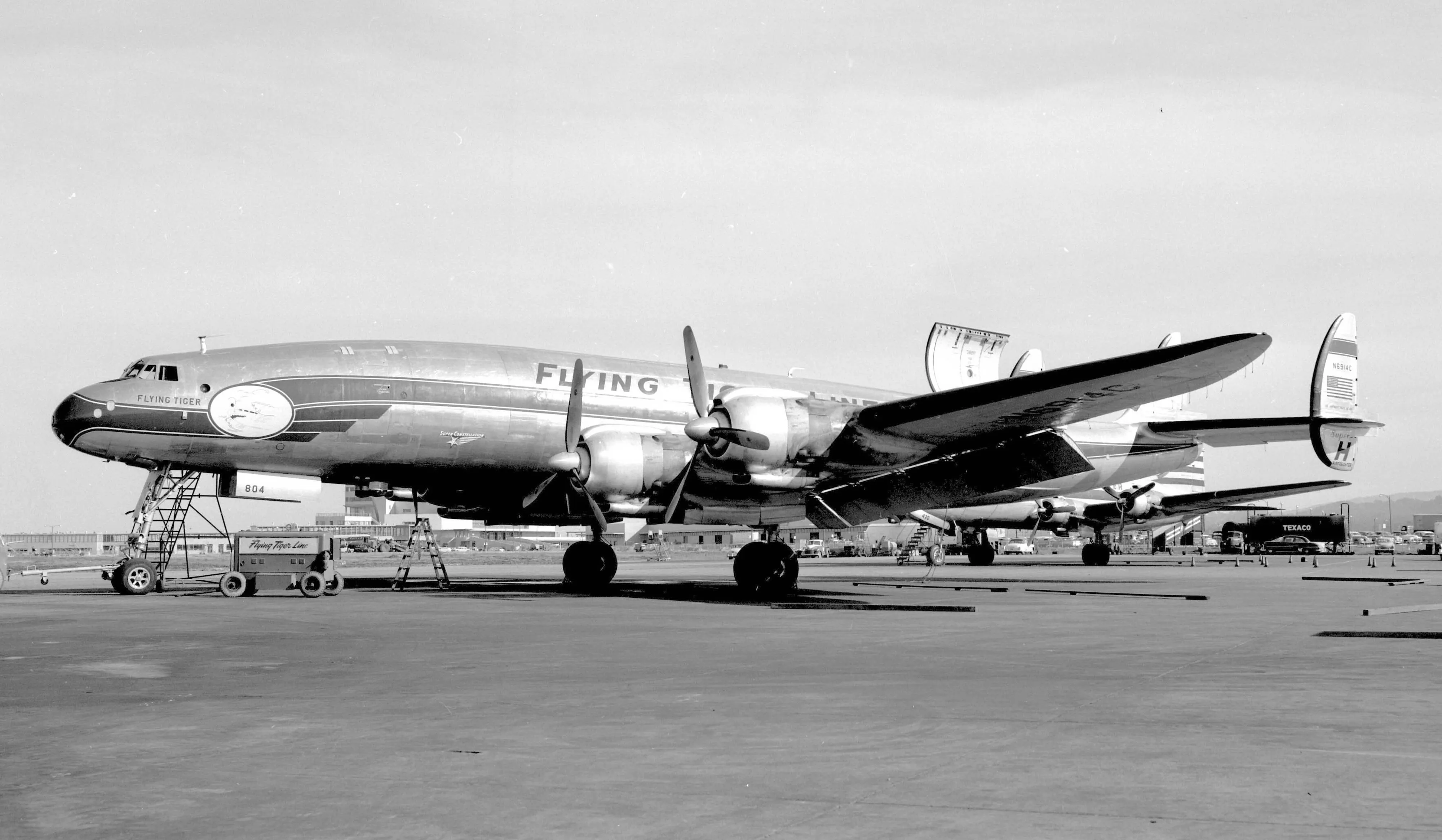
The aircraft was a Lockheed L-1049H Super Constellation, a four-engine piston airliner, registration N6921C. It was about five years old, with roughly 17,224 airframe hours. It was operated by the Flying Tiger Line, a US cargo and charter carrier, flying as Military Air Transport Service charter Flight 739/14, chartered by the US Army to move personnel across the Pacific toward South Vietnam.
Aboard were 107 people: 96 passengers and 11 crew. The passengers were 93 US Army soldiers and 3 South Vietnamese military personnel. The soldiers are described in the record as personnel specializing in electronics, communications, and related skills, deploying to South Vietnam; the deployment was a classified one. The crew of 11 were American civilians: three pilots, under Captain Gregory P. Thomas, two flight engineers, two navigators and radio operators, and four stewardesses.
The route ran from Travis Air Force Base in California across the Pacific in stages: Honolulu, then Wake Island, then Guam, with the aircraft to continue from there to Clark Air Base in the Philippines and on to Tan Son Nhut at Saigon. The aircraft left Travis at 05:45 GMT on 14 March 1962. It reached Guam and departed there at 12:57 GMT on 15 March for the overwater leg toward the Philippines. (The Guam stop is commonly cited as Andersen Air Force Base; the accident report’s own routing language refers to Agana Naval Air Station, Guam.)
At 14:22 GMT the captain transmitted a routine position report, placing the flight roughly 280 nautical miles west of Guam. The navigator’s estimate for the next scheduled report, at 15:30 GMT, put the aircraft farther west, over open ocean. That 15:30 GMT report never arrived. From about 15:33 GMT the Guam International Flight Service Station began trying to raise Flight 739 and could not. The aircraft was never heard from again, and no distress call was ever received.
The disappearance set off one of the largest air and sea searches in the history of the Pacific to that date. Aircraft and surface ships from the US Navy, Air Force, Coast Guard, and Marines swept the ocean west of Guam, on the order of 144,000 square miles by the figures most commonly cited, over roughly eight days. (The reported scale varies between accounts, with some putting the area larger; the load-bearing fact is the qualitative one, that the search was among the largest the region had seen.) It found nothing. No wreckage, no debris, and no remains that could be definitely associated with N6921C were ever recovered.
The Civil Aeronautics Board investigated. Weighing what little there was, it concluded the aircraft was probably destroyed in flight, and then recorded that it was unable to determine the cause. The loss stands as one of the largest losses of US military personnel aboard a single aircraft outside combat.
The evidence
The defining feature of this case at the level of evidence is absence. There was no wreckage, there were no remains, and there was no distress call. With nothing physical to examine, the case rests on a thin record: a radio log, a single multi-witness sighting, the fact of the empty ocean, and the official report built on all three. The honest work is in stating what each one can and cannot show.
The radio record, and the silence after it. The last routine transmission, at 14:22 GMT, is the strongest hard data point on the flight’s normal operation. What it shows is that the aircraft was operating routinely as of that time, reported its position, and then fell silent without any distress call. The absence of any mayday is itself evidentiary: it is consistent with a sudden, catastrophic event that left no time to transmit. Its limit is sharp. It establishes only that something happened between 14:22 GMT and the missed 15:30 GMT report. It cannot say what.
The sighting from the SS T. L. Lenzen. This is the core piece of evidence in the case, and the reason the Board leaned toward destruction in flight. Five crew of the Standard Oil Company tanker SS T. L. Lenzen, in the western Pacific along the aircraft’s projected path, reported at 15:30 GMT a midair explosion near Flight 739’s estimated position. According to aviation-history accounts that cite the Board’s report, the men first saw a vapor trail, or some phenomenon resembling one, overhead and slightly to the north, moving east to west; as it passed behind a cloud there was an explosion, described in those accounts as intensely luminous, with a white nucleus surrounded by a reddish-orange periphery; the explosion came in two pulses lasting some seconds, and from it two flaming objects of unequal size apparently fell, at different speeds, into the sea. (This wording is reported from the report by reputable secondary sources and has not been confirmed against the report text itself for this account; it is given here as reported, not as the Board’s verified verbatim words.) What this shows is an independent, multi-person eyewitness account of an aerial explosion at the right place and the right time to be Flight 739, which is why the Board treated it as probably the loss of the aircraft. Its limits are equally real. It is eyewitness testimony, not instrument data, of a brief event at night. It could not be conclusively linked to the disappearance. And it shows an effect, an explosion, while saying nothing about the cause of that explosion. The tanker searched the area for hours and found nothing.
The empty ocean. Despite a search on the order of 144,000 square miles by four military services over roughly eight days, nothing definitely associated with N6921C was recovered. What this shows is the central fact that keeps the case open: there is no airframe to examine, so no failure mode, whether structural, mechanical, fire, or a device, can be physically confirmed or excluded. Its limit is that the absence of recovered wreckage in deep open ocean is not itself a mechanism. It is consistent with destruction over very deep water, but it proves no specific cause.
The CAB report. The formal federal investigation is the authoritative reconstruction of the timeline, the Lenzen account, the search, and the official judgment. According to aviation-history accounts that cite it, the report’s analysis is summarized as concluding that a summation of all relevant factors tended to indicate the aircraft was destroyed in flight, while stating that, for lack of substantiating evidence, the Board could not state with any degree of certainty the exact fate of N6921C. Its formal finding, stated separately, is reported as that the Board was unable to determine the probable cause of the accident from the evidence then available. These are two distinct statements: one is the reasoning toward a probable in-flight destruction that remained short of certainty, the other is the headline finding of an undetermined cause, and we keep them apart. (As with the Lenzen description, this wording is given as reported by the secondary record pending confirmation against the report text; it is not presented as the Board’s verified verbatim words.) What the report shows is a reasoned official conclusion reached, like the Star Tiger court before it, with no physical wreckage in hand. Its limit is that same emptiness: the destruction reading rests on the Lenzen sighting, and the undetermined cause is exactly the honest residue.
The honest summary of the evidence is this. The record holds a normally operating aircraft that fell silent with no distress call, one independent multi-witness account of an explosion at the right place and time, and the complete absence of any recovered physical evidence. The inquiry could reasonably infer destruction in flight from the sighting. It could not establish, and no one since has established, what caused that destruction.
The theories
Everything in this section is a hypothesis. The Board determined no probable cause, so none of what follows is a finding, and they differ sharply in how much the record supports them.
Catastrophic in-flight destruction. This is the leading inference, and it is less an explanation than a description of what the evidence most directly supports. The reading is that the aircraft was destroyed by a sudden explosion in flight, consistent with the Lenzen sighting. In its favor are the multi-witness account of an intensely luminous explosion and two burning objects falling into the sea, at the right place and time, and the lack of any distress call, which fits an instantaneous event. It is also the closest thing to the Board’s own summation. Its weakness is built in. Even this could not be raised to certainty, and it names an effect rather than a cause. An explosion can arise from many sources, and the evidence cannot distinguish among them. It is the best-supported reading of what happened, explicitly short of proof, and silent on why.
An accidental mechanical or fuel-vapor failure. This is the most ordinary candidate for the explosion. The reading is that an accidental in-flight failure, for example a fuel or fume ignition or a structural or systems failure, destroyed the aircraft. In its favor: piston airliners of the era carried known fire and fuel-vapor risks, and an accidental explosion requires no conspiracy. Against it is the same void. With no wreckage, no specific failure mode can be confirmed. Reported remarks attributed to Flying Tiger Line executives, to the effect that an in-flight explosion in normal operation was hard to credit and that something violent must have happened, are attributed opinion, not findings, and we treat them that way. This is the most mundane explanation, plausible and unproven.
Sabotage or a device. The reading is that a bomb or an act of sabotage destroyed the aircraft, perhaps tied to the military nature of the deployment. The appeal of the idea is the combination of an explosion with a classified, wartime-adjacent mission. But it has no evidentiary support. The Flying Tiger Line is reported to have publicly floated sabotage, and even a kidnapping scenario, while characterizing both as wild guesses with no evidence to support either, the airline’s own words. The Board established no sabotage, and there is no documentary support for any specific plot. No identifiable person is accused, then or since. This is attributed speculation only, disclaimed by the airline that raised it.
A connection to the second Flying Tiger crash. A second Flying Tiger Line L-1049H went down in the same period, on approach at Adak in the Aleutians, killing one crew member. Because two aircraft of the same type and operator were lost so close together, some retellings infer the two losses were connected, or both sabotaged. The Adak crash was a documented, separate, ordinary accident, an approach crash with survivors and a single fatality, a wholly different profile from a planeload lost without trace over open ocean. Coincidence is not connection, and no evidence links the two. We present it and dismiss it.
The secret-mission and Bermuda-Triangle framing. This is the register the case is best known for, and it is the legend the record corrects, not a contender within it. Common retellings cast Flight 739 as a mysterious, possibly suppressed Cold War operation, told in the manner of Flight 370 or the Bermuda Triangle. There is nothing evidentiary behind it. Its only appeal is the genuine strangeness of a vanished planeload of soldiers on a classified deployment. Two facts that the framing seizes on are administrative, not sinister: the deployment was classified at the time, and the men were later left off the Vietnam Veterans Memorial because of its date and eligibility criteria. Neither is evidence of a cover-up. The CAB report is a sober document with no paranormal or conspiratorial content, and the conspiratorial reading is not a finding.
What remains unknown
The honest residue of this case is narrow and it is real. A normally operating airliner carrying 107 people, most of them soldiers, fell silent over the western Pacific with no distress call. Five men on a tanker saw what was very likely its destruction, an explosion at the right place and the right time. An enormous search by four military services recovered nothing. And the federal accident authority concluded it could not determine the cause.
So we will not tell you it was sabotage, because the only people who floated that idea, the airline, called it a wild guess with no evidence, and the Board established none. We will not tell you it was connected to the second Flying Tiger crash that period, because that was a separate, ordinary approach accident with an entirely different profile and nothing links them. We will not tell you it was a secret mission gone wrong or a vanishing in the Bermuda-Triangle mold, because the classified deployment and the memorial exclusion are administrative facts and the report is a sober one. And we will not tell you the case is solved, because no wreckage was ever found and no cause was ever established.
What we can tell you is this. The leading inference, that the aircraft was destroyed in flight, describes an effect, not a cause. The Board could see, in the Lenzen sighting, that something very likely tore the aircraft apart in the air, and it wrote that down. Then it wrote that it could not say why, and that even the in-flight destruction could not be stated with certainty, because there was nothing left to examine. The single open question the rigor leaves standing is the simplest and the hardest one: what caused the explosion that five men watched fall into the sea, and where the 107 people aboard came to rest. The record has never closed it. The file is still open, and the authorities said so themselves.
Sources
Primary / official
Secondary / contextual
- This Day in Aviation, “15 March 1962” (Bryan R. Swopes)
- FlyingMag, “60 Years Missing: The Mystery of Flying Tiger Line Flight 739”
- Bureau of Aircraft Accidents Archives (BAAA), Lockheed L-1049H Super Constellation crash record
- Aviation Safety Network (ASN) / Flight Safety Foundation, accident record N6921C, 16 March 1962
- Wikipedia, “Flying Tiger Line Flight 739”
- Wreaths Across America, “Wreaths Across America Honors Flying Tiger Line Flight 739 with a Special Remembrance Ceremony” (GlobeNewswire, 2 March 2026)