Aviation Mysteries Case file
Pan Am Flight 7: 67 years and a finding the Board refused to make
A Boeing Stratocruiser left San Francisco for Honolulu on 8 November 1957 and never reported again. A federal board took the case seriously, recovered debris and 19 bodies, found elevated carbon monoxide in 14 of them, and then declined to name a cause. That line has stood for 67 years.
- Case type
- Aviation
- Status
- Unexplained
- Event date
- November 8, 1957
- Location
- Pacific Ocean en route San Francisco (SFO) to Honolulu (HNL); wreckage recovered at 29°26′N 143°34′W approximately 90 nautical miles north of planned track - Pacific Ocean - United States
- Evidence
-
- Official record
- Physical
- Testimonial
The open question What happened to Pan Am Flight 7 between the routine 5:04 p.m. PST position report on 8 November 1957 and the in-flight event that left 19 recovered bodies, watches stopped at varying times, elevated carbon monoxide in many of the recovered remains, and a debris field 90 nautical miles north of track?
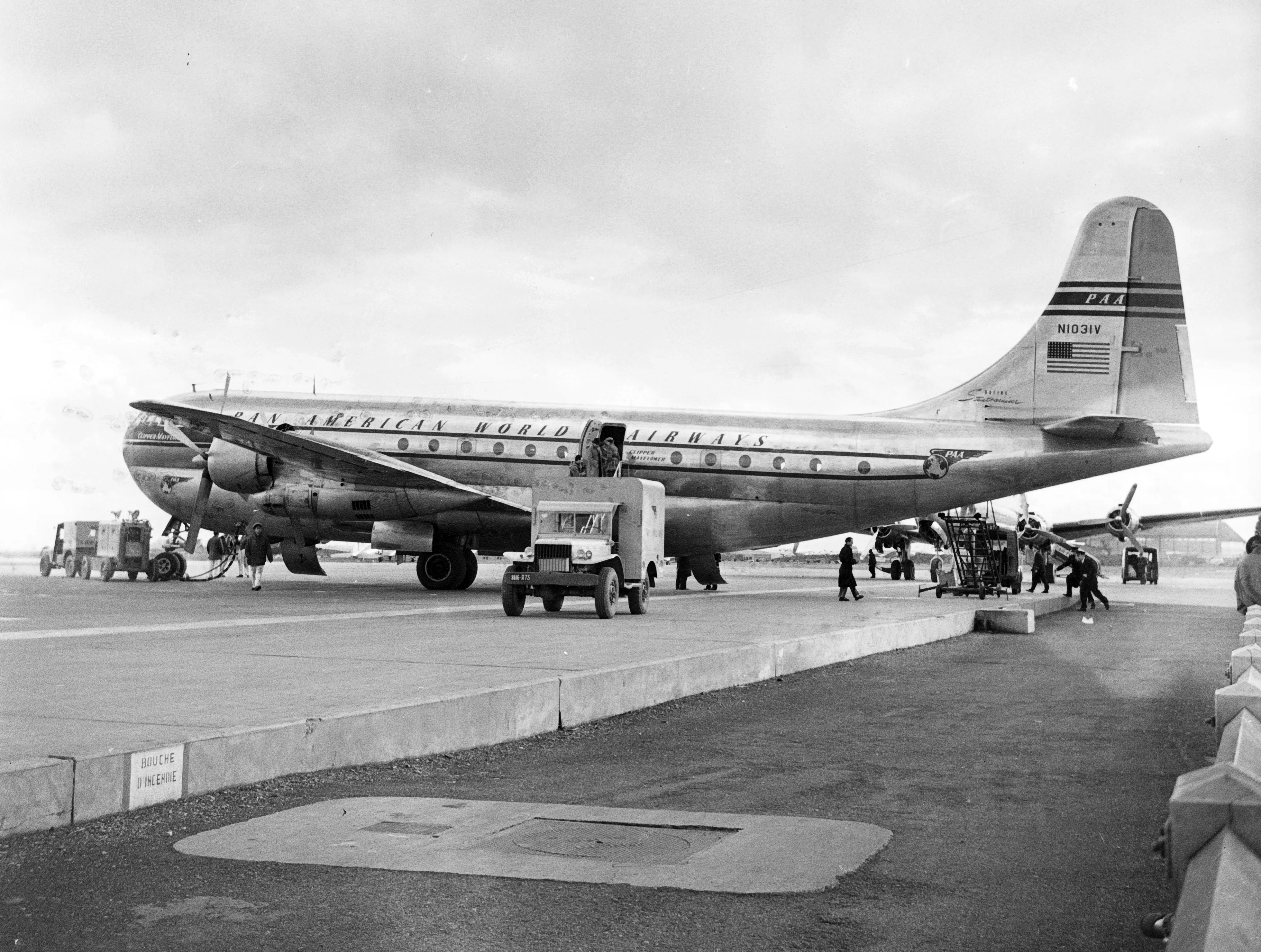
On the afternoon of 8 November 1957, a Pan American Boeing 377 Stratocruiser named Clipper Romance of the Skies left San Francisco for Honolulu with 44 people aboard. Its last contact, at 5:04 p.m. PST, placed it on the planned track roughly 1,028 nautical miles east of Hawaii. No distress call followed. The 6:04 p.m. position check was missed. An emergency alert went out at about 6:35 p.m. Six days later USS Philippine Sea recovered about 500 pounds of floating debris and 19 of the 44 occupants in a stretch of ocean about 90 nautical miles north of the planned track.
The Civil Aeronautics Board took the case. It convened hearings in San Francisco and Honolulu in 1958. Boeing, Pratt & Whitney, Hamilton Standard, Pan Am, and the Federal Bureau of Investigation contributed. Autopsies were performed, wristwatches were logged, debris was analyzed. In early 1959 the Board issued Aircraft Accident Report SA-330, and the operative line of that report has been reported as: “The Board has insufficient tangible evidence at this time to determine the cause of the accident.”
That sentence has stood for 67 years. The institutional record has never been amended. What it stands on is a forensic detail the Board could not resolve: 14 of the 19 recovered bodies showed elevated carbon monoxide saturation at what the report characterized as “possibly disabling” levels, and no one in the investigation could agree whether that was the trace of a cabin event in flight or, in some part, the product of decomposition in the sea.
The popular afterlife of the case has been louder than the report. Two named individuals from the manifest have, for decades, anchored a hypothesis that someone aboard brought the aircraft down deliberately. Neither was ever charged. The CAB did not identify either as the cause. We keep the three layers separate: what is documented, what the evidence shows, and what remains only hypothesis.
The aircraft and the route
The aircraft was a Boeing 377 Stratocruiser, model designation 377-10-29, registration N90944, manufacturer’s serial number 15960, first flown on 30 August 1949. Delivered originally to American Overseas Airlines, it passed to Pan American World Airways when Pan Am acquired AOA in 1950, and was named Clipper Romance of the Skies. The Stratocruiser was a double-deck, pressurized, four-engine piston airliner; in 1957 it sat near the end of its commercial life as long-range piston transport, with jet equipment in sight on the same routes.
It was powered by four Pratt & Whitney R-4360 Wasp Major 28-cylinder radial piston engines turning Hamilton Standard propellers. The R-4360 had a recorded fire history. The Hamilton Standard hollow-steel propeller blade was the subject of FAA Airworthiness Directives in 1955, 1957, and 1958 addressing pitch-control failures and overspeed. The Stratocruiser fleet’s period record carries a series of ditchings: United’s Mainliner Oahu lost at San Francisco in September 1951; Pan Am Flight 202 lost in the Amazon basin in April 1952; Clipper United States off Oregon in March 1955 after the loss of the No. 3 engine and propeller, four of 23 lost; Northwest Orient’s Stratocruiser Tokyo in Puget Sound in April 1956, five of 38 lost; and Pan Am’s Clipper Sovereign of the Skies en route Honolulu to San Francisco in October 1956, with all 31 aboard rescued.
N90944 had two documented anomalies in 1957. On 18 June it suffered a runaway propeller on departure from SFO and returned for an emergency landing. On 19 September it produced an unexplained loud noise in flight for which inspection found no cause. Both are in the CAB record as background; the Board did not connect either to the 8 November loss.
The 8 November service was the first leg of a westbound round-the-world rotation, with 15 intermediate stops scheduled to arrive in Philadelphia the following Wednesday. The San Francisco to Honolulu segment was planned at about ten hours fifteen minutes at 10,000 feet.
The voyage and the recovery
The flight departed San Francisco around midday on 8 November 1957; the exact time is given as 11:30 a.m. PST in some reports and 11:51 a.m. PST in others. There were eight crew and 36 passengers, 44 souls aboard.
The cockpit crew were Captain Gordon H. Brown, 40, in command; First Officer William P. Wygant, 37; Second Officer and Navigator William H. Fortenberry, 35; and Flight Engineer Albert F. Pinataro, 26. The cabin complement were Flight Supervisor John (Jack) King, Purser Eugene Crosthwaite, and Stewardesses Yvonne Alexander and Marie McGrath. Most of the 36 passengers were US citizens, with single passengers from Australia, Japan, Turkey, and Indonesia. The full manifest is in CAB SA-330 and the Aviation Safety Network entry.
The flight made routine position reports through the afternoon. The last confirmed report, at 5:04 p.m. PST, placed the aircraft on the planned track approximately 1,028 nautical miles east of Hawaii. The 6:04 p.m. check was missed. An emergency alert was issued at about 6:35 p.m. No distress transmission was received by Pan Am dispatch, US military stations, or other aircraft in the area. The Stratocruiser’s HF and VHF radio equipment had been operational at the previous check.
A multi-agency search began that evening. US Coast Guard cutters, US Navy vessels including USS Philippine Sea (CV-47), US Air Force and Pan Am aircraft, and commercial shipping swept the eastern Pacific for six days. Reputable secondary accounts describe it as the largest air-sea search in the Pacific to date.
On 14 November USS Philippine Sea located the floating remains. Reported positions cluster around 29°26′N 143°34′W. Descriptions of the distance from Honolulu vary between 900, 940, and 1,000 nautical miles northeast; all reports put the wreckage roughly 90 nautical miles north of the planned track. The recovery brought up approximately 500 pounds of debris, personal effects sufficient to identify the flight, and 19 of the 44 occupants. No major sections of the airframe were recovered. The debris field has been characterized as about 33 square miles, in seas estimated at 15,000 to 16,500 feet depth. The engines and propellers, the components of greatest interest to any mechanical-failure reading, were not recovered.
The evidence
The CAB Bureau of Safety Investigation worked from a sharply constrained physical record: floating debris, 19 of 44 bodies, personal effects including wristwatches, a normal radio log up to 5:04 p.m., and the absence of any distress call.
The institutional finding. SA-330 documents the airframe and powerplant history, the dispatch and route, the position reports, the search, the recovery, the autopsies, the wreckage analysis, and the Bureau’s conclusion. The operative finding, as reported by the secondary literature drawing on the report, is that “The Board has insufficient tangible evidence at this time to determine the cause of the accident.” The report acknowledged that the carbon monoxide finding was unresolved and that further research was in process. No subsequent amendment has been issued.
The recovered wreckage. The Board’s analysis of the floating debris recorded burn marks only above what would have been the waterline. The CAB read this as consistent with a post-impact, fuel-fed fire on floating wreckage after the aircraft struck the sea, not with a pre-impact in-flight fire severe enough to bring the aircraft down on its own. The major airframe sections that would test the alternative reading were not recovered, and the engines remain unexamined.
The recovered bodies and the carbon monoxide finding. Of the 19 recovered occupants, 14 showed elevated carbon monoxide saturation that the CAB characterized as “possibly disabling” levels. The autopsy data sits in the SA-330 record; the secondary literature does not reproduce per-body percentages. The Board noted the CO finding was disputed at the time of issue. Investigators identified several mechanisms by which CO could have reached the cabin, but pathologists were not unanimous on whether the levels found were pre-mortem, the trace of an in-flight cabin event, or in part a product of post-mortem decomposition. The post-mortem reading was disputed by, among others, the Army pathologist who performed autopsy work. The CAB declined to settle the question. The report further recorded that 14 of the 19 were wearing life jackets, none were wearing shoes, the bodies presented “multiple fractures and external injuries” consistent with high-energy impact with water, and there were no burns on the bodies themselves.
The wristwatches. The recovered watches did not all stop at the same moment. Three stopped at 5:27 p.m. PST, 23 minutes after the last position report; secondary accounts give 4:26 p.m. on some others, with 5:27 p.m. cited in most treatments as the consensus impact-time indicator. The CAB worked from the watches as the best available time-of-impact evidence. The dispersion is consistent with in-flight breakup and debris reaching the water at varying intervals. It does not by itself identify a cause.
The silence. No distress call was received by anyone. The 5:04 p.m. position report was the last contact. A claim that a faint mayday was received roughly seven and a half minutes later has surfaced in some treatments; it is not adopted by the CAB record.
The named crew member in the modern literature. Purser Eugene Crosthwaite, about 46, of Felton, California, is named in the CAB record. His wife had died about three months before the flight. He was reportedly in poor relations with his stepdaughter and had telephoned the Santa Cruz County Sheriff’s office less than a week before the flight blaming his wife’s death on her. On the morning of the flight he formally altered his will, conditioning her inheritance on her living “a moral and upright Catholic life,” and left a copy in the glove box of his car at SFO. He held a long-running grievance against Pan Am, attributing a pre-war case of tuberculosis to his employment on the company’s flying-boat operations. A family member is reported to have stated he had shown them blasting powder days before the flight; no explosive material was found at his home. Crosthwaite died in the crash. The CAB did not identify him as the cause. He was never charged, never indicted, never convicted.
The named passenger in the modern literature. William Harrison Payne, 41, of the Scott Bar area of California, was a passenger, not crew. He was an honorably discharged US Navy veteran with 22 years of service and a demolitions background. He owned a hunting lodge near Scott Bar, a money-losing concern with about $10,000 owed against it, and was trying to sell it. He bought a one-way ticket to Hawaii to collect an overdue debt, the cost of which reportedly exceeded the debt itself. Shortly before the flight he purchased life insurance: most consistently reported as a Western Life policy of $20,000 (by some accounts declined by the carrier) plus air-trip insurance of approximately $125,000, with at least one policy providing double indemnity. His body was not among the 19 recovered. The Roxbury Lodge burned down in June 1958, seven months after the crash; the cause is unestablished. Payne died in the crash on 8 November 1957. The CAB did not identify him as the cause. He was never charged, never indicted, never convicted.
The CAB hearings and the modern reinvestigation. The Board convened hearings in San Francisco and Honolulu in 1958, taking testimony from Pan Am dispatchers, maintenance personnel, and pilots who had flown with the cockpit crew, and from Pratt & Whitney, Boeing, and Hamilton Standard representatives. The transcripts sit in the CAB and NTSB historical archives. The principal modern reinvestigation has been led by Ken Fortenberry, son of Navigator William H. Fortenberry, with historian Gregg Herken (UC Merced; formerly senior historian at the Smithsonian’s National Air and Space Museum). Their work appeared in Air & Space / Smithsonian in 2004 and 2017; Fortenberry’s book, Flight 7 Is Missing: The Search for My Father’s Killer, was published by Fayetteville Mafia Press in 2019. The FBI participated as an advisor to the original investigation; it did not open a parallel criminal case.
Hypotheses and open questions
The CAB record supports several readings. None is asserted here. Each is held with the constraints the record imposes.
Mechanical failure in the powerplant or propellers, with cabin CO ingress. An R-4360 engine failure, a Hamilton Standard propeller overspeed of the type documented elsewhere in the fleet, or a cabin-heater malfunction known to introduce CO into the Stratocruiser cabin, or some combination, could have initiated an in-flight event that incapacitated the cockpit crew. The same airframe had two unexplained incidents in 1957. This is the reading Gregg Herken has separately argued, citing the propeller-overspeed history. No engine wreckage was recovered for inspection, and the CAB declined to adopt the reading as proven.
A deliberate act by a person aboard. The modern hypothesis is developed by Ken Fortenberry and by Fortenberry with Herken in their Air & Space / Smithsonian work. The CAB record documents Crosthwaite’s altered will, his stated grievance against Pan Am, his bereavement, and the family-member account of blasting powder. It separately documents Payne’s debts, one-way ticket, life-insurance purchases, Navy demolitions background, and the non-recovery of his body. Reviewers read the modern literature differently: Punch Magazine reads the book as identifying Crosthwaite, citing forensic-psychologist analysis, while secondary summaries of the Smithsonian work foreground Payne. The two are not collapsed into a single suspect. Laboratory testing of the recovered debris did not, per the Smithsonian-derived summary, demonstrate explosive residue. Neither Crosthwaite nor Payne was charged, indicted, or convicted. The CAB did not identify either as the cause.
A cabin-heater malfunction introducing CO without mechanical failure of the powerplant. Stratocruiser cabin heating was a documented maintenance issue. A heater leak alone could account for the elevated carboxyhemoglobin without an engine event. The CAB considered the possibility and did not adopt it; the structural cause of the in-flight breakup would still require a separate explanation.
An R-4360 engine fire with rapid structural failure. A nacelle fire that severed a wing or propagated through the fuselage could account for in-flight breakup and the absence of a distress call; the 1955 ditching of Clipper United States sits in the type record as precedent. The CAB read the burn marks on recovered debris as consistent with a post-impact fire on floating wreckage, not a pre-impact in-flight fire severe enough to bring the aircraft down.
Other. Mid-air collision, lightning, missile, large-bird strike, and similar readings appear in the secondary literature. There is no positive evidence in the CAB record for any. The CAB and the modern investigators considered and dismissed them.
What remains unknown
Sixty-seven years on, no positive identification of the cause has been made. No engine or propeller wreckage was ever recovered. The CAB record has never been amended. The carbon monoxide finding in 14 of 19 recovered bodies remains the case’s open forensic detail: whether the CO reached the cabin in flight or was in part a product of post-mortem decomposition has never been settled, and the institutional record refuses to settle it.
Two named individuals from the manifest sit in the institutional record because their conduct is in it. Eugene Crosthwaite altered his will on the morning of the flight, held a documented grievance against Pan Am, and was the subject of a family-member account of blasting powder. William Harrison Payne held debts, bought air-trip life insurance shortly before the flight, travelled on a one-way ticket, and his body was not recovered. The modern literature develops both files; reviewers have read it as foregrounding one or the other, and the two are not collapsed into a single suspect.
The discipline of this record is to repeat what the Board declined to do. Eugene Crosthwaite was never charged, never indicted, never convicted. William Harrison Payne was never charged, never indicted, never convicted. The CAB did not identify either as the cause. Each died in the crash on 8 November 1957. They are named here because the institutional record names them and the modern literature has built its hypothesis on them; that is the limit of the naming.
On 4 April 2023 the Pan Am Flight 7 Memorial was unveiled at the Millbrae History Museum in Millbrae, California, marking the 44 lost. The institutional finding remains the one the Board recorded in early 1959: insufficient tangible evidence at this time to determine the cause of the accident.