Aviation Mysteries Case file
An Unsolved Mystery, Twice Over: The Lost BSAA Tudors, Star Tiger and Star Ariel
Two airliners of the same troubled British type vanished over the western Atlantic within a year, neither sending a distress word, neither leaving a scrap of wreckage. Then a formal government court did something rare: it wrote down that it could not say why.
- Case type
- Aviation
- Status
- Unexplained
- Event date
- January 30, 1948
- Location
- Western Atlantic Ocean (Star Tiger: Santa Maria, Azores to Bermuda; Star Ariel: Bermuda to Kingston, Jamaica) - North Atlantic Ocean - International waters
- Evidence
-
- Official record
- Testimonial
The open question How did two airworthy, competently crewed BSAA airliners of the same type vanish over the western Atlantic within a year, with no distress call and no wreckage, such that an official court recorded that one's fate must remain an unsolved mystery?
In the early hours of 30 January 1948, a radio officer aboard a British airliner over the western Atlantic acknowledged a bearing from Bermuda and signed off. The aircraft was an hour or so from landing. It never arrived, and no one ever heard from it again. Ten months later, on 17 January 1949, a second airliner of the same type, on the same airline, left Bermuda in flawless weather, reported a routine position, and then went silent in exactly the same way. Between them the two aircraft carried fifty-one people into the same ocean. Neither sent a distress call. No wreckage, no bodies, no confirmed scrap of either aircraft was ever found.
The popular memory of all this is the Bermuda Triangle, a phrase that did not exist when the two aircraft were lost and that the official record never used. The documented version is stranger and more disciplined than the legend that buried it. Each loss was examined by a formal United Kingdom government inquiry, with the resources of the state behind it, and each inquiry wrote down, in plain words, that it could not say what had happened. For one of the two, a public Court of Investigation chaired by a Law Lord recorded that its fate “must remain an unsolved mystery.” That is the spine of this case: not a riddle nobody studied, but a documented disaster that the responsible authority looked at hard and formally declared unexplained. We keep three things separate, as always: what is documented, what the evidence shows, and what is still only a hypothesis.
The documented account
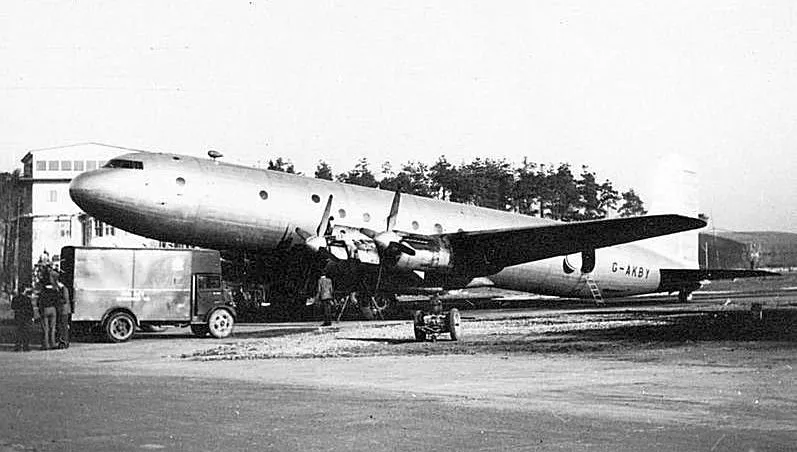
The airline was British South American Airways, a state carrier flying long-haul routes from Britain to Bermuda, the Caribbean, and South America in the late 1940s. Its chief executive was Air Vice-Marshal Donald Bennett, who had commanded the RAF’s wartime Pathfinder force. Both lost aircraft were the same machine: the Avro Type 688 Tudor Mark IV, a four-engine, pressurized British piston airliner.
The Tudor’s record before the disappearances matters, because it explains why the type was distrusted, and it is context, not a cause. The Tudor was Britain’s first pressurized airliner, developed from 1943 out of the Avro Lancaster and Lincoln bomber lineage; the prototype first flew in June 1945. Its chief designer, Roy Chadwick, was killed in August 1947 when a Tudor II prototype crashed on takeoff. The early Tudor I suffered stability and handling problems, and the British Overseas Airways Corporation requested more than 340 modifications before rejecting the type in April 1947 as unsuitable for the North Atlantic, buying Canadair aircraft instead. The Tudor IV was a stretched variant built specifically for BSAA. Roughly eleven were made. A reader should hold both facts at once: the type had a troubled history, and neither inquiry established that a Tudor fault caused either loss.
Star Tiger, the night of 30 January 1948
Star Tiger, registration G-AHNP, was a relatively new aircraft, with about 575 flying hours and some eleven transatlantic crossings behind it since late 1947. It was working the UK-to-Bermuda-to-Caribbean service, flown in stages: London, Lisbon, Santa Maria in the Azores, then the long overwater leg to Bermuda. The captain was Brian W. McMillan, an experienced former RAF pilot. (The name should not be confused with Lord Macmillan, the judge who later presided over the inquiry; they are different people, spelled differently.) Aboard for the final leg were thirty-one souls in total: six crew and twenty-five passengers. Among the passengers was Air Marshal Sir Arthur Coningham, a senior wartime RAF commander, whose loss was reported on the front page of The New York Times.
The dating of the loss is worth fixing precisely, because loose accounts garble it. The aircraft moved across several days, reaching Lisbon and then Santa Maria, where weather delayed it. It made its final departure from Santa Maria on the afternoon of 29 January and was lost during the overnight crossing, with the last radio contact logged at 03:17 on 30 January. The “28 January” date that appears in some retellings reflects the earlier staging at Lisbon and Santa Maria, not the disappearance. The official report is titled for the 30th of January, 1948, and that is the correct date.
McMillan chose to fly the leg low, at around 2,000 feet, to stay beneath strong forecast headwinds. The aircraft fell progressively behind schedule against the wind. A position fix near 02:00 reportedly found it pushed off course. Just after 03:00 the radio officer asked Bermuda for a bearing; the signal was too weak. A second request near 03:15 succeeded, Bermuda passed a bearing, and the radio officer acknowledged it at 03:17. That acknowledgement was the last anyone heard. No distress call was ever sent. From around 03:50 Bermuda tried repeatedly to raise the aircraft and got nothing. The search that followed ran for several days and is reported in outline as on the order of twenty-six aircraft flying several hundred hours, with surface vessels, in worsening weather. It found no trace of the aircraft or the thirty-one people aboard. A search aircraft reported some floating boxes and an oil drum northwest of Bermuda, but nothing was ever connected to Star Tiger.
Star Ariel, the daylight of 17 January 1949
Star Ariel, registration G-AGRE, was the same type and the same airline. On the morning of 17 January 1949 it left Bermuda at 08:41, bound for Kingston, Jamaica. The captain was John Clutha McPhee, formerly of the Royal New Zealand Air Force. Aboard were twenty souls in total: seven crew and thirteen passengers.
The single sharpest contrast with Star Tiger is the weather. Where Star Tiger was lost at night in a gale near the fuel-critical end of a long leg, Star Ariel flew in conditions every source describes as excellent: good visibility, light winds, and no cloud above about 10,000 feet across the whole route. McPhee climbed to a high cruising altitude to use the fine weather. At 09:42, near the start of the flight, he transmitted a routine message reporting his position and his intention to change radio frequency. As reproduced in the secondary record, the message read roughly: “I was over 30 N at 9:37. I am changing frequency to MRX.” Nothing further was ever received from the aircraft, and again no distress call was sent. Because Kingston did not expect to hear from Star Ariel until later in the flight, hours passed before the silence was recognized as a loss, a detail later researchers stressed: by the time the search began, there was no fresh datum for where the aircraft had actually gone quiet.
The search for Star Ariel was large. A United States Navy task force joined it, reported to have included the battleship USS Missouri and the carriers USS Kearsarge and USS Leyte, sweeping an area widened to tens of thousands of square miles before it was called off on 23 January. (Some popular accounts cite a million square miles; that figure almost certainly reflects cumulative track-miles flown or simple exaggeration, and should not be read as the area covered.) As with Star Tiger, the search found no debris, no oil slick, and no wreckage.
After Star Tiger, the Minister of Civil Aviation grounded BSAA’s remaining Tudors; they were later allowed to fly cargo only, on a rerouted path that shortened the longest overwater leg. After Star Ariel, the remaining Tudor IVs were withdrawn from passenger service. The type’s reputation took a further blow from the unrelated Llandow air disaster in March 1950.
The evidence
The defining feature of this case at the level of evidence is absence. There was no wreckage, there were no bodies, there was no distress call, and there was no recovered debris from either aircraft. With nothing physical to examine, the two official inquiries became the central evidence, and what they could show was mostly what could be established about each aircraft before it left, not what happened after the last routine message.
The Star Tiger inquiry
The loss of Star Tiger triggered a formal public Court of Investigation, the first such court convened since the loss of the R101 airship in 1930. It was chaired by Lord Macmillan, a senior judge, sat with expert assessors in public at Church House, Westminster, over eleven days in April 1948, and reported later that year as Command Paper Cmd 7517.
What the court could establish points consistently toward a competent operation. The crew were highly experienced. The court noted a “want of care and attention to detail” in the flight plan but found nothing in it serious enough to explain the loss. It identified no known design fault that would cause the aircraft to break up in the air, and no weather in the area capable of producing a sudden catastrophic structural failure. The aircraft had been flown low into strong headwinds, and the final bearing exchange placed it on its approach to Bermuda when it fell silent.
What the court could not establish was the cause. It examined radio failure, navigational error, engine failure, fuel exhaustion, and an altitude or altimeter error, the possibility that a crew flying unusually low had misjudged its height above the sea. None could be confirmed. The report’s conclusion is the heart of this case. As reproduced in the reputable secondary record (the original Command Paper survives as a scanned image, and the wording here is attributed to the report as reported, not matched character for character against the primary text as of publication), the court found that in the complete absence of reliable evidence as to the nature or cause of the disaster, it could do no more than suggest possibilities, none of which reached even the level of probability, and that the fate of Star Tiger “must remain an unsolved mystery.” The same report is widely quoted, as a separate sentence, observing that no more baffling problem had ever been presented for investigation. The two lines are distinct, and we keep them so.
The Star Ariel report
The Star Ariel loss was handled differently. Rather than a public judicial court, it produced a report by the Chief Inspector of Accidents, Air Commodore Vernon Brown, issued in December 1949. The loss had already been acknowledged in Parliament in January 1949, in the record of the Commons.
The report’s findings echo the Star Tiger court’s. There was no evidence of any defect in or failure of the aircraft before it left Bermuda. Weight and balance were within limits. The crew was experienced. Radio communications were good up to the last message. The weather raised no complication, because it was fine. And there was no evidence of sabotage, a possibility the report did not entirely eliminate but did not support. As with Star Tiger, the report could not establish the cause. As reproduced in the secondary record (again attributed to the report as reported, not confirmed against the primary text at the time of writing), its conclusion was that, through lack of evidence owing to no wreckage having been found, the cause of the accident was unknown.
The honest summary of the evidence is this. Both inquiries established that the aircraft were airworthy and competently crewed when they left, that conditions did not obviously doom them, and that no trace of either was ever recovered. Neither could establish what happened after the last routine transmission. The evidentiary record is, by the inquiries’ own account, almost empty. That emptiness is precisely why a court reached for the word “mystery.”
Hypotheses and open questions
Everything in this section is a hypothesis. None of these was proven by either inquiry, and the crews were not blamed by either. Each possibility below is one the inquiries weighed against an evidentiary void and could not raise to the level of proof.
Mechanical or systems failure. One reading is that a sudden in-flight failure, fast enough to leave no time for a distress call, downed one or both aircraft: a structural or systems failure of a known-troubled type, or a problem with the cabin heater. The Tudor used a Janitrol-type cabin heater, and a later theory holds that its installation created a fire or carbon-monoxide pathway. This heater idea is a modern reconstruction, advanced notably in a 2009 BBC treatment, not a finding of either official report. Against it stands what the inquiries actually said: the Star Tiger court found no design fault capable of breaking the aircraft up in the air, and the Star Ariel report found no pre-departure defect. With no wreckage, there is nothing to confirm a fire, a structural break, or carbon monoxide. The hypothesis is plausible and unproven, and the Tudor’s troubled history is the reason it is raised at all, not evidence that it occurred.
Fuel, headwinds, or navigation error. This fits Star Tiger far better than Star Ariel. The reading is that Star Tiger, flying low into stronger-than-forecast headwinds, ran short of fuel or drifted off course, and went into the sea near the end of the leg, possibly after a misjudged descent at low altitude. The aircraft was flying unusually low into a gale, had fallen behind schedule, and was operating near the limits of the type’s range; the court took the fuel, headwind, and altitude possibilities seriously. But it found no evidence to confirm any of them, ranking them below the level of probability. And the explanation barely touches Star Ariel, which was lost in fine weather, in daylight, near the start of its leg rather than at the fuel-critical end. A reasonable best guess for the first aircraft; weak for the second; proven for neither.
Sudden catastrophic weather. A violent, abrupt weather event could in principle plunge a low-flying aircraft into the sea before any call. Star Tiger was in gale conditions and very low, where a single strong gust would leave little room to recover. But the Star Tiger court found no weather in the area capable of sudden catastrophic structural failure, and Star Ariel was lost in clear, calm conditions, which all but rules this out for the second aircraft. Possible for Star Tiger; essentially excluded for Star Ariel.
Sabotage. BSAA’s chief, Donald Bennett, reportedly raised the possibility of sabotage at the time, and by some accounts alleged a cover-up. These are his attributed claims, and they are unsupported. The Star Ariel report found no evidence of sabotage, and there is no documentary support for the cover-up allegation. The claims belong in the historical record as Bennett’s, not as evidence.
The Bermuda Triangle. This is the framing the case is best known for, and it is the legend the record corrects, not a contender within it. The term “Bermuda Triangle” was coined by Vincent Gaddis in 1964 and popularized by Charles Berlitz in The Bermuda Triangle in 1974, well after the losses; the two Tudors were absorbed into the legend after the fact. Neither official report invokes anything paranormal. In 1975, Larry Kusche examined the Triangle cases, including both Tudors, in The Bermuda Triangle Mystery: Solved, and concluded the legend was a “manufactured mystery,” built on careless and sometimes false reporting. On the Tudors specifically, he stressed two mundane points: the aircraft were operating at the very limits of their range, so a small fault or error could be fatal, and the delayed recognition of Star Ariel’s loss left searchers without a clear place to look. The Triangle adds nothing evidentiary. Its only appeal is the genuine strangeness of two no-trace losses in one region, and that strangeness is fully present in the documented record without any of the myth.
What remains unknown
The honest residue of this case is narrow and real. Two airliners of the same distrusted British type vanished over the same ocean within a year. One was lost at night in a gale near the end of a long overwater leg; the other in flawless daylight near the start of its flight. Neither sent a distress word. No wreckage from either was ever found.
For Star Ariel, the Chief Inspector of Accidents wrote that, for lack of any wreckage, the cause was simply unknown. For Star Tiger, a formal public Court of Investigation, the first since the R101 airship, went further and recorded that its fate must remain an unsolved mystery. The most defensible explanations are the mundane ones the inquiries actually weighed: for Star Tiger, fuel and headwind margins, a possible low-altitude error, or a sudden mechanical failure on a troubled aircraft; for Star Ariel, a sudden systems failure in otherwise perfect conditions. Every one of them is a possibility that a state inquiry examined and could not raise to proof.
So we will not tell you the crews failed, because both inquiries found experienced crews and neither blamed them. We will not tell you a Tudor fault brought the aircraft down, because the type’s troubled record explains the suspicion but not the losses, and the inquiries established no such fault. We will not tell you it was the Bermuda Triangle, because that framing was invented years later, the reports never used it, and a careful researcher traced the legend to ordinary causes and faulty reporting. And we will not tell you the case is solved, because with no wreckage, no cause was ever established for either loss.
What we can tell you is that within a single year two airworthy, competently crewed airliners disappeared so completely that a court with the full apparatus of the state behind it had to write the word “unsolved.” That verdict, an official body declaring a documented disaster genuinely unexplained, is rarer and more unsettling than any myth stacked on top of it. The file is still open, and the authorities said so themselves.
Sources
Primary / official
- Ministry of Civil Aviation, Report of the Court Investigation of the Accident to the Tudor IV Aircraft “Star Tiger” G-AHNP on the 30th January, 1948 (Cmd 7517, 1948), University of Edinburgh ERA repository
- UK Parliament, Hansard, “Missing B.S.A.A. Aircraft” (House of Commons, 19 January 1949)
Secondary / contextual
- Wikipedia, “BSAA Star Tiger disappearance”
- Wikipedia, “BSAA Star Ariel disappearance”
- Wikipedia, “Avro Tudor”
- PlaneHistoria, “The Star Tiger, A Baffling Aviation Mystery”
- PlaneHistoria, “The Star Ariel, Another BSAA Disappearance”
- SimpleFlying, “Britain’s First Pressurized Airliner: The Story Of The Avro Tudor”
- Larry Kusche, The Bermuda Triangle Mystery: Solved (1975), Internet Archive (Bermuda Triangle debunking)