Aviation Mysteries Case file
One Word from a Glacier: Star Dust and STENDEC, 1947
A BSAA airliner crossing the Andes vanished in 1947 after a routine final message that ended in a word no one understood: STENDEC, reportedly sent three times. No trace was found for 50 years, until the wreck emerged from a glacier on Mount Tupungato. The crash is now explained by a jet stream the crew could not have known about. The meaning of that last word has never been deciphered.
- Case type
- Aviation
- Status
- Partially explained
- Event date
- August 2, 1947
- Location
- Crossing the Andes from Buenos Aires (Morón) to Santiago (Los Cerrillos); the wreck was found decades later high on Mount Tupungato, Argentina - Argentina
- Evidence
-
- Physical
- Official record
- Testimonial
The open question What was the word STENDEC, the last thing Star Dust ever transmitted, meant to say, the one piece of the case the recovered wreck did not explain?
On the afternoon of 2 August 1947, a British airliner was crossing the Andes toward Santiago, and four minutes before it was due to land its radio operator tapped out a routine message in Morse. It gave an arrival time and then ended with a word the receiving operator in Chile had never seen: STENDEC. By his account he did not understand it, queried it, and got the same five letters back twice more. Then the aircraft went silent. It never reached Santiago, and a five-day search found nothing. For the next 50 years there was no wreck, no bodies, and no explanation, only that one strange word and a list of eleven people who had walked aboard at Buenos Aires.
A glacier eventually gave the aircraft back. In 1998 and 2000 wreckage and human remains worked their way out of the ice high on Mount Tupungato, far short of where the crew thought they were, and the crash that had been a total mystery became an explained one: a powered aircraft that flew into a mountain it believed it had already crossed, almost certainly because of a high-altitude wind nobody in the cockpit knew existed. The ice answered nearly everything. It did not answer the word. This is an account of a case that is half-solved, and the discipline of it is to keep the halves apart. We keep three things separate, as always: what is documented, what the evidence shows, and what is still only a hypothesis.
The documented account
The airline was British South American Airways, the British state carrier flying long-haul routes from the United Kingdom to South America in the late 1940s. Its chief executive was Air Vice-Marshal Donald Bennett, who had commanded the RAF’s wartime Pathfinder force. BSAA had an unusually bad run in these years: between 1947 and 1949 it lost several aircraft, and two of them, the Avro Tudors Star Tiger and Star Ariel, vanished over the western Atlantic in a way that was never explained. The Cold File has covered those two losses separately. Star Dust belongs to the same operator and the same uneasy period, but it is a different aircraft, a different ocean of air, and, in the end, a different outcome. We do not conflate them.
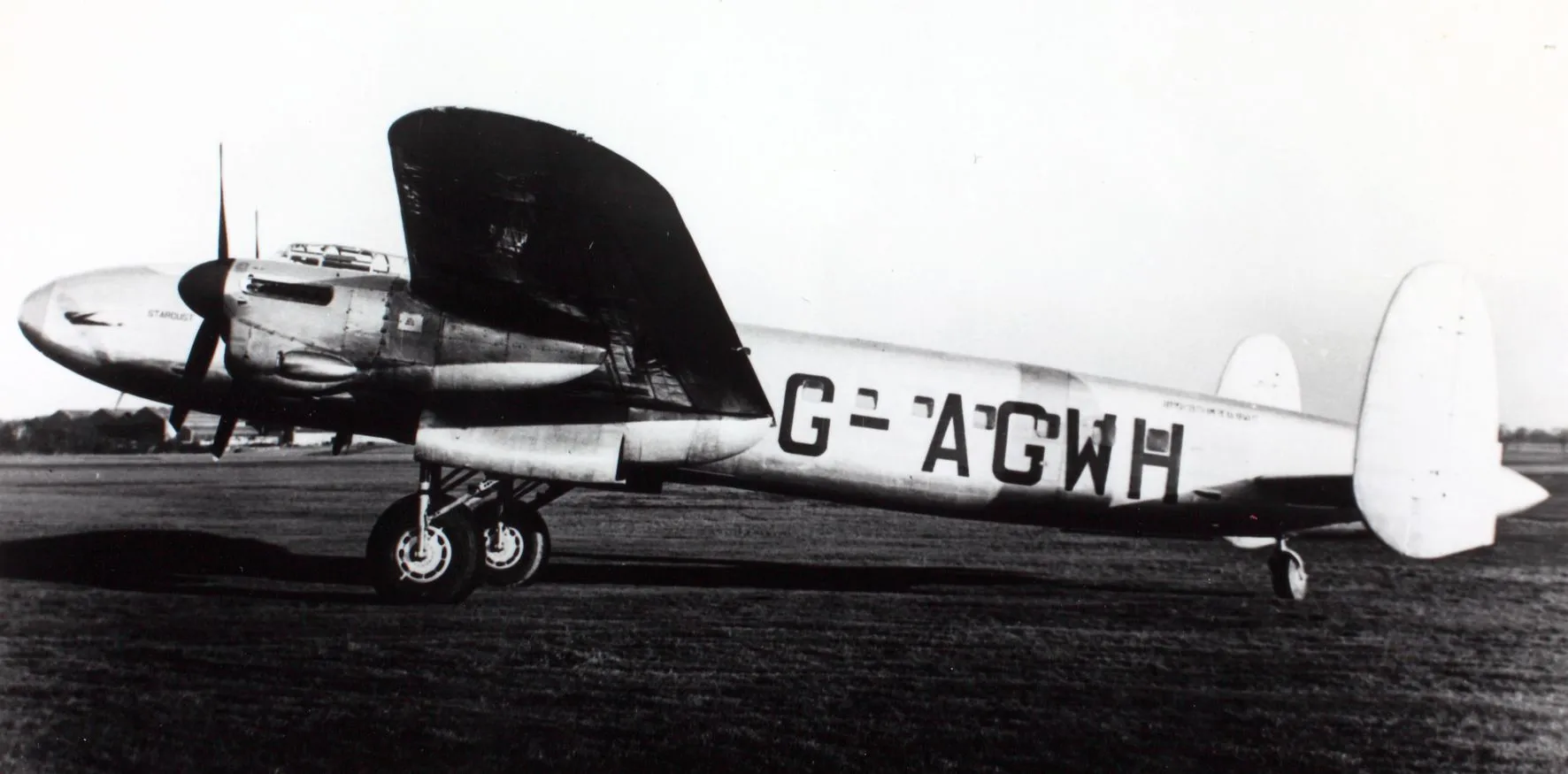
The aircraft was an Avro Lancastrian (a Lancastrian III), the civil passenger conversion of the Lancaster heavy bomber, powered by four Rolls-Royce Merlin engines and able to cruise above 20,000 feet. It carried the registration G-AGWH and the name Star Dust. On 2 August 1947 it was flying a scheduled BSAA service from Morón Airport at Buenos Aires, Argentina, to Los Cerrillos Airport at Santiago, Chile, a route that crosses the high spine of the Andes.
Eleven people were aboard: five crew and six passengers. The crew were experienced former RAF personnel. The captain was Reginald Cook, a decorated wartime pilot; the radio operator who sent the final message was Dennis Harmer; the rest of the flight crew and the cabin attendant made up the five. The six passengers are documented in the contemporaneous reporting, and a few of their details have since been folded into the legend that grew around the case. We note them once, plainly, as record rather than intrigue: among them were businessmen and commercial agents, a British official traveling as a King’s Messenger with a diplomatic bag for the embassy in Santiago, a passenger reported to be carrying a diamond, and a widow reported to be carrying her late husband’s ashes. They are people who died, not props in a mystery, and we leave them there.
As the aircraft approached Santiago, Harmer signaled ahead. By the account recorded in the British accident investigation that followed and relayed in the later documentary work, Santiago received, at about 17:41, a Morse message rendered “ETA SANTIAGO 17.45 HRS STENDEC,” giving an expected arrival of 17:45. The Chilean operator reported that the transmission came in clearly but very fast. He did not recognize the final word, queried it, and received STENDEC two more times in succession. The message carried no distress; it was a routine arrival report. Then contact was lost. We flag the obvious limit now and return to it: the entire STENDEC enigma rests on one operator’s recollection and transcription of a fast signal, and the exact wording, the times, and the certainty that the word was identical all three times reach us through him and the report that recorded him. We do not present them as independently verified verbatim.
Star Dust never arrived. A search began at once. Bennett personally directed an unsuccessful effort over about five days, with Chilean and Argentine teams searching on the ground and BSAA pilots searching from the air. They found nothing: no wreckage, no bodies, no trace of the aircraft or the eleven aboard. The aircraft had simply gone, somewhere in the Andes, and there it stayed.
It stayed for half a century. Then, in 1998, two Argentine mountaineers on Mount Tupungato came upon a Rolls-Royce Merlin engine and twisted metal and fragments of clothing in the glacier, at roughly 15,000 feet. In January 2000 a joint Argentine Army and civilian expedition reached the site and recovered identifiable wreckage, including the engine, an Avro propeller, and undercarriage, along with human remains preserved by the ice. By 2002 several of the victims had been identified through DNA comparison with surviving relatives. The recovery confirmed that the wreck was Star Dust, and where it lay, high on Tupungato and well east of Santiago, short of where the crew believed themselves to be, became the key to everything that could be explained.
The evidence
The case has two evidentiary phases, and they are almost opposites. For 50 years the record held one contested radio message and an official report that, with no wreck to examine, could not say what had happened. After 2000 there was a physical wreck, and the wreck is what converted a vanishing into a solved crash. We take the evidence in that order, and we are honest about where each piece runs out.
The record from the flight itself is the single transmission. As reported by the Chilean operator and entered into the British investigation, it establishes that Star Dust was flying and communicating normally about four minutes before its expected arrival, giving an ETA and no distress. That is what it shows. Its limit is severe and central: it is one person’s copy of a fast Morse signal taken across the Andes, and the wording, the spacing, and even the claim that the word came through identically three times are filtered through that operator and the document that recorded him. This is the weakest point in the entire file and the origin of every dispute about the last word. Everything that has ever been argued about STENDEC is argued about this one transcription.
The loss was investigated by the United Kingdom Ministry of Civil Aviation, through its Accidents Investigation Branch, in a report published in 1948 on the loss of the Lancastrian G-AGWH in the Andes. What it shows is that an official body documented the loss and the final transmission close to the event. Its limit is the obvious one: with no wreckage located, the 1947-48 investigation could not establish what had happened to the aircraft. The cause was undetermined at the time. The explanation that satisfies the case today did not exist in 1948; it had to wait for the glacier, and it post-dates the recovery by more than 50 years.
The wreck, when it came, did its most important work simply by being where it was. It lay high on Tupungato, on the Argentine side of the range, by some accounts on the order of 50 miles east of Santiago, far short of the city. By the aircraft’s own dead-reckoned position it should already have been past the mountains and descending toward the airport. The gap between where the wreck actually is and where the crew believed they were is the spine of the navigation-error explanation. What that location proves is that the crew were badly mispositioned. What it does not prove, by itself, is why.
The physical state of the wreckage points to how the aircraft hit. According to the investigators’ interpretation of the recovered components, the propeller indicated the engine was turning near cruising speed at impact, the undercarriage was retracted, and the debris was localized rather than scattered over a wide area. Read together, that is the signature of a powered aircraft in normal cruise configuration striking the mountain, with no mid-air break-up and no explosion. It is the physical pattern of controlled flight into terrain, not of sabotage or structural failure. The limit here matters: these are reconstructions drawn from parts that spent 50 years in a glacier, and they should be held as the investigators’ interpretation, attributed, not as laboratory-certified fact.
The reason the crew were mispositioned is meteorological, and it is a retrospective reconstruction rather than a 1947 measurement. The jet stream, a narrow band of very high, very fast wind, was only being identified by meteorologists in the mid-to-late 1940s and was not understood by line aircrew at the time. Reconstructed weather charts for 2 August 1947, analyzed for the 2000-era investigation and the documentary work, indicate conditions favorable to a powerful jet stream over the Andes, blowing against the aircraft. A strong headwind the crew could not have known about would have cut their true ground speed well below the value they were flying by, so that when their dead reckoning told them they had crossed the mountains, they had not. This is the most persuasive available explanation, and it is an inference from reconstructed data, attributed to the modern investigation, not a fact recorded in 1947.
The remains were recovered from the ice in 2000 and treated forensically, and several of the dead were identified by DNA by 2002. That identification confirmed the wreck as Star Dust and gave some families an answer after half a century. We report the recovery and the identification, and we do not dwell on the condition of the remains. They are the dead of a documented disaster, and they are owed that.
The honest summary of the evidence is this. For 50 years the only material was a single contested radio message and an official report that, lacking a wreck, could not say what happened. The glacier delivered the rest, and the wreck’s location and physical state, read against reconstructed jet-stream data, turned the vanishing into a solved crash. The one thing the wreck did not explain is the word.
The theories
Everything in this section must be read with the central divide in mind. The mechanism of the crash is solved, to a high degree of confidence and attributed to the modern investigation. The meaning of the last word is unsolved. The lurid stories that filled the 50-year silence are dispelled. We take them in that order and we do not let them bleed into one another.
The crash mechanism, the solved half. The explanation supported by the recovered wreck and the reconstructed weather is straightforward and well-grounded. Flying above an unbroken cloud deck with no ground reference, in a strong and then-unknown jet-stream headwind, the crew’s dead reckoning put them well past the Andes when they were not. Believing they had cleared the mountains and could descend toward Santiago, they descended early and flew into Tupungato, a controlled flight into terrain. By the investigators’ reconstruction, the impact triggered an avalanche that buried the wreck, and the glacier then carried it downhill for about 50 years before the melt zone released it. The support for this is the convergence already laid out: the wreck’s location far short of Santiago, the physical signature of a powered aircraft in cruise configuration at impact, and the reconstructed jet-stream conditions. A 2000 Argentine investigation is reported to have attributed the crash to severe weather and navigation rather than to pilot error, in effect clearing Captain Cook; we relay that as the investigation’s reported finding, not as a settled verdict. This is the well-supported, broadly accepted reading. It is presented as the solved half of the case, attributed rather than asserted as absolute certainty, and the avalanche-and-glacier mechanism specifically is the investigators’ reconstruction.
The word STENDEC, the unsolved half. Here nothing is confirmed. The Chilean operator judged the sending itself clear and copied the same five letters three times, which constrains the theories without settling any of them. Several readings have been proposed over the decades, and they are worth laying out precisely because none of them has ever been proven.
The most popular idea is that STENDEC is an anagram of “descent,” scrambled by a hurried or hypoxia-impaired operator. It is the version most often repeated. It is also contested by the experts consulted for the NOVA documentary, who note that anagram-style errors are much harder to make in Morse than in plain text, and that an accidental scramble repeated identically three times is unlikely; the crew, flying at altitude, also had oxygen. It is the most popular reading and an unproven one.
A second family of readings treats STENDEC as an acronym, expanded into phrases such as “Santiago Now Descending Entering Cloud” and similar constructions. These are fan and amateur inventions of later decades, not documented period usage, and Morse experts regard it as highly unlikely that an operator would encode a routine arrival report as a cryptic acronym. They are folklore, not evidence, and we label them as such.
The strongest informed reading treats STENDEC as a transcription or spacing error rather than a code. Sent quickly, the dot-dash sequence of STENDEC closely matches “SCTI AR,” where SCTI is the ICAO identifier for the Santiago airport and AR is the standard Morse sign-off meaning “over,” so the operator may have mis-segmented an ordinary closing transmission. A related variant maps it instead to “VALP,” for Valparaiso. The BBC Horizon program is reported to have concluded that, with the possible exception of just such a Morse-based misunderstanding, none of the proposed solutions held up. This is the reading that best fits how Morse actually works.
The most defensible position is also the least dramatic: that STENDEC is simply a garbled, mis-spaced, or miscopied routine transmission with no hidden meaning at all. As the NOVA material puts it, we will most likely never know for certain what the message was meant to say; This Day in Aviation calls it a mistake of some kind with no meaning in any language. Among informed analysts, this prosaic conclusion and the “SCTI AR” Morse reading are the most credible; the anagram is the most popular; the backronyms are folklore. The one thing every honest treatment agrees on is that none of them is confirmed.
The dispelled legends. In the absence of a wreck, the void filled with stories: that Star Dust had been carrying Nazi gold, that it was sabotaged, that it had been taken by a UFO. These grew up precisely because there was nothing to examine, and the documented details of the passenger list, a diamond, a diplomatic bag, gave them something to feed on. The legend left a cultural mark; the Spanish UFO magazine Stendek, founded in the 1970s, took its name from the case. The 2000 recovery is what dispelled the legends. What came out of the ice was a localized wreck consistent with a weather-driven navigation error and a controlled flight into terrain: no explosion, no anomaly, nothing that pointed to a heist, a bomb, or anything otherworldly. These stories are the popular overlay the evidence cleared away, and we present them as that and never as fact.
What remains unknown
The honest residue of this case is unusually clean, and it is a single word.
The crash is explained. The wreck on Tupungato, far short of Santiago, and in the physical state of a powered aircraft that flew into a mountain it believed it had already crossed, read against reconstructed charts showing a jet stream the crew could not have known about, gives an account that holds together and is broadly accepted. The legends are dispelled by that same wreck, which showed a navigation accident and nothing more. After 50 years of silence, an engine and a propeller and the remains of the people aboard came out of the ice and answered the question that had defeated the 1947 search.
They did not answer the other one. Three times, fast but by the operator’s account clear, Santiago copied STENDEC, and decades of analysis, a book, a documentary, and the attention of cryptographers and Morse veterans have not produced a reading anyone can prove. The most rigorous answer is the least romantic, that it was a garble of a routine Morse sign-off, most plausibly “SCTI AR.” But almost certainly is not certainly, and that narrow gap, one uncracked word recovered from a solved crash, is what stays open. Star Dust and the eleven people aboard it are no longer missing. The last thing the aircraft ever sent is still not understood, and almost certainly never will be.
Sources
Primary / official
The anchor primary record is the United Kingdom Ministry of Civil Aviation / Accidents Investigation Branch report on the loss of the Lancastrian G-AGWH, published in 1948, which documented the loss and the final transmission and, lacking a wreck, left the cause undetermined; and the contemporaneous 1947 press reporting from which the passenger details derive. No confirmed direct URL for the 1948 report or the original press coverage was available for this article, so they are cited in prose rather than linked. Jay Rayner’s book Star Dust Falling: The Story of the Plane that Vanished (Doubleday, 2002) is the fullest modern narrative of the case and is noted here without a link. The two items linked below are the closest available investigation record for the modern findings and the most authoritative treatment of both the solved crash and the STENDEC analysis, and are listed as primary-adjacent.
- BBC Horizon, “Vanished: The Plane That Disappeared” (2000) / PBS NOVA “Vanished!” (2001), Internet Archive
- NOVA Online, “Vanished!” - STENDEC Theories
Secondary / contextual
- NOVA Online, “Vanished!” - Resources
- Wikipedia, “1947 BSAA Avro Lancastrian Star Dust accident”
- This Day in Aviation, “2 August 1947”
- Damn Interesting, “The Star Dust Mystery”
- Plane & Pilot, “A Pilot’s Last Words: STENDEC”
- The Vintage News, “STENDEC: The mysterious 1947 Star Dust airliner crash”
- SAR Technology, “Aviation Cold Case Response” (STENDEC Morse analysis)
- “Search for ‘Star Dust’,” Pathfinder Craig (family account of the 1947 search)