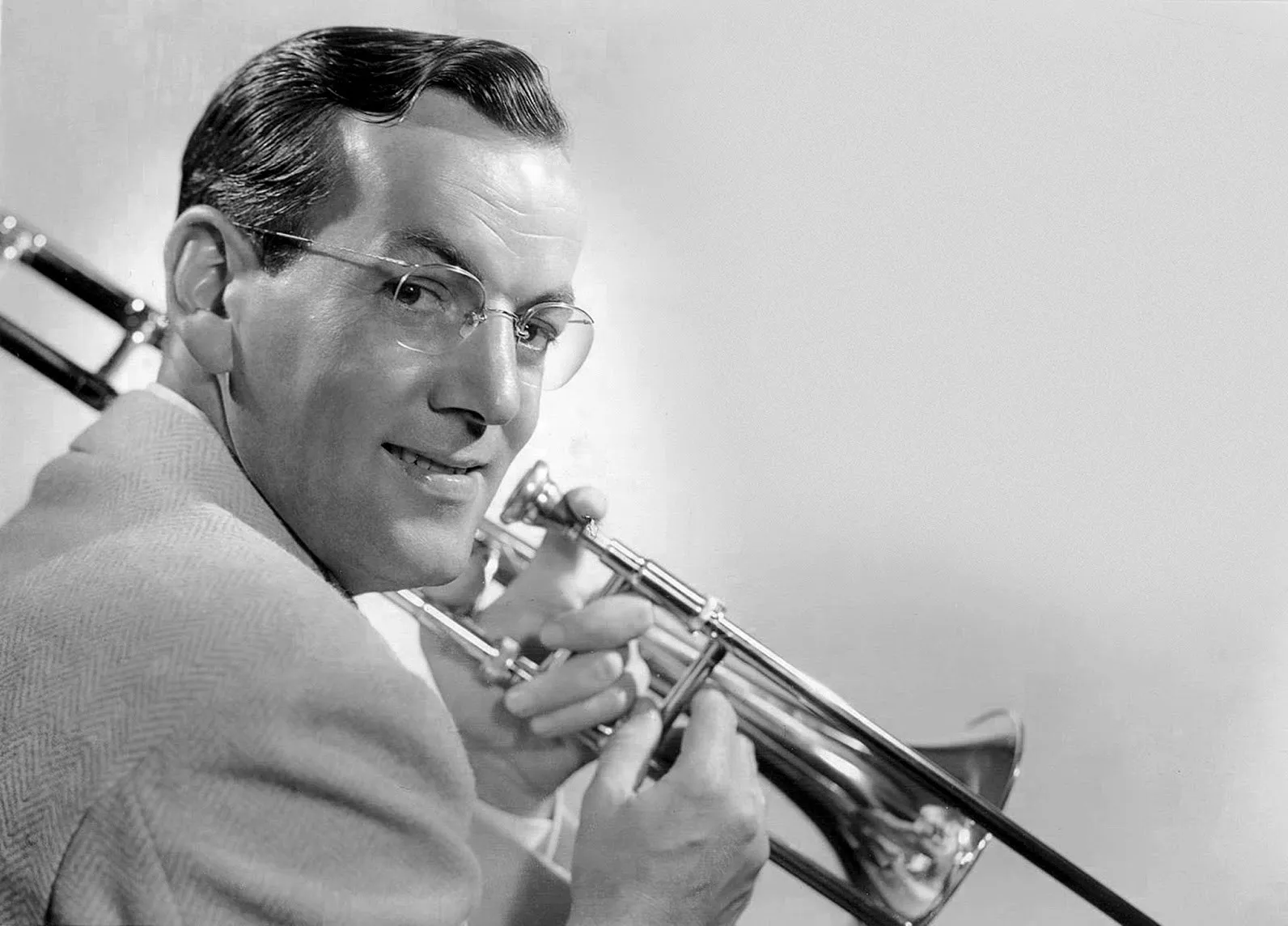
Aviation Mysteries Case file
Out Over the Channel: The Disappearance of Glenn Miller, 1944
The most famous bandleader in America, by then an Army major, took off from an English airfield for Paris on 15 December 1944 and his aircraft was never seen again. No wreckage, no bodies, no distress call. An official board ruled it an accident it could not prove without wreckage, a serious friendly-fire theory followed, and a cover-up rumor the record does not support has never gone away.
- Case type
- Aviation
- Status
- Unexplained
- Event date
- December 15, 1944
- Location
- Took off from RAF Twinwood Farm near Bedford, England, bound for Paris; lost over the English Channel - English Channel - United Kingdom
- Evidence
-
- Official record
- Testimonial
The open question What brought down Glenn Miller's Norseman over the English Channel on 15 December 1944, and where it and the three men aboard came to rest, neither of which was ever established?
On the afternoon of 15 December 1944, in one of the coldest winters England had seen, a single-engine plane lifted off from an airfield north of Bedford and turned toward the Channel and France. Aboard were three men. One of them was Major Alton Glenn Miller, who eighteen months earlier had been the biggest bandleader in America and was now an officer in the US Army Air Forces, flying ahead of his orchestra to arrange concerts for Allied troops in newly liberated Paris. The plane never reached France. No one heard a distress call. No wreckage was found, no bodies were recovered, and no instrument ever recorded what went wrong. More than eighty years later, that is still true.
The popular memory of all this runs toward the lurid: a secret death in a Paris brothel, a military cover-up, a friendly bomber that blew Miller out of the sky. The documented version is quieter and harder. An Eighth Air Force Board of Inquiry concluded in January 1945 that the loss came from a combination of human error, mechanical failure, and weather, an accident. But it reached that conclusion without ever examining a piece of the aircraft, because there was no piece to examine. That is the spine of this case. The cause was never physically confirmed and the plane was never found, so the best-supported explanation remains an inference rather than a finding. We keep three things separate, as always: what is documented, what the evidence shows, and what is still only a hypothesis.
The documented account
Glenn Miller did not have to be in uniform at all. By 1942 his civilian band was among the most popular musical acts in the United States. He reported for military service on 7 October 1942, was commissioned, and was eventually promoted to the rank of Major while in England. He built and led an Army Air Forces orchestra, the American Band of the Allied Expeditionary Forces, whose job was to raise the morale of troops through broadcasts and performances. By late 1944 the band was stationed in England, with plans to move to the Continent after the liberation of Paris.
In December 1944 Miller intended to fly ahead of his band to Paris to arrange a series of performances for Allied troops. After two days of weather delays, he secured passage on a Noorduyn UC-64A Norseman, a single-engine utility aircraft, USAAF serial 44-70285. The flight was not a normally scheduled or fully cleared troop movement, a detail that later complicated the paperwork: Miller and the officer who arranged the trip were effectively unofficial passengers on it.
On 15 December 1944 the Norseman departed RAF Twinwood Farm, about three miles north of Bedford, at 13:55. Three men were aboard. The pilot was Flight Officer John Robert Stuart Morgan. The passenger who had arranged the flight was Lieutenant Colonel Norman F. Baessell, of the Eighth Air Force Service Command. The third was Major Glenn Miller. The route lay out over the English Channel toward an aerodrome serving Paris, identified in the most rigorous sourcing as Villacoublay, near Versailles. The exact destination aerodrome is given inconsistently across accounts, so the honest framing is simply that the flight was bound for the Paris area. The weather was foul: heavy fog, low cloud, and freezing temperatures.
The aircraft never arrived. Two circumstances delayed any alarm. The flight was unscheduled, so no one was firmly expecting it at a set time, and on 16 December the German offensive that became the Battle of the Bulge erupted, throwing the theater into chaos. The disappearance of the three men was not even noticed until around 18 December. A Missing Air Crew Report, MACR #10770, was filed. The public announcement of Miller’s loss came around 24 December 1944, after his wife, Helen, had been notified. On 20 January 1945 an Eighth Air Force Board of Inquiry concluded that the aircraft had gone down over the Channel from a combination of human error, mechanical failure, and weather. The wreckage and the three men were never found.
The evidence
With no wreckage, no bodies, and no recovered debris, this case has almost no physical evidence at all. What exists is a paper record and a set of recollections, and the honest work is in stating clearly what each one can and cannot show.
The Missing Air Crew Report, MACR #10770. This is the core official document, held by the US National Archives. Missing Air Crew Reports of this kind record the names and ranks of those aboard, the date and circumstances of the loss, the unit, the origin of the flight, and the aircraft particulars. What it shows is the official, contemporaneous fact that the aircraft went missing and who was on it. What it does not show is a physical cause, because a missing-aircraft report establishes that a plane was lost, not why. There was nothing recovered to examine.
The Board of Inquiry finding of 20 January 1945. The official conclusion was that the loss came from a combination of human error, mechanical failure, and weather, that is, an accident. The most thorough later account of the investigation, by Dennis Spragg of the Glenn Miller Archive at the University of Colorado Boulder, frames the probable mechanism as pilot disorientation together with engine icing. What this shows is a reasoned official judgment of probable cause. What it does not show is a forensic determination, because the board, like everyone since, had no wreckage to work from. It was a conclusion drawn from circumstance, not from recovered parts.
The aircraft and its known vulnerability. The Norseman was powered by a Pratt and Whitney R-1340 Wasp engine fed by a Stromberg carburetor of a type prone to icing, with carburetor heating intended to counter the problem. Several accounts state that the UC-64 model had been subject to a recall over defective carburetor heaters. What this shows is a documented technical weakness of the type that is consistent with the icing explanation in the prevailing weather. Its limit is sharp: whether this particular airframe, 44-70285, had a defective or working heater that day is not established by any primary record in the sources reviewed. The recall point applies to the model, not provably to this plane on this date, and should be read as inference rather than fact.
The weather. Multiple accounts describe heavy fog, low cloud, and freezing temperatures, with the flight conducted at low altitude beneath the cloud. Altitude figures of roughly 1,500 to 3,000 feet appear in the record. What this shows is conditions consistent with both carburetor icing and pilot spatial disorientation. Its limit is that the specific altitude and timing figures vary between accounts and should be treated as approximate, not as logged measurements.
The friendly-fire basis: a recollection, a logbook, and a captain’s confirmation. The evidentiary foundation of the friendly-fire theory is threefold. First, the recollection of former RAF navigator Fred Shaw, who said that as his Lancaster jettisoned bombs over a designated Channel jettison area after an aborted raid, he looked down and saw a small high-wing monoplane, which he later identified as a Norseman, go into the sea. Second, the surfacing in 2000 of flight engineer Derek Thurman’s logbook, said to corroborate that the Lancaster’s crew saw a light aircraft below. Third, confirmation attributed to the Lancaster’s captain, Victor Gregory. What this shows is a witness recollection and a logbook entry placing a small aircraft beneath jettisoning bombers. Its limits are serious: this is testimony recalled decades later and built largely around one navigator’s account; the logbook surfaced in 2000; the raid was aborted, so there was no standard debrief or raid report to check it against; and the timing and position are heavily disputed, as the next section sets out.
The rejected wreckage claim. A claim made in the 1980s, often dated to 1987, that a fisherman had dredged up the Norseman’s wreckage off Portland Bill, has been rejected by Spragg on three grounds: the paint color did not match, an intact airframe after decades submerged was implausible, and the location lay roughly 150 miles west of the Channel corridor the flight would have used. It is not evidence of recovery.
The single most important evidentiary fact is an absence. There is no confirmed wreckage, there are no bodies, and there is no instrument record. With nothing physical to examine, every explanation of the cause, including the official one, rests on documentary inference rather than on a recovered aircraft.
The theories
Everything in this section is a hypothesis. The cause of the loss was never physically confirmed, so none of what follows is a finding, and they differ sharply in how much the record supports them.
Carburetor icing, spatial disorientation, and the weather. This is the leading conventional explanation and the best-supported inference in the case. The reading is that in freezing fog the Norseman’s icing-prone carburetor failed, or the pilot became spatially disoriented at low altitude over water, or both, and the aircraft went into the Channel within seconds, too fast for any call. It is the explanation the original Board of Inquiry reached in 1945, and it is the one argued most rigorously by Dennis Spragg, whose 2017 book Glenn Miller Declassified concludes there is no mystery about the cause and reconstructs the loss as a swift, non-survivable accident: the engine ices, the engine stops, the aircraft noses down, and it is in the water almost at once. The supporting reasoning is real: a documented icing vulnerability in the type, severe icing weather, and a pilot flying low under visual rules in conditions that punished any error. Its honest weakness is the same one that hangs over the entire case. It cannot be proven without wreckage, so it stands as the most likely answer rather than a confirmed one. We give it the most weight, and we still label it a hypothesis.
The accidental friendly-fire jettison. This is the most serious alternative, and it is an accident theory, not an accusation against anyone. By the theory’s account, on 15 December 1944 a force of RAF Lancaster bombers, returning from an aborted raid on Germany, jettisoned their bombs into a designated Channel jettison area, and Miller’s low-flying Norseman was beneath the falling ordnance. As later retellings describe it, the force numbered around 138 aircraft and the jettison zone was a circle south of Beachy Head, though those specifics come from secondary accounts rather than from primary RAF records and should be treated as such. The case for the theory is the witness material set out above: Fred Shaw’s recollection, Derek Thurman’s logbook surfacing in 2000, and Victor Gregory’s confirmation, with aviation historian Roy Nesbit credited with corroborating elements against RAF records. The case against it is substantial, and it comes from the leading specialist research. On timing, Spragg places the bomb jettisons at roughly 13:00 to 13:30, while Miller’s aircraft would only have reached the Channel around 14:45 to 15:00, with the bombers already back at base before the Norseman arrived; a Miller-family-linked investigation similarly put the Norseman in that airspace well over an hour after the bombs fell. On course, former B-17 pilot Howard Roth argued in 2003 that for the Norseman to have been under the jettison zone it would have had to stray more than 20 degrees off track. On visibility, critics note it was near zero, which is the very reason the raid was scrubbed and the bombs dropped, making a clear sighting of a small aircraft far below doubtful. And Spragg notes that observation aircraft in the area reported the bombs falling near them, pointing to a different location. The theory has real witness and logbook material behind it. It is also contradicted on timing, position, and physics by the most careful research, and it remains speculative as applied to Miller’s specific aircraft.
The cover-up and brothel rumor. This belongs in the record only as attributed, unsubstantiated rumor, and we treat it that way. The claim is that Miller did not die in a crash at all but of a heart attack in a Paris brothel, with the flight story invented to cover it up; related variants hold he was on a secret mission or was assassinated. The brothel and cover-up version traces to a single 1997 story in the German tabloid Bild, attributed to the journalist Udo Ulfkotte, who said he had found US documents indicating Miller reached Paris safely and died there. Ulfkotte subsequently walked the claim back, saying he had never actually found such documents and had instead heard the story off the record, with no papers behind it. There is no documentary support for any version. The logical problem is plain on its own terms: a cover-up of this kind would have required silencing Miller’s manager, his band, and many other witnesses, and it does nothing to account for the simultaneous loss of Baessell and Morgan, two other men who also never came home. We state it once, attribute it to its single source, note that the source retracted it, and leave it there. It is not a fact, and it is not the point.
What remains unknown
The honest residue of this case is narrow and it is real. The cause of the loss is an inference, not a forensic finding, because no part of the aircraft was ever examined. The aircraft itself has never been found, on the Channel floor or anywhere else; the group TIGHAR has reportedly looked into a claim that it lay west of the required flight path, and nothing has been confirmed or recovered. The leading explanation, carburetor icing and pilot disorientation in freezing fog, fits the weather and the aircraft better than any alternative, and it remains unproven for want of a single recovered piece.
So we will not tell you a returning bomber blew the plane out of the sky, because the timing, the course, and the visibility all cut against it, and the men who advanced the theory were recalling an aborted raid decades later. We will not tell you Miller died in a brothel and the Army hid it, because that claim rests on one tabloid story whose own author said he had no documents and ignores the two other men lost with him. And we will not tell you the case is solved, because the cause was never physically confirmed and the wreckage was never found.
What we can tell you is that on a freezing December afternoon in 1944, a famous bandleader who had put on a uniform he did not need to wear, a pilot, and the officer who arranged the flight took off for Paris in a small plane, went out over the Channel, and were never seen again. An official board called it an accident it could not prove. The most defensible reading is still icing and disorientation in terrible weather. But the single open question the rigor leaves standing is the simplest one: what brought the Norseman down, and where the three men came to rest. The record has never closed it. The file is still open.
Sources
Primary / official
- US National Archives, “Remembering Major Alton ‘Glenn’ Miller (1904-1944)” (The Text Message blog, 24 December 2024)
- Missing Air Crew Report #10770, Noorduyn UC-64A Norseman 44-70285 (via NARA / Fold3)
- Aviation Safety Network, accident record, Noorduyn UC-64A Norseman 44-70285, 15 December 1944
- UPI Archives, “Bild: Glenn Miller died in bordello” (13 July 1997)
- Deseret News, “Band leader Miller died in brothel, paper says” (13 July 1997)
- The Spokesman-Review, “Paper: Glenn Miller died in Paris brothel” (13 July 1997)
Secondary / contextual
- Dennis M. Spragg / CU Boulder, “Revealed: What really happened when Glenn Miller disappeared in 1944”
- Dennis M. Spragg, “Glenn Miller Airplane Claims, An Update”
- Dennis M. Spragg, “Glenn Miller Disappearance, The Definitive Facts”
- The National WWII Museum, “Major Glenn Miller: The Loss of an Icon”
- Wikipedia, “Glenn Miller”
- Rambles in the Air (airbornerambler), “Riding a Norseman into Posterity”
- Classical Music magazine, “How did Glenn Miller die?”
- The Vintage News, “New Evidence in the Mystery of Glenn Miller’s Fatal Last Flight” (21 January 2019)
- Tales of History and Imagination, “The Many Deaths of Glenn Miller” (7 August 2022)
- Today I Found Out, “The Mysterious Disappearance…” (December 2022)
- The Straight Dope, “Did band leader Glenn Miller die in a French brothel?”
- History.com, “Legendary bandleader Glenn Miller disappears over the English Channel”