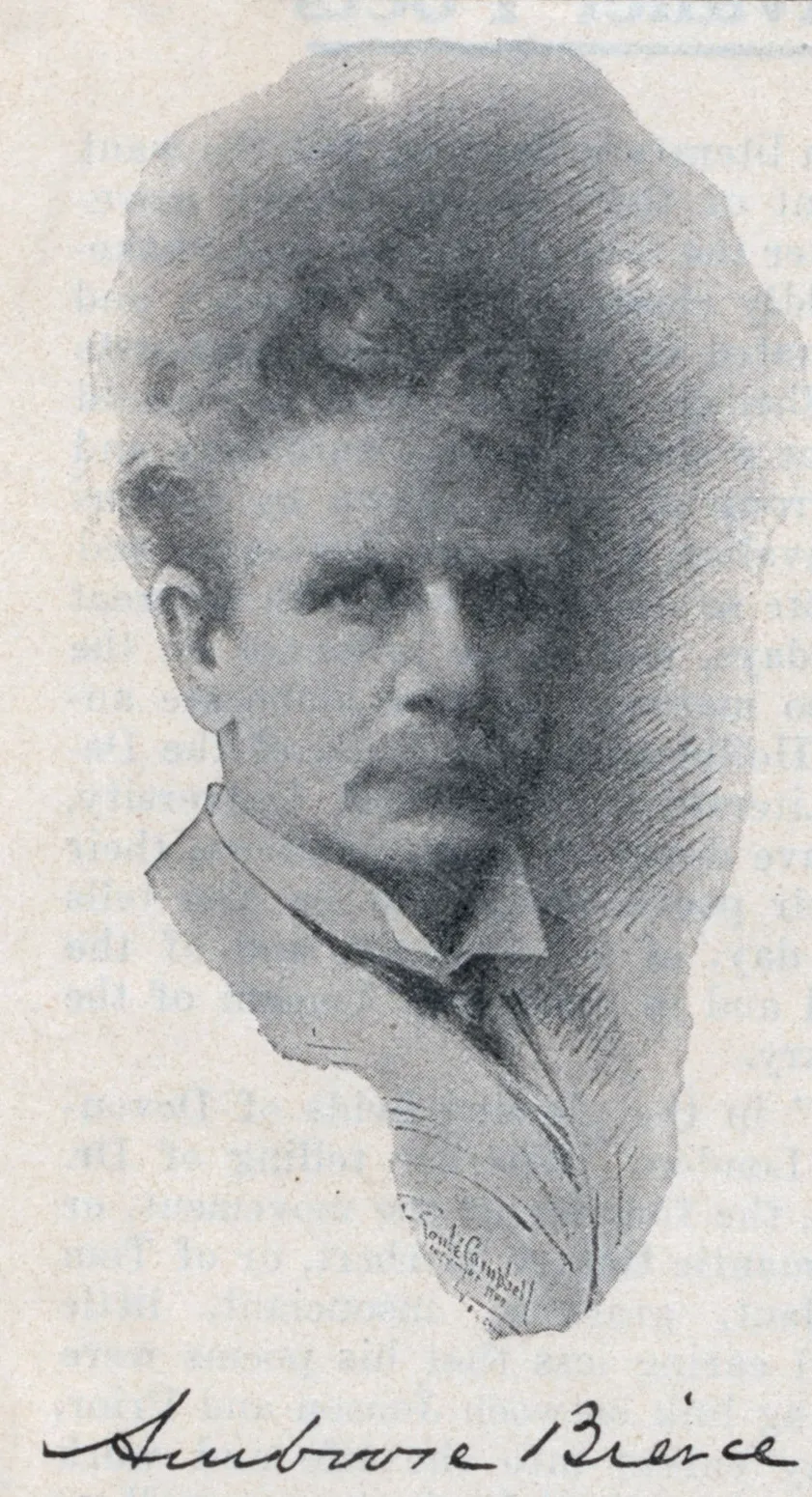
Disappearances Case file
An Unknown Destination: The Disappearance of Ambrose Bierce, 1913
The American writer and Civil War veteran known as Bitter Bierce left Washington in October 1913 at about seventy-one, headed for the Mexican border, and was never reliably heard from again. No body, no grave, no death record has ever surfaced. The romantic story of an old man riding off to die with Pancho Villa rests largely on a secretary's notebook reconstructed from destroyed letters, and the US government could not even confirm he entered Mexico.
- Case type
- Disappearance
- Status
- Unexplained
- Event date
- December 1, 1913
- Location
- Last reliably traced heading for the Texas-Mexico border (El Paso); his last reported letter was placed in Chihuahua, Mexico, in late December 1913, though even his entry into Mexico was never officially confirmed - Mexico
- Evidence
-
- Testimonial
- Official record
The open question What became of Ambrose Bierce after October 1913, given that the only record of his final months is a secretary's transcription of destroyed letters and no body, grave, or death record has ever been found.
In October 1913, Ambrose Bierce left Washington, D.C. He was about seventy-one years old, a Civil War officer turned famous and feared newspaperman, and he told people he was going to tour the battlefields where he had fought half a century earlier and then continue south toward the Mexican border. A revolution was burning across that border. The standard telling has him crossing into Mexico, attaching himself to Pancho Villa’s army as an observer, and writing one last letter from Chihuahua that ended with a line that has outlived him: he was leaving, he said, for an unknown destination. After that, nothing. No body, no grave, no death record has ever been confirmed.
That is the documented core, and it needs to be held carefully, because the Bierce case is unusual among famous disappearances. Here the fragility of the record is the story. The vivid version, the old writer riding into a war to die with Villa, is far better documented as legend than as fact. Two things have to stay in front of the reader from the start. First, the famous last letter and most of the Mexico itinerary survive only second-hand, through a notebook kept by his secretary and companion, Carrie Christiansen, written in her hand and reconstructed from letters she said had been destroyed. Second, the United States government was never able to confirm that Bierce crossed into Mexico at all, and its consul could find no evidence he had ever been in Chihuahua. This is an account of what the record establishes, what the surviving evidence does and does not show, and what is only hypothesis. We keep three things separate, as always: what is documented, what the evidence shows, and what is still only a hypothesis. There is no ending to dump in the first line, because no one has ever found one.
The documented account
Ambrose Gwinnett Bierce was born on 24 June 1842 in Meigs County, Ohio. He enlisted in the 9th Indiana Volunteers in 1861, fought at Shiloh and Chickamauga, served as a topographical engineer on the staff of General William B. Hazen, and was seriously wounded, a head wound, at the Battle of Kennesaw Mountain in June 1864. He came out of the war and into journalism. He edited the San Francisco News Letter from 1868, wrote the “Prattle” column for William Randolph Hearst’s San Francisco Examiner from 1887, and worked for Hearst’s papers into 1909. His attacks on frauds, politicians, and pretenders earned him the name Bitter Bierce. He is remembered today as the author of The Devil’s Dictionary, first published in 1906 as The Cynic’s Word Book, and of the much-anthologized short story “An Occurrence at Owl Creek Bridge.”
In October 1913, at about seventy-one, Bierce left Washington. He said he was undertaking a tour of his old Civil War battlefields, and he moved south toward the Texas-Mexico border. That much sits on firm ground.
What he intended is documented in his own letters, and the intent was unmistakably fatalistic. The most quoted of these passages, the one in which he imagined being stood against a Mexican stone wall and shot to rags and called that a good way to depart this life, beating old age and disease, is dated by scholarly accounts to a letter of 1 October 1913 written to Lora Bierce, the wife of his nephew Carleton. The line often paired with it, that to be a gringo in Mexico is euthanasia, is generally presented as part of that same October passage. These lines are commonly transcribed in popular accounts, but they belong to that October correspondence, not to the later letter from Mexico, and they describe a state of mind, not an event.
The Mexico itinerary is a different kind of fact, and the difference matters. The detailed route, that he reached El Paso, crossed at Ciudad Juárez, joined Villa’s army as an observer, and witnessed the Battle of Tierra Blanca before reaching Chihuahua, rests largely on Carrie Christiansen’s notebook. This is reported, not documented, and it should be read that way throughout. The last reported communication, generally placed in late December 1913 from Chihuahua, is the source of the line “I leave here tomorrow for an unknown destination.” That line survives only as an entry in Christiansen’s notebook, in her handwriting, drawn from letters whose originals were reportedly destroyed. It is not a surviving manuscript. Even its basic details are disputed: the date is given as 26 December by most popular accounts and as 25 December by the skeptic Joe Nickell, and the recipient is given variously as Christiansen herself or the writer Blanche Partington. We do not resolve those disagreements here, because the record does not.
After that letter there is nothing confirmed. No body was recovered, no grave was confirmed, and no death record exists. Inquiries were made. United States consular officials investigated; Army Chief of Staff Hugh L. Scott contacted Villa’s American representative, Felix A. Sommerfeld, who looked into it; and, as Nickell records, the US government was unable to confirm that Bierce had crossed into Mexico, while the American consul could find no evidence that he had ever been in Chihuahua. The official effort was real, and it came back empty.
The evidence
Strip away the romance and the case rests on a very short list of evidentiary channels, and the most important feature of that list is how thin and how second-hand the channels are. There is no physical evidence at all: no body, no grave, no artifact. What survives is a single witness’s transcription, a muddied documentary trail, and the null result of a contemporaneous official search.
Carrie Christiansen’s notebook. This is the load-bearing document of the entire Mexico story, and it cannot bear the weight that the legend puts on it. Christiansen, Bierce’s secretary and companion, kept a notebook recording his 1913 wanderings, probably written from letters that Bierce sent her. She said the original letters had been destroyed, reportedly on Bierce’s own instruction, and what she supplied was her summary. The final Chihuahua letter, by Nickell’s account, exists only among other colorful and suspicious notebook entries, penned in Christiansen’s handwriting. What the notebook shows is roughly where Bierce claimed to be and what he claimed to be doing in late 1913. What it cannot show is whether any of it happened, because it is not a primary manuscript. It is a single-witness transcription of destroyed material, and a skeptic has argued the entries are unreliable. Almost everything vivid in the popular story passes through this one bottleneck.
The recipient and date discrepancy. Some popular accounts say the late-December letter went to Blanche Partington and quote it as though from a surviving text. Nickell and others say the relevant final letter was to Christiansen and note that the letter to Partington had not been found. Both cannot be cleanly true at once. The disagreement is not a trivial footnote. It is itself evidence of how muddied the record is, that the field cannot even agree on who received the last words or on what day they were written.
The absence of a death record. There is no confirmed body, no confirmed grave, and no death certificate. Encyclopaedia Britannica records his death as January 1914 in Mexico, and marks both the date and the place with question marks. The honesty of that punctuation is the point.
The contemporaneous inquiries. The consular investigation, Scott’s contact with Sommerfeld, and the government’s stated inability to confirm a border crossing all establish that an official effort was made and turned up nothing. That null result has to be read carefully in both directions. It does not prove Bierce never went to Mexico, because a chaotic revolutionary war zone is exactly the kind of place where a single elderly traveler could vanish without a trace in any official ledger. But it does mean that the most basic claim in the romantic narrative, that he was in Mexico at all, was never independently confirmed by anyone with the standing to confirm it.
The honest end of this layer is uncomfortable. The record is so thin that even the itinerary is uncertain. We do not have an independently documented route, a confirmed last location, an agreed date or recipient for the final letter, or a primary text of that letter. We have one notebook, one set of question marks in an encyclopedia, and an official search that found nothing.
The theories
Everything in this section is a hypothesis. None of it is proven. Several of these theories place Bierce’s death in the hands of long-dead actors, and every one of those is handled as attributed, unsubstantiated speculation and nothing more. The ordering reflects what the evidence will and will not bear, not certainty.
Killed in the fighting at Ojinaga, January 1914. This is the most commonly cited mainstream conjecture, and Britannica states it as exactly that. Its wording is careful: Bierce’s fate is a mystery, but a reasonable conjecture is that he was killed in the siege of Ojinaga in January 1914. Britannica frames it as conjecture, not finding, and it is repeated here on those terms. There is no confirmed evidence that Bierce was at Ojinaga.
Executed at Sierra Mojada, Coahuila. The soldier-of-fortune Tex O’Reilly, in a 1928 New York Times piece and in his memoir Born to Raise Hell, reported hearing that an elderly American had been shot by federal volunteers near a cemetery wall at Sierra Mojada. Decades later an amateur historian, Leon Day, interviewed an elderly local known as Don Chuy, who as a child said he had seen an old, bearded gringo shot near the cemetery in 1914. Day remained skeptical of the account but found it hard to pick holes in. A Catholic priest, James Lienert, later installed a marker at Sierra Mojada stating that the man had been executed on suspicion of being a spy. The strength of this strand is that it offers two seemingly independent oral accounts. Its weaknesses are severe and decisive: every account is oral, all of it surfaced decades after the fact, there was no forensic identification of anyone, and the identification of the “old gringo” as Bierce is an inference layered on top of the rest. The priest’s later marker is a monument to that inference, not proof of it.
Natural death or illness. Bierce was elderly, reportedly asthmatic, and headed into a war zone. Death from illness or exposure is plausible on its face and would require no culprit and no crime. No specific evidence supports any particular natural-death event, and this possibility overlaps with the next.
The Marfa pneumonia lead. In Harper’s in February 2002, the journalist Jake Silverstein traced a letter from one Abelardo Sanchez, who claimed that in 1957 he had given a ride to a former federale, Agapito Montoya, who described an old, sick American calling himself “Ambrosia,” a man who spoke of writing a book with “devil” in the title, who died of pneumonia on 17 January 1914 and was buried in an unmarked grave in Marfa, Texas. This lead does not hold. The Sanchez letter was found to be full of holes, serious and minor, and Silverstein’s later book on the subject deliberately blurs fact and fiction. It is recorded here as a discredited and unreliable thread, included only because it recurs in the literature.
Suicide, and the reading that he never went to Mexico at all. The skeptic Joe Nickell, writing in Skeptical Inquirer in 2021, argued that the Mexico story was a deliberate distraction, a puff of smoke, and that Bierce most likely died by his own hand, possibly at the Grand Canyon. His case is built on Bierce’s documented fatalism and on the man’s own admission that he had fed the newspapers a story, telling a correspondent not to believe everything the papers said of him because he had to tell them something. Nickell points to the publisher Walter Neale’s account that Bierce had selected the place of his last earthly habitat at the Canyon on a 1912 trip, to Bierce’s essay advocating suicide, to farewell letters speaking of finished work and a longing for the good darkness, and to his relinquishing of his cemetery plot. The reading is consistent with the government’s failure to confirm any border crossing. It is also an interpretation rather than an established fact. The Neale claim about the Grand Canyon is itself second-hand and unverified, no body was ever found there either, and mainstream biography treats the deliberate-concealment idea as a theory and not a finding. It belongs here, clearly labeled, as Nickell’s argued interpretation.
There are older, thinner attributions worth noting only to set aside. The writer Vincent Starrett suggested a 1915 execution, and a 1919 Washington Times article referenced an execution by Villa’s general Tomás Urbina. These are early newspaper speculation, not evidence, and no version of them was ever substantiated. This publication does not assert that Villa’s forces, federal troops, General Urbina, or anyone else killed Ambrose Bierce, because the record does not support any such claim.
One last layer belongs outside the record entirely. The popular image of Bierce, the old gringo riding off into the revolution to die, owes much of its shape to fiction: Carlos Fuentes’s 1985 novel Gringo Viejo and the 1989 film Old Gringo built on it, with Gregory Peck playing a fictionalized Bierce. That is the legend, and it is a good one. It is not the case file, and it is walled off here from the documented record.
What remains unknown
The honest residue of the Bierce case is unusually large, because so little of what is normally taken as settled was ever settled at all.
We do not know whether Ambrose Bierce reached Mexico. The detailed itinerary that places him with Villa’s army survives through a single secretary’s notebook, reconstructed from letters that were destroyed, and the United States government could not confirm that he crossed the border or that he was ever in Chihuahua. We do not know who received his last letter, whether Christiansen or Blanche Partington, or on what day it was written, or what the destroyed originals actually said, because no original survives. We do not know whether any of the executed-old-gringo accounts, oral and decades-late, are about Bierce at all. We do not know where, or when, or how he died. Britannica’s question marks are still the most honest summary anyone has produced.
So we will not tell you he was shot against a wall in Mexico, because the only accounts of it are oral, surfaced decades later, and never identified the man as Bierce. We will not tell you he died at Ojinaga, because even Britannica calls that a conjecture. We will not tell you the Marfa grave is his, because the letter behind it was found to be full of holes. We will not tell you he killed himself at the Grand Canyon, because that rests on a second-hand claim, no body was found there either, and it remains one skeptic’s interpretation. And we will not tell you he simply rode off to die with Villa, because that is the legend, and the record cannot even confirm he entered the country. What we can tell you is that in October 1913 an old man who had spent a lifetime writing precisely about death left Washington, headed for the border, told the newspapers a story he later admitted he had made up, and then went quiet. He had imagined, in a letter that summer, being stood against a wall and shot. Whether anything like it happened, no one has ever been able to show. The file is still open.
Sources
Primary / near-primary
- Ambrose Bierce Papers, 1872-1913, Online Archive of California finding aid (ark:/13030/tf009n97nj)
- Jake Silverstein, “The Devil and Ambrose Bierce,” Harper’s (Feb. 2002)
Two of the most load-bearing items in this case have no clean source of their own and are cited in the prose above rather than in this list. Carrie Christiansen’s notebook, the single source for the last letter’s text and most of the Mexico itinerary, was not accessed directly and is described second-hand through the biographies and through Nickell. Tex O’Reilly’s 1928 New York Times account of the Sierra Mojada execution was likewise reached through later retrospectives rather than in original form. The foundational biographies by Carey McWilliams (1929) and Paul Fatout (1951) have no link here and are named for the reader who wants to chase the original wording of the October 1913 and December 1913 letters.
Secondary / contextual
- Encyclopaedia Britannica, “Ambrose Bierce”
- Wikipedia, “Ambrose Bierce”
- Joe Nickell, “Incredible Vanishings and the Case of Ambrose Bierce,” Skeptical Inquirer (Mar. 2021)
- Roy Morris Jr., Ambrose Bierce: Alone in Bad Company (1995)
- wormwoodiana, “Ambrose Bierce’s Final Words” (Dec. 2013)
- Literary Hub, Dan Sheehan, “No one knows why Ambrose Bierce disappeared, but here are some theories”
- Austin Chronicle, “Devil in the Details” (2002)
- ExplorersWeb, “The Disappearance of Ambrose Bierce”
- HowStuffWorks, “The Mysterious Disappearance of Ambrose Bierce”