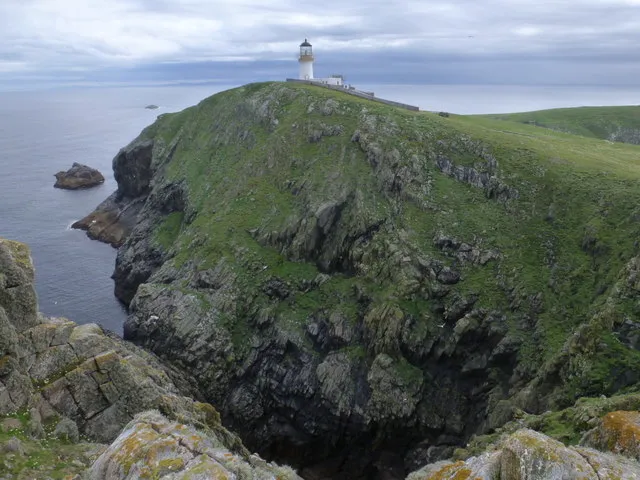
Disappearances Case file
The Light That Went Dark: The Flannan Isles Keepers, December 1900
Three lighthouse keepers vanished from a rock in the Atlantic and were never found. The famous version, with its storm-torn log, stopped clock, and untouched meal, is largely a 20th-century invention. The documented case is quieter, and harder to dismiss.
- Case type
- Disappearance
- Status
- Partially explained
- Event date
- December 15, 1900
- Location
- Eilean Mòr, Flannan Isles, Outer Hebrides, Scotland - North Atlantic Ocean - United Kingdom
- Evidence
-
- Physical
- Testimonial
- Official record
The open question What exact sequence put three trained keepers at an exposed Atlantic landing at the same moment, leaving the lighted station unattended in a way their training forbade?
On Boxing Day, 1900, a relief boat reached a lighthouse on a bare rock in the North Atlantic and found no one waiting. No flag flew. No supply boxes had been set out. When the relief keeper climbed to the station he found the gate shut, the door shut, the beds empty, the fire dead, and the lamps cleaned and ready to light. Three men were gone, and they were never found.
That much is in the record. Almost everything else you have probably heard about the Flannan Isles, the log entries describing a once-in-a-generation storm, the clock stopped at the moment of disaster, the meal set on the table and never eaten, the toppled chair, comes from a poem and a piece of pulp fiction written decades later. The documented case is narrower and, in its way, more unsettling. This is an account of what the investigation actually recorded, what the physical evidence showed, and where the real open question sits once the inventions are stripped away. We keep three things separate, as always: what is documented, what the evidence shows, and what is still only a hypothesis.
The Account
The Flannan Isles are a small uninhabited group in the Outer Hebrides, about 32 km (roughly 17.5 nautical miles) west of the Isle of Lewis. The largest, Eilean Mòr, rises to about 88 m (289 ft) above the sea and holds the only building on the islands: the lighthouse, established in December 1899 and barely a year old at the time of the events here. It has two boat landings, east and west, both fully exposed to the Atlantic swell. The west landing, and the path and crane platform above it, is where the story turns.
Three keepers were on the rock in December 1900. James Ducat was the Principal Keeper, married with four children. Thomas Marshall was the Second Assistant Keeper. The third, Donald MacArthur, was an Occasional Keeper standing in for the regular keeper William Ross, who was on sick leave. (MacArthur’s surname also appears as “McArthur” in official-derived records; he is occasionally and wrongly given the first name “William,” which belonged to the man he was relieving.) A fourth keeper, Joseph Moore, was ashore on rotation and would return as the relief who found the station empty.
The light was kept up to and including 15 December. The last written entries in the logbook were for 13 December; particulars for 14 December and the time the light was put out on the morning of 15 December were noted in chalk on a slate, to be transcribed into the log later. The last slate note was a routine weather observation at about 9 a.m. on 15 December. From the state of the station, the official inference was that the men finished their forenoon work that Saturday and were lost in the early afternoon, before dark, which at that latitude in December comes before about 4 p.m. There is no written record of any kind covering the hours in which they died.
At about midnight on 15 December the steamer Archtor, bound from Philadelphia to Leith, passed in the vicinity and her master noted that the light was not showing. He described the conditions as clear but stormy. The Archtor reached Leith on 18 December and the observation was passed to the Northern Lighthouse Board. The relief tender Hesperus was due to sail with the replacement keeper on 20 December but could not put out because of bad weather.
The Hesperus, under Captain James Harvie, finally reached Eilean Mòr around noon on Boxing Day, 26 December. No flag flew, no supply boxes had been put out on the landing, and no keeper came down to meet the vessel. Harvie sounded the steam whistle and sent up a flare. Nothing answered. Joseph Moore was put ashore and climbed to the lighthouse. He found the entrance gate and the main door shut, the beds empty, the fire unlit and cold for some days, the lamps cleaned and refilled, and no one on the island. In his own words, recorded in his statement:
“I entered the rooms in succession and found the beds empty, just as they left them in the early morning.”
He noted that the kitchen was in order, which mattered to him for what it implied about timing. Moore’s account, as reproduced in the record, puts it this way:
“The kitchen utensils were all very clean, which is a sign that it must be after dinner some time they left.”
That single observation, from the first man on the scene, is worth holding onto, because it flatly contradicts the most famous detail in the legend. There was no abandoned meal. The men had eaten and cleaned up.
Harvie sent the news by telegram the same day. The exact original wording is not confirmed, and transcriptions differ. As transcribed by the Northern Lighthouse Board, Harvie’s telegram read, in part:
“A dreadful accident has happened at Flannans. The three Keepers, Ducat, Marshall and the occasional have disappeared from the island… Poor fellows they must been blown over the cliffs or drowned trying to secure a crane or something like that.”
The Northern Lighthouse Board’s Superintendent, Robert Muirhead, who had personally recruited all three men, reached the island on 29 December to investigate. His written report followed on 8 January 1901. It concluded that the men had died by accident, drowned, and it is the backbone of everything we can responsibly say about the case.
The Evidence
The strength of the Flannan Isles case is that it rests on a single, internally consistent, contemporaneous official investigation, Muirhead’s, corroborated by the relief keeper’s first-hand statement and by physical damage that Muirhead inspected himself. Its weakness is equally plain: no body was ever recovered, no one witnessed the loss, and no logbook covers the hours in which it happened. The evidence is circumstantial and physical, not direct. With that stated up front, here is what the investigation actually had to work with.
The state of the station. Everything inside the quarters was in routine order. The lamps were cleaned and the oil reservoir full, the blinds were drawn, the kitchen was clean. Taken with the slate’s 9 a.m. note, this told Moore and Muirhead that the men had completed the morning’s work and eaten before they left. There was no sign of haste indoors, no disturbance, no struggle.
The clothing. This is the strongest behavioral clue, and it is precise. Ducat’s waterproof and sea boots were gone. Marshall’s oilskins and sea boots were gone. Keepers wore those items only when going down to the landings. Muirhead set out the reasoning plainly in his report:
“When the accident occurred, Ducat was wearing sea boots and a waterproof, Marshall sea boots and oilskins, and as Moore assures me that the men only wore those articles when going down to the landings, they must have intended, when they left the Station, either to go down to the landings or the proximity of it.”
MacArthur’s case was different, and telling. His outdoor “wearing coat” was still on its peg. As the Occasional Keeper he owned no oilskins, only that old coat, and it was left behind. Moore’s inference, in Dash’s account, was that MacArthur “went out in his shirtsleeves.” The reading Muirhead and later researchers drew from this is that two men dressed for the landing and went down to it, and the third left the building suddenly, without stopping to dress for foul weather, as if rushing to help.
The storm damage at the west landing. This is what made an exceptional sea more than a guess. Muirhead recorded fresh, severe damage at and well above the west landing, at heights that establish the water had been violent and very high:
- A box used to store mooring ropes, landing ropes, and crane handles, secured in a crevice about 110 feet above sea level (on the lower west-landing approach, well below the island’s 88 m summit), had been broken open and its contents strewn and twisted about.
- Iron railings around the crane platform and along the path were bent and twisted, and the iron tramway by the path had been wrenched out of its concrete.
- A block of stone weighing upwards of a ton had been dislodged and moved.
- Turf had been torn away at the cliff top, reportedly some distance back from the edge.
On the most striking detail, Muirhead’s own words survive:
“It was evident that the force of the sea pouring through the railings had, even at this great height (110 feet above sea level), torn the life buoy off the ropes.”
He also noted what was not damaged. The crane itself was unharmed, its jib lowered and secured, with no sign the men had been working at it. That pointed the inference away from the crane and toward the rope box as the thing they had gone down to secure.
Muirhead’s conclusion. From this, the Superintendent reconstructed the loss: the men had been on duty until dinner time on Saturday 15 December, had gone down toward the west landing to secure the rope box, and were caught by an enormous wave. His stated cause, as given on the Northern Lighthouse Board’s own history page, was that
“an unexpectedly large roller had come up on the Island, and a large body of water going up higher than where they were and coming down upon them had swept them away with resistless force.”
One detail of context supports the physical plausibility of such a wave, though it must be kept as context and not evidence of the 1900 event. Later keepers at this station documented seas of extraordinary violence at the west landing. One, Walter Aldebert, is cited describing spray reaching heights of around 100 m. That is anecdotal and from a different decade. It speaks only to whether a wave large enough to reach a point 110 feet up is credible here. It is.
The Theories
Everything in this section is a hypothesis. Only the first is supported by the contemporaneous evidence; the rest range from reasonable refinements of it to pure folklore that is listed here only to be set aside.
An exceptional wave swept them off the west landing. This is Muirhead’s finding and the only hypothesis grounded in the physical and documentary record. Ducat and Marshall went down in foul-weather gear to secure the rope box during heavy seas; MacArthur, seeing danger, ran out in his shirtsleeves to help; and all three were caught and drowned. For it: two sets of oilskins and sea boots gone, one coat left on its peg, fresh storm damage at 110 feet, a station otherwise in routine order, and a careful superintendent who inspected the scene himself. There may also have been a motive to secure tackle in a storm. Later research turned up a five-shilling fine, imposed about six months earlier, for gear left out and damaged at the west landing. That detail is real but it comes from modern research, not from Muirhead’s 1901 report, and the sources disagree on which keeper it attaches to, Marshall in one account and Ducat in another. It should be treated as a later finding, not a documented fact of the case, and not pinned to a name.
Against it, and this is the honest residue: it is reconstruction, not observation. No body was found, no one saw the wave, and the slate log stops hours before the loss. Why all three men left the lighted station unattended in daylight, something keepers were trained never to do, remains an inference. The sequence (two down at the landing, one running to help) is plausible and consistent with the clothing, but it could as easily have run the other way: one man at the landing first, the other two following. The mechanism survives either ordering. The point is that the best-supported answer is still an answer the evidence allows rather than one it proves.
A fall, or being blown from the cliff. Harvie’s first telegram floated being “blown over the cliffs,” which is slightly different from Muirhead’s later settled conclusion of a single overwhelming wave. A fall or a man blown over the edge in high wind is compatible with the evidence, but it is less specific than the wave reconstruction and is essentially a variation on the same accidental-death finding.
Violence among the men. The idea that one keeper killed the others, or that a quarrel turned fatal in the isolation of the rock, appears in popular retellings and is sometimes attached, unfairly, to MacArthur. There is no evidence for it. The station showed no sign of a struggle, the official finding was accidental death, and nothing in the record implicates any of the three men in a crime. It is named here only to be dismissed.
The folklore. Sea serpents, a giant seabird, a ghost ship, foreign spies, men fleeing debts, abduction. None of these has any evidentiary basis whatsoever. They belong to the legend the case accumulated over the 20th century, not to the documented event, and they are listed only so that they can be set firmly aside.
What Remains Unknown
Before stating what is genuinely open, it is worth being clear about what is closed, because the public version of this case has it almost exactly backward. The dramatic logbook, the entries describing a storm raging for days, Marshall calling it the worst he had seen, Ducat gone quiet, MacArthur weeping, the men praying, a final note that the storm had ended and “God is over all,” is a hoax. The historian Mike Dash, returning to the primary sources, showed that the official log was kept only to 13 December, that the slate held nothing but routine notes, and that the famous entries were invented. They were popularized by Vincent Gaddis in a 1965 book, which attributed them to a 1929 pulp-magazine article published under a pseudonym, a piece of fiction. The Northern Lighthouse Board confirmed in 2014 that it does not even hold the logbook. In Dash’s blunt summary:
“The supposed log whose entries are quoted so frequently in the Fortean secondary literature is a hoax.”
The stopped clock, the meal set but uneaten, and the toppled chair are not in the investigation either. They come from Wilfrid Wilson Gibson’s 1912 poem “Flannan Isle,” which imagined a discovery scene the real one never matched:
“Yet, as we crowded through the door, / We only saw a table spread / For dinner… But, all untouch’d; and no-one there… a chair / Lay tumbled on the floor.”
Gibson’s poem is fiction and was written to be fiction. Moore, the actual first man through that door, recorded a clean kitchen and men who had finished dinner. A “canary in a cage,” repeated in several popular accounts, does not appear in the official record at all and should be treated as one more embellishment. None of this scene-setting happened.
What is left, once the inventions are removed, is a real and narrow mystery. No bodies were ever recovered, so the cause of death is inferred and never confirmed. No log or testimony covers the hours of the loss. And it is nowhere documented why three trained keepers left a lighted station together in the afternoon, leaving the light unattended in a way their training forbade. The genuine open question is not what supernatural thing happened on Eilean Mòr. It is the exact sequence that put three men at an exposed Atlantic landing at the same moment.
So we will not tell you the case is supernatural, because the record describes weather, missing foul-weather gear, and a ton of dislodged stone, not anything beyond explanation. We will not tell you one of the men killed the others, because there is no evidence for it and the station showed no sign of violence. We will not tell you the wave theory is proven, because there is no body, no log, and no witness, and Muirhead’s careful conclusion is a reconstruction, not a thing anyone saw. What we can tell you is that on a December afternoon in 1900, three men in storm gear went down toward a landing 110 feet above a violent sea, and the sea, by every piece of physical evidence Muirhead could find, came up to meet them. The file is still open.
Sources
Primary / official
- Northern Lighthouse Board, “Flannan Isles” history page
- National Records of Scotland, “Flannan Isles Lighthouse Keepers: The disappearance”
- Mike Dash, “The Vanishing Lighthousemen of Eilean Mòr” (Fortean Studies)