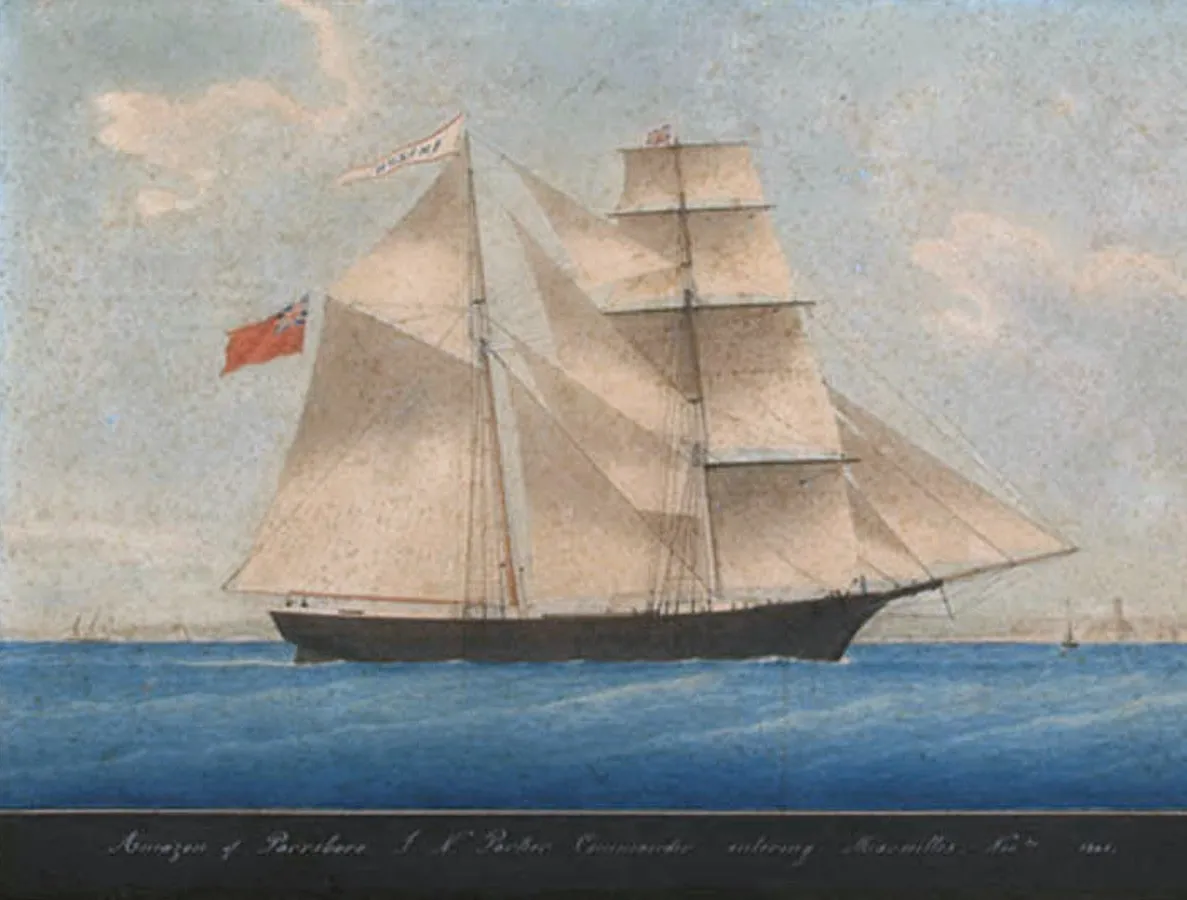
Maritime Mysteries Case file
A Sound Ship, Abandoned: The Mary Celeste, 1872
A seaworthy American brigantine was found adrift east of the Azores with her one boat gone and ten people missing. The famous version, with its warm breakfast and untouched coffee, is fiction. The documented case is stranger, and harder to close.
- Case type
- Maritime
- Status
- Unexplained
- Event date
- December 4, 1872
- Location
- North Atlantic Ocean, about 400 miles east of the Azores (found adrift; she had sailed from New York bound for Genoa) - North Atlantic Ocean
- Evidence
-
- Physical
- Testimonial
- Official record
The open question What alarm convinced an experienced captain to put ten people into a single small boat beside a sound, seaworthy ship, and why none of them were ever found.
In early December 1872, a brigantine sailing for Gibraltar came upon another vessel behaving oddly in the open Atlantic, several hundred miles east of the Azores. She was making way under reduced and damaged sail, yawing about as though no hand was on the wheel. When a boarding party rowed across and climbed aboard, they found her abandoned. No one was at the helm, no one answered, and a search of the cabins and hold turned up not a single living soul. Her one small boat was gone. Ten people had sailed from New York in her a month before, and not one of them, nor the boat, nor a body, was ever found.
That much is in the record. Almost everything else you have likely heard about the Mary Celeste, the table laid with a half-eaten breakfast, the coffee still warm in the cups, the ship found in perfect order with every sail set and not a rope out of place, the boats riding quietly in their davits, comes from fiction and sensational press, not from the men who actually boarded her. The documented ship was wetter, more disordered, and more interesting than the legend. This is an account of what the salvage court and the official survey actually recorded, what the physical evidence showed, and where the real open question sits once the inventions are stripped away. We keep three things separate, as always: what is documented, what the evidence shows, and what is still only a hypothesis.
The documented account
The ship was the Mary Celeste, and the spelling matters, because the more familiar “Marie Celeste” is an error introduced by Arthur Conan Doyle in 1884 and repeated ever since. She was American, registered in the United States, a brigantine (a “half-brig,” in the rig of the day) of roughly 282 tons after an 1872 refit in New York. She had been built in 1861 at Spencer’s Island, Nova Scotia, under the name Amazon, and was re-registered under American ownership and renamed in the late 1860s. At the time of this voyage she was part-owned by her master.
She left New York for Genoa, Italy, in early November 1872. The records reconcile to this: she cleared the East River around 5 November, lay at anchor off Staten Island for two days in poor weather, and put to sea on 7 November. Her cargo was 1,701 barrels of denatured, industrial alcohol, the kind used to fortify wine, shipped by a New York firm and consigned to Genoa. The cargo type is worth marking now, because it bears on the theories later: this was not drinking spirit.
Ten people were aboard. (Several reputable summaries say eight crew and eleven aboard; the carefully reconstructed and named crew lists support seven crew and ten in total, which is the figure used here.) They were Captain Benjamin Spooner Briggs, a Massachusetts master of sober and experienced reputation; his wife, Sarah Elizabeth Briggs; their daughter Sophia Matilda, about two years old; and a crew of seven. The Briggses’ young son was left at home and did not sail. The crew were the first mate Albert G. Richardson, the second mate Andrew Gilling, the steward and cook Edward William Head, the German brothers Volkert and Boz Lorenzen, and the seamen Arian Martens and Gottlieb Goudschaal. Spellings of the crew names vary across sources.
The vessel that found her was the Dei Gratia, another brigantine, under Captain David Reed Morehouse. She had left New York about a week after the Mary Celeste, also bound for the Mediterranean. The sighting and boarding fall on what the sources record variously as 4 or 5 December 1872, and the discrepancy has a simple cause: the afternoon of 4 December in civil, land-based time corresponds to 5 December in the ship’s older “sea time” reckoning, which began the day at noon. Most accounts give 4 December; one major summary gives 5 December. They describe the same afternoon. The position was roughly 38 degrees 20 minutes north, 17 degrees 15 minutes west, in the stretch of ocean between the Azores and Portugal, commonly summarized as about 400 miles east of the Azores.
The boarding party, led by the Dei Gratia’s mate Oliver Deveau, found a ship that was abandoned but afloat and fundamentally sound. She was under partial sail, with some sails set and others gone or blown away, and her rigging was damaged with ropes hanging loose. There was about three and a half feet of water in the hold, a significant amount for a vessel her size but well short of sinking. Her main hatch was secured, but the fore hatch and the lazarette hatch were open, their covers lying on deck nearby. One of her two pumps had been dismantled, and a sounding rod, used to measure the depth of water in the hold, was lying on deck. Her single boat, a yawl normally stowed over the main hatch, was gone.
Inside, the cabins were wet, water having come in through doorways and skylights, but they were not ransacked. The captain’s bed was wet. A harmonium, a sewing machine, women’s and a child’s clothing, toys, and other personal effects remained aboard. The ship’s papers and the captain’s navigation instruments, the chronometer, the sextant, and the navigation book, were missing. The ship’s log and the running log slate stayed behind. There was no prepared or cooked food and nothing set out to eat or drink. A sword was found in the captain’s cabin, in its sheath.
The running log’s final position entry was made on the morning of 25 November 1872 (sources differ on whether around 5 or 8 a.m.), placing the ship near Santa Maria, the easternmost of the Azores. She was found roughly nine or ten days later, several hundred miles further on, still making way under no one’s command.
The Dei Gratia’s mate put a prize crew aboard and sailed the derelict to Gibraltar, arriving on 13 December 1872, where she was arrested for a salvage hearing before the Vice-Admiralty Court. The hearings began on 17 December under the Chief Justice, Sir James Cochrane. The Crown’s case was driven by the Attorney-General of Gibraltar, Frederick Solly-Flood, who suspected foul play and pressed for it. He ordered the ship surveyed; the surveyor John Austin, with a diver, inspected her around 23 December, examining marks on the bow and stains aboard that were thought to be evidence of violence. The investigation ran for more than three months. It found no evidence of foul play. A salvage award, commonly given as £1,700, roughly one-fifth of the combined value of ship and cargo, was announced around April 1873; one summary instead puts it at one-sixth of a value near $46,000. The figure was widely read as low for a clean salvage, a reflection of the suspicions that the court had been unable to prove.
The evidence
The strength of the Mary Celeste case is unusual for a 19th-century sea mystery: a contemporaneous court actually examined the vessel, ordered a survey of her, and questioned the salvors under oath. The case rests on that sworn salvage testimony, chiefly the deposition of the boarding mate Oliver Deveau, on Austin’s official survey, on the recorded physical state of the ship and her cargo, and on the surviving log and log slate. Its weakness is just as plain. No one aboard survived, no body was recovered, no witness saw the abandonment, and the log slate stops days before it happened. Everything about the abandonment itself is inference. With that stated, here is what the record actually had to work with.
The state of the ship. The boarding account and the survey describe a seaworthy but wet and disordered vessel: about three and a half feet of water in the hold, sails partly set and partly gone, damaged rigging, one pump dismantled, the fore and lazarette hatch covers off. This is the single most important corrective to the legend. There was no warm meal and no food set out; the galley held no cooked food, and nothing had been laid on the cabin table to eat or drink. One limit must be stated honestly: Deveau was a salvor with a financial stake in the award, so his testimony, though it forms the spine of the record, is not disinterested. The court tested it and found no dishonesty, and we note the incentive without implying any.
The cargo and the nine empty barrels. The 1,701 barrels were largely intact and unplundered. When the cargo was unloaded at Genoa, nine of the barrels were found empty. Those nine were reportedly made of red oak, more porous than the white oak of the rest, which is consistent with alcohol seeping and venting as vapor rather than with theft. This is the physical anchor of the leading modern theory. The limit: “nine empty” is a transcribed figure from the unloading, and the idea that escaping vapor frightened the crew is a reconstruction, not something the record states as the cause.
The missing yawl. The ship carried one boat, and it was gone. Several accounts describe a rope or halyard trailing from the vessel, read as a possible line by which the boat had been made fast. A single missing boat is the strongest physical sign that the people aboard left deliberately, in that boat, rather than vanishing. The limit is real: whether the boat was tied to the ship and the line then parted is inference, not record, and at least one historian has argued it would make little sense to tie a boat to a ship believed to be sinking.
The sounding rod and the dismantled pump. A sounding rod was found on deck and a pump had been taken apart. Read together, these suggest a crew actively trying to measure the water below, and possibly getting a frightening or false reading, a choked or miscounted sounding, or a pump fault, that made the ship seem to be flooding fast when she was not. This is a coherent reading of two suggestive objects, not a documented sequence of events.
The instruments taken, the logs left. The chronometer, sextant, navigation book, and ship’s papers were gone, while the log and log slate remained. Taking the navigation instruments and the papers is exactly what a captain would do on a planned, deliberate departure: you take what you need to find your way and to prove the ship’s identity. It argues against sudden violence or a panicked flight by empty-handed strangers. What it cannot do, by itself, is distinguish a precautionary evacuation from any other orderly departure by the ship’s own people.
The absence of plunder or violence. Valuables, the cargo, and the family’s possessions all remained. The stains on the sword and on the rails were chemically tested and shown not to be blood, and the marks on the bow were judged natural rather than man-made, a reading later supported by a US Navy assessment. There were no bodies and no signs of a struggle. This is the evidentiary basis for ruling out piracy and for the court’s failure to sustain any theory of murder or mutiny. (One detail, that the analysis clearing the marks was withheld for years, recurs in secondary accounts and is noted here as unconfirmed.) The honest limit: the absence of evidence of violence is not proof of what did happen. It narrows the field without choosing among the innocent possibilities.
Hypotheses and open questions
Everything in this section is a hypothesis. None is proven, and the court itself reached no finding of cause. They are set out best-supported first, and the historical suspicions of crime are included only because the record contains them, clearly marked as suspicions that were raised and never sustained.
A precautionary abandonment into the yawl that went fatally wrong. This is the leading modern inference, not a settled answer. On this reading, some alarm, most plausibly alcohol vapor venting from the seeping barrels, possibly a feared explosion, or a misread sounding suggesting the ship was flooding fast, led Captain Briggs to order everyone into the single yawl as a precaution, keeping the boat attached to the ship by a line while they waited to see whether she would founder or blow. The line then parted or was lost in worsening weather, the ship sailed on without them, and all ten were lost at sea in an open boat. Much of the physical evidence fits: the single missing boat, the dismantled pump and the sounding rod on deck, the nine emptied red-oak barrels, the trailing rope, the deliberately taken navigation instruments and papers, and the complete absence of plunder or violence. It describes a competent, cautious abandonment with a fatal outcome. What it cannot supply is the trigger. A 2006 experiment by the chemist Andrea Sella, simulating an alcohol-vapor ignition, produced, in the words reported by Wikipedia, “a spectacular wave of flame, but behind it was relatively cool air. No soot was left behind and there was no burning or scorching.” That cuts both ways: it makes a frightening flash without burn marks plausible, but it also removes the expectation of visible fire damage that might have confirmed the theory. Why an experienced master would put ten lives into a tiny boat beside a ship that was not actually sinking remains the hard question.
A waterspout or sudden squall, misread as imminent sinking. A waterspout or violent squall could have driven water below and damaged the rigging, and the combination of sudden water and a faulty pump or miscounted sounding could have convinced the crew she was going down. This supplies the alarm that the abandonment reading needs, and it fits the damaged rigging, missing sails, and water in the hold. But no log entry or witness records any such event; it is conjecture fitted to the damage, and the roughly three and a half feet of water was real but not fatal, which is precisely the point. They may have overestimated it.
A seaquake. An underwater seismic shock could in principle have jolted the ship and frightened the crew into leaving. It would explain a sudden, ship-wide alarm without leaving wreckage behind. It is also entirely speculative, with no instrumental or documentary support specific to this event, and it sits at the bottom of the “benign alarm” family.
Piracy. Raised historically and effectively ruled out by the evidence. Pirates do not leave an intact cargo, a family’s possessions, and the valuables aboard untouched. The state of the ship is incompatible with a raid.
Mutiny or murder by the Mary Celeste’s own crew. This was a theory pressed by the Attorney-General, Frederick Solly-Flood, at Gibraltar: that the crew, drunk on the cargo, killed the Briggs family and the officers. It was investigated and was not sustained. The cargo was denatured industrial alcohol, not drinkable without serious harm; the stains were not blood; the bow marks were natural; there were no bodies and no signs of struggle, and the valuables were intact. It is recorded here strictly as a 19th-century suspicion that the evidence did not support. Nothing in the record implicates Captain Briggs or any member of his crew in a crime.
Insurance or salvage fraud, or a conspiracy between Morehouse and Briggs. Also a suspicion pressed at Gibraltar: that the two masters, said to be acquaintances, conspired to fake an abandonment, or that the Dei Gratia’s men killed the crew to claim salvage. No evidence was found. The low salvage award reflected lingering suspicion, but no charge was sustained, and the claim that the two captains were friends rests on a single recollection by Morehouse’s widow some fifty years later. It is recorded here as an unproven suspicion. Nothing in the record implicates Captain Morehouse or the mate Oliver Deveau in any crime, and both brought the derelict safely into port and were never charged.
It is also worth setting aside what the case is not. It is not a ghost story, and the ship was not “cursed”; that framing is an import from fiction, discussed below. The 1913 “Abel Fosdyk” account, presented as the testimony of a survivor, is a known fabrication and is not evidence of anything. And the Mary Celeste’s deliberate wrecking in 1885 by a later captain, Gilman Parker, in an insurance fraud that finally destroyed the ship, is a separate event thirteen years on and has no bearing on the 1872 abandonment.
What remains unknown
Before stating what is open, it is worth being clear about what is closed, because the popular version of this case has it almost backward. The familiar scene, every sail set and not a rope out of place, the fire burning in the galley, the dinner standing untasted and scarcely cold, comes not from the men who boarded her but from a short story. In January 1884, in The Cornhill Magazine, Arthur Conan Doyle published “J. Habakuk Jephson’s Statement,” a piece of fiction that renamed the ship “Marie Celeste,” invented a different route and cargo, set the boats intact in their davits, and laid out the untouched meal. Doyle wrote, of the fictional ship:
“Every sail was set, the tiller was lashed fast, not a rope was out of place. The fire was burning in the galley. The dinner was standing untasted and scarcely cold.”
That is the source of the warm breakfast, the steaming coffee, the perfect order, and the boats in the davits. None of it is in the salvage record. Sensational newspapers, including one “perfect condition” account that ran the year before Doyle’s story, pushed in the same direction, and the two reinforced each other. The real ship was wet and partly de-rigged, with water in her hold and her one boat gone, and, as the reconstruction of the boarding puts it, “there was nothing to eat or drink on the cabin table and no evidence of preparations being made for eating,” and “no cooked food on the galley stove, or elsewhere in the galley.” There was no abandoned meal. There was no perfect order. There were no boats in the davits, because there was only ever one boat, and it was gone.
What is left, once the fiction is removed, is a real and narrow mystery. The evidence indicates a deliberate, captain-led abandonment of a sound ship into her one small boat, by people who took their navigation instruments and papers, who left no meal, no violence, and no plunder behind, and who were never seen again. The leading reading is that this was a precautionary abandonment that went fatally wrong, the boat lost from the ship and all ten dying at sea. That reading is well fitted to the physical clues, but it is an inference, not a finding. The exact trigger, alcohol vapor, a misread flooding, a waterspout, or something else, was never established, and the fate of the ten was never learned. The court reached no conclusion as to cause.
So we will not tell you the case is solved, because the men who investigated it at the time could not solve it, and the best modern account is a reconstruction the evidence allows rather than one it proves. We will not tell you it was murder or fraud, because those suspicions were raised at Gibraltar, tested, and never sustained, and nothing in the record implicates any of the named men in a crime. We will not tell you the ship was haunted or cursed, because the record describes seeping barrels, a dismantled pump, a sounding rod on deck, and a missing boat, not anything beyond explanation. What we can tell you is that on some afternoon after 25 November 1872, for an alarm we can no longer name, an experienced captain decided to put ten people into a single small boat beside a ship that was not actually sinking, and that decision appears to have killed them all. The file is still open.
Sources
Primary / documentary
- Gibraltar Vice-Admiralty Court salvage records, 1872–1873 (depositions, the Austin survey), as reprinted in Charles Edey Fay, “Mary Celeste: The Odyssey of an Abandoned Ship” (1942)
- Charles Edey Fay, “Mary Celeste: The Odyssey of an Abandoned Ship” (1942), Internet Archive
Secondary / contextual
- Royal Museums Greenwich, “The mystery of the Mary Celeste”
- Smithsonian Magazine, “Abandoned Ship: The Mary Celeste”
- American Heritage, “The Mystery of the Mary Celeste” (1981)
- History Hit, “Ghost Ship: What Happened to the Mary Celeste?”
- New England Historical Society, “The Mysterious Disappearance of the Mary Celeste”
- Wikipedia, “Mary Celeste”