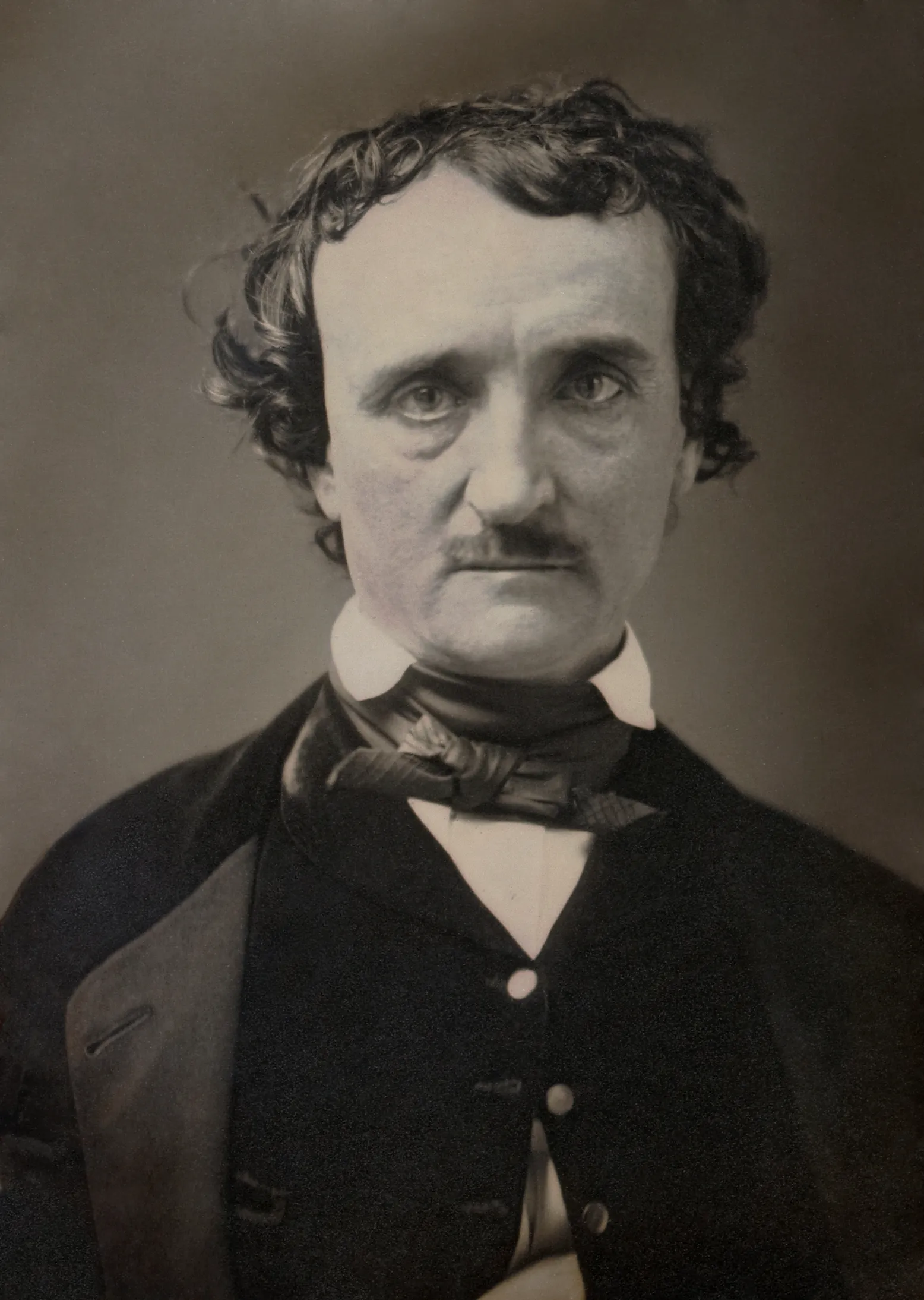
Unexplained Deaths Case file
Five Lost Days and a Polling-Place Tavern: The Death of Edgar Allan Poe
In October 1849 the most famous writer in America was found delirious at a Baltimore tavern that doubled as a polling place, in clothes that were not his own. He never said what had happened. Then the record ran out.
- Case type
- Unexplained death
- Status
- Unexplained
- Event date
- October 7, 1849
- Location
- Baltimore, Maryland (found at Ryan's Tavern / Gunner's Hall, a Fourth Ward polling place; died at Washington College Hospital) - United States
- Evidence
-
- Testimonial
- Official record
The open question What killed Edgar Allan Poe across the five lost days and four delirious nights of early October 1849, when no death certificate, no medical record, and no autopsy survives to settle it?
Edgar Allan Poe left Richmond around 27 September 1849 and reached Baltimore about a day later. Then, for roughly five days, the most famous writer in America simply disappears from the record. No reliable document places him anywhere. On 3 October he surfaced, found in distress at a tavern that was serving that day as a polling place, wearing clothes that witnesses agreed were not his own. He was carried to a hospital, sank into a delirium that never lifted, and died four nights later without ever becoming lucid enough to say what had happened to him. He was forty.
What happened in those five lost days, and what actually killed him, is one of the most picked-over questions in American letters. It is also, on the evidence, unanswerable. The internet sells you a verdict: it was drink, it was rabies, it was a beating, it was a voting gang. We are going to do something harder and duller. We are going to separate the thin documented record from a century and a half of competing theory, and from a famous, partly forged legend, and show why the file cannot be closed. We keep three things apart, as always: what is documented, what the evidence shows, and what remains only a hypothesis.
The single fact that governs everything else, and that belongs at the top rather than buried at the end: no death certificate survives, no medical or hospital records survive, and no autopsy was ever performed. The PBS NewsHour account of the case puts it plainly: “none of Poe’s medical records or even the actual death certificate survives.” Every theory you will read below, including the ones with a doctor’s name attached, is therefore an inference drawn from a few letters, one same-day note, a euphemistic newspaper line, and the recollections of a handful of people, several of whom had reasons to shade what they said. That absence is not a detail. It is the spine of the case.
The documented account
The defensible core is spare, and it is worth stating exactly how spare.
Poe had been on a lecture tour and a stay in Richmond, where he had renewed an attachment to Elmira Royster Shelton, a sweetheart from his youth, by 1849 a widow. He left Richmond around 27 September 1849 by steamer, bound, on most accounts, for Philadelphia and then New York on editing business and to collect his aunt and mother-in-law, Maria Clemm. He arrived in Baltimore on or about 28 September.
After that there is a gap of about five days that no one has ever filled with a reliable record. Poe’s own cousin, Neilson Poe, wrote on 11 October that he had been unable to ascertain where Edgar had spent the time. This blank is not a gap in our knowledge that better research might close. It was already a blank to the people closest to him within days of his death. We are not going to narrate those days, because nothing in the record supports a narration.
On 3 October 1849, a printer named Joseph W. Walker found Poe in distress at or near Ryan’s Tavern, also called Gunner’s Hall, which was serving that day as a Fourth Ward polling place in a Baltimore election. Walker sent a note to Dr. Joseph E. Snodgrass, a local acquaintance of Poe’s. That note is the firmest single document in the entire case: a neutral, same-day record establishing the place, the date, and that Poe was alive and in serious distress. It reports a gentleman “rather the worse for wear” at Ryan’s Fourth Ward polls, in great distress, who named Poe as the man and Snodgrass as someone he knew, and asked for immediate assistance. The note says nothing about a cause. (The Edgar Allan Poe Society of Baltimore, the leading scholarly archive on this case, reproduces it; we treat the exact wording as attributed.) One popular detail does not belong in the record at all: the Poe Society states there is “no foundation for the tradition that Poe was found in a gutter.” Where that phrase appears, it is legend, not fact.
Snodgrass, joined by Henry Herring, an uncle of Poe’s by marriage, arranged for Poe to be taken by carriage to Washington College Hospital. (The institution went by several names in 1849, including Washington University Hospital and the Washington Medical College of Baltimore; we use Washington College Hospital.) There he was attended by the resident physician, Dr. John J. Moran.
What followed, almost everything we have about the hospital days, comes through Moran, and Moran is a problem we will treat in full in the next section. Stripped to the part that is credible and consistent across the early record: Poe was delirious, confused, lapsing in and out of consciousness, and was never lucid enough to explain what had happened to him or how he had come to be in this state. He was reportedly wearing clothes that were not his own, cheap and ill-fitting, a detail attested by more than one witness, though the specific garments differ between accounts. He died in the early hours of 7 October 1849, commonly given as about 5 a.m.
The only contemporaneous public statement of a cause was a brief line in the Baltimore Clipper giving “congestion of the brain,” and a parallel return to the Baltimore City Health Commissioner recording one death from congestion of the brain among males in their thirties. That phrase, and the related “phrenitis” or “cerebral inflammation,” were period euphemisms. They could politely cover a range of deaths, including ones thought disgraceful, such as alcoholism. This is the point at which a reader should be careful: some reputable popular accounts loosely refer to a “death certificate” listing “phrenitis.” The better-anchored sources hold that no death certificate survives, if one was ever made, and that the Baltimore Clipper euphemism is the only contemporaneous cause on record. We follow the better-anchored position. “Congestion of the brain” is a reported euphemism, not a documented diagnosis.
Two days after Poe died, the posthumous distortion began. On 9 October 1849, Rufus Wilmot Griswold published a hostile obituary in the New York Tribune under the pseudonym “Ludwig,” announcing Poe’s death in terms suggesting that few would grieve it and casting him as a friendless figure given to wandering the streets in madness or melancholy. In 1850, Griswold, having secured a role as Poe’s literary executor (the claim that Poe appointed him is itself unproven, per the Poe Society), produced a longer “Memoir” portraying Poe as a chronically drunk, drug-addled madman. The historian Arthur Hobson Quinn demonstrated in 1941 that Griswold built this portrait partly on forged and altered letters. For roughly a quarter century, Griswold’s “Memoir” was the most readily available account of Poe’s life. This matters to the death because it manufactured the “depraved drunkard” Poe that still colors the most popular theory of how he died.
The evidence
The defining feature of this case is how little there is to weigh, and how compromised the little that exists is. There is no physical evidence in any modern sense: no toxicology, no autopsy, no surviving hospital chart, no surviving death certificate, no tissue. Everything specific about Poe’s final week rests on a small set of accounts, and the two richest of them are distorted in opposite directions.
Dr. John J. Moran, the attending physician. Moran is the only source for most of the hospital detail, and he is demonstrably unreliable. His story did not merely soften with age; it changed in its load-bearing facts across three tellings spread over thirty-six years. On the date Poe was admitted, his 1849 letter to Maria Clemm says 3 October, around 5 p.m.; his 1875 New York Herald article says about ten in the forenoon on 7 October; his 1885 book gives 6 October, about nine in the morning. On the time of death, the 1849 letter has Poe still alive at 3 a.m. on 7 October; the 1875 version puts death around midnight; the 1885 version “between 12 and 1 o’clock.” On where Poe was found, his 1875 account relocates the discovery to a bench in front of a mercantile house on the Light Street wharf, contradicting the contemporaneous Walker and Snodgrass record of Ryan’s Tavern. And the dramatic deathbed scenes, the long florid speeches, the famous dying word “Evermore!”, appear in the later tellings, not the early one. The scholar W. T. Bandy, examining all three accounts, compared Moran’s invention to Griswold’s doctoring of Poe’s letters and concluded that Moran was effectively a frustrated writer of fiction, and that his shifting dates prove he could not have been working from any hospital records, because there were none to consult.
The consequence is strict. We can credit the bare core: Moran attended Poe, and Poe was delirious and incoherent. We cannot treat his dramatic later material as fact. That includes the celebrated detail that Poe spent his last night repeatedly calling out a name, “Reynolds,” whose identity has never been established. The “Reynolds” calling traces to Moran, and Bandy argued it is itself a Moran artifact, writing that “the Poe-Reynolds myth, then, is only that, a myth.” The alleged last words, variously reported as “Lord help my poor soul,” come through the same compromised channel and conflict with Moran’s own “Evermore!” We present “Reynolds” and any specific last words as reported, attributed to Moran, and contested. The 1875 “Evermore!” we cite only as an example of how the legend was built, never as something Poe actually said.
Dr. Joseph E. Snodgrass, the friend summoned to the tavern. Snodgrass was genuinely present on 3 October, which makes his account of Poe’s distressed and ill-clad state among the better-anchored testimony. But Snodgrass was a committed temperance advocate, and the Poe Society judges that this commitment “clearly colored his statements” and apparently led him to exaggerate. A campaigner against drink had a motive to present a famous man’s collapse as a drunkard’s cautionary end. So his emphasis on intoxication must be discounted for that agenda, not taken at face value.
Joseph W. Walker’s note. The short note Walker sent to Snodgrass on 3 October is the closest thing to a neutral, same-day primary document in the entire case. It establishes place, date, and that Poe was alive and in great distress, and it asserts no cause. It is the firmest single anchor we have, and it is also nearly the only one.
The clothes that were not his own. That Poe was found in shabby, ill-fitting clothing not characteristic of him is attested by both Snodgrass and Moran, which makes the general fact well supported. The specific garments differ between the two accounts, so the specifics are attributed and variable. This detail carries weight in one of the theories below, and it is worth being clear that it is solid as a general observation and soft on particulars.
The polling place on an election day. Ryan’s, or Gunner’s Hall, was a Fourth Ward polling place, and 3 October 1849 was an election day in Baltimore. That is a documented fact about the location. The inference some draw from it is a theory, treated below, not a fact.
The absence of physical evidence, the decisive limit. There is no toxicology, no autopsy, no hospital chart, no death certificate, no preserved 1849 tissue. The only later physical episode is the 1875 exhumation and reburial, during which graveside observers described the skeleton and reported, secondhand, something like a mass inside the skull. That is a layperson’s graveside impression a quarter century after death, not a pathological examination, and brain tissue does not survive twenty-six years in the ground. Even the modern hair analyses, run in the late twentieth and early twenty-first centuries for heavy metals and carbon monoxide, work from hair rather than clinical data, and they returned results inconsistent with poisoning rather than supportive of it. There is, in short, nothing physical that points to a cause.
Hypotheses and open questions
Everything in this section is a hypothesis. None is established, and none is endorsed. They are laid out roughly most-discussed first, which is not the same as most-likely. The honest position, stated again, is that the cause is unknown.
Alcohol. The oldest and most traditional reading. Poe was found at a tavern; Snodgrass and Herring presumed drink; the Baltimore Clipper euphemism could cover it. In its favor, Poe had a documented history of episodic heavy drinking and a notoriously poor tolerance, and he was found at a drinking establishment. Against it, and this is the crucial correction, the theory is entangled with two biases that have to be stripped out before it can be weighed honestly. The first is Griswold’s defamation, which manufactured the chronic drunkard out of forged letters and broadcast it for twenty-five years. The second is Snodgrass’s temperance agenda, which inclined his account toward a drunkard’s-death reading. Strip both away and the contemporaneous evidence for acute alcohol as the cause is thin: Moran, unreliable in every direction, later insisted Poe had no odor of liquor on his breath, and Poe had reportedly taken a temperance pledge in Richmond shortly before leaving. Alcohol must be judged on what the record actually shows, not on Griswold’s portrait. On that basis it is plausible and unproven, no more.
Cooping. Cooping was a real and documented form of Baltimore election fraud in this era: gangs seized men, plied them with drink, sometimes disguised them in changed clothes, and forced them to vote repeatedly at different polls. Applied to Poe, it has an undeniable appeal, because it is the one theory that fits the two strangest documented facts at once. Poe was found at a polling place on an election day, in clothes that were not his own. That is exactly the signature cooping would leave. But the case for it is entirely circumstantial. There is no testimony that Poe was cooped, no witness, no claim of it in 1849; the idea surfaces decades later, first around 1872. It is the theory that best fits the two odd facts, and it is unprovable. We present it as exactly that.
Rabies. In 1996, Dr. R. Michael Benitez, a cardiologist at the University of Maryland, was handed an anonymized case at a routine clinical conference and diagnosed rabies before he learned the patient was Poe. He published the analysis in the Maryland Medical Journal. In its favor, the reported clinical course (acute confusion, hallucinations, perspiration, a fluctuating pulse, a roughly four-day decline, and reported difficulty drinking that could be read as hydrophobia) is consistent with rabies encephalitis, and most human rabies patients cannot recall a bite. The case against it is equally specific, and Benitez largely conceded it himself. He worked from summaries of the historical accounts, not from Poe’s records, which are lost; he disclaimed certainty, with the press coverage quoting his point that no one can say conclusively that Poe died of rabies because there was no autopsy. There is no record of an animal bite. Some accounts have Poe drinking water, which cuts against hydrophobia. And PBS, among others, dismisses it. It is an attributed hypothesis from 1996, not a finding.
An inflammatory brain illness, or pneumonia. A cluster of medical readings points at acute illness rather than drink or trauma. Some clinicians, and the Poe Museum curator Chris Semtner, favor an inflammatory brain disease such as encephalitis or meningitis, which fits the delirium and hallucination and squares neatly with the “congestion of the brain” euphemism. Others note that Poe reportedly left Richmond unwell and that cold Baltimore weather could have driven a respiratory illness into fatal pneumonia with delirium. Each fits some of the reported symptoms. None is anchored by any physical evidence, because there is none. These are plausible medical possibilities, not conclusions.
Carbon monoxide and heavy-metal poisoning. Two poisoning theories were tested directly, which is rare in this case, and the testing did not support them. The researcher Albert Donnay proposed chronic coal-gas (carbon monoxide) exposure in the late 1990s; a hair analysis run to check it was inconclusive. A 2006 hair analysis, and earlier mercury claims, were examined for lead and mercury poisoning; the measured mercury was reportedly far below a poisoning threshold and consistent with medical treatment. Here the physical evidence, such as it is, tends to refute the theory rather than support it.
A brain tumor. Raised after the 1875 reburial on the strength of that graveside report of a hardened mass inside the skull, later glossed as a possible calcified tumor. The evidentiary basis is weak for the reasons already given: brain tissue does not survive that long, and the observation was secondhand, untrained, and a quarter century after death.
Murder or a beating. The most-cited version is John Evangelist Walsh’s 2000 theory, which proposed that relatives of Poe’s fiancee Elmira Shelton beat him and forced him to drink. Older mugging and robbery theories also circulate. We treat this strictly as unproven historical speculation. No evidence of a beating or a homicide is documented; the symptom record points to illness and delirium rather than trauma; and a reviewer judged Walsh’s account entertaining but of limited scholarly value. We name no theory as established, and we accuse no identifiable person of anything.
What remains unknown
Set the theories side by side and the same hard kernel survives all of them: there is not enough left to choose. The contemporaneous record is a same-day note that names no cause, a euphemistic newspaper line, a handful of letters, and the recollections of two compromised witnesses, one a demonstrable fabricator and one a temperance campaigner with a motive to see a drunkard. There is no death certificate, no medical record, no autopsy, no toxicology. Every cause-of-death theory is an inference from that, and the inferences do not converge.
So we will not tell you Poe drank himself to death, because the contemporaneous evidence for it is thin once Griswold’s forged portrait and Snodgrass’s agenda are taken out, and because for twenty-five years the only widely read account of Poe’s life was a documented character assassination. We will not tell you it was rabies, because the doctor who proposed it worked from summaries, never had the records, and said himself that without an autopsy no one can know. We will not tell you he was cooped, because the theory that best fits the polling place and the borrowed clothes rests on not one word of 1849 testimony. We will not tell you he was murdered, because nothing in the record documents a crime, and we will name no one. And we will not hand you a tidy “congestion of the brain” diagnosis, because that was a euphemism on a newspaper page, not a finding.
What we can tell you is the documented blank itself, which is the real and permanent mystery. A famous man left Richmond, lost five days no one has ever accounted for, and was found delirious at a polling-place tavern in clothes that were not his own. He spent four nights in a hospital and never once became clear enough to say what had happened. Then the record runs out, and the two voices that might have filled it spent the following decades distorting it instead. As the Poe Society puts it, Poe’s death “must, probably, remain a mystery, but the puzzle still teases and entices us.” The file is thin, it is tampered with, and it is not going to close.
Sources
Primary / authoritative scholarly
- Edgar Allan Poe Society of Baltimore, “The Mysterious Death of Edgar Allan Poe”
- W. T. Bandy, “Dr. Moran and the Poe-Reynolds Myth” (1987), Edgar Allan Poe Society
- Dr. J. J. Moran, “Official Memoranda of the Death of Edgar A. Poe” (1875), Edgar Allan Poe Society
- Edgar Allan Poe Society of Baltimore, “Edgar Allan Poe and Rufus Wilmot Griswold”
Secondary / contextual
- U.S. National Park Service, “The Mystery of Edgar Allan Poe’s Death”
- Smithsonian Magazine, “The (Still) Mysterious Death of Edgar Allan Poe”
- PBS NewsHour, “Edgar Allan Poe’s greatest mystery was his death”
- Baltimore Sun (1996), Benitez rabies coverage
- Deseret News (1996), “Study suggests rabies, not alcohol, claimed Poe in 1849”
- Wikipedia, “Death of Edgar Allan Poe”