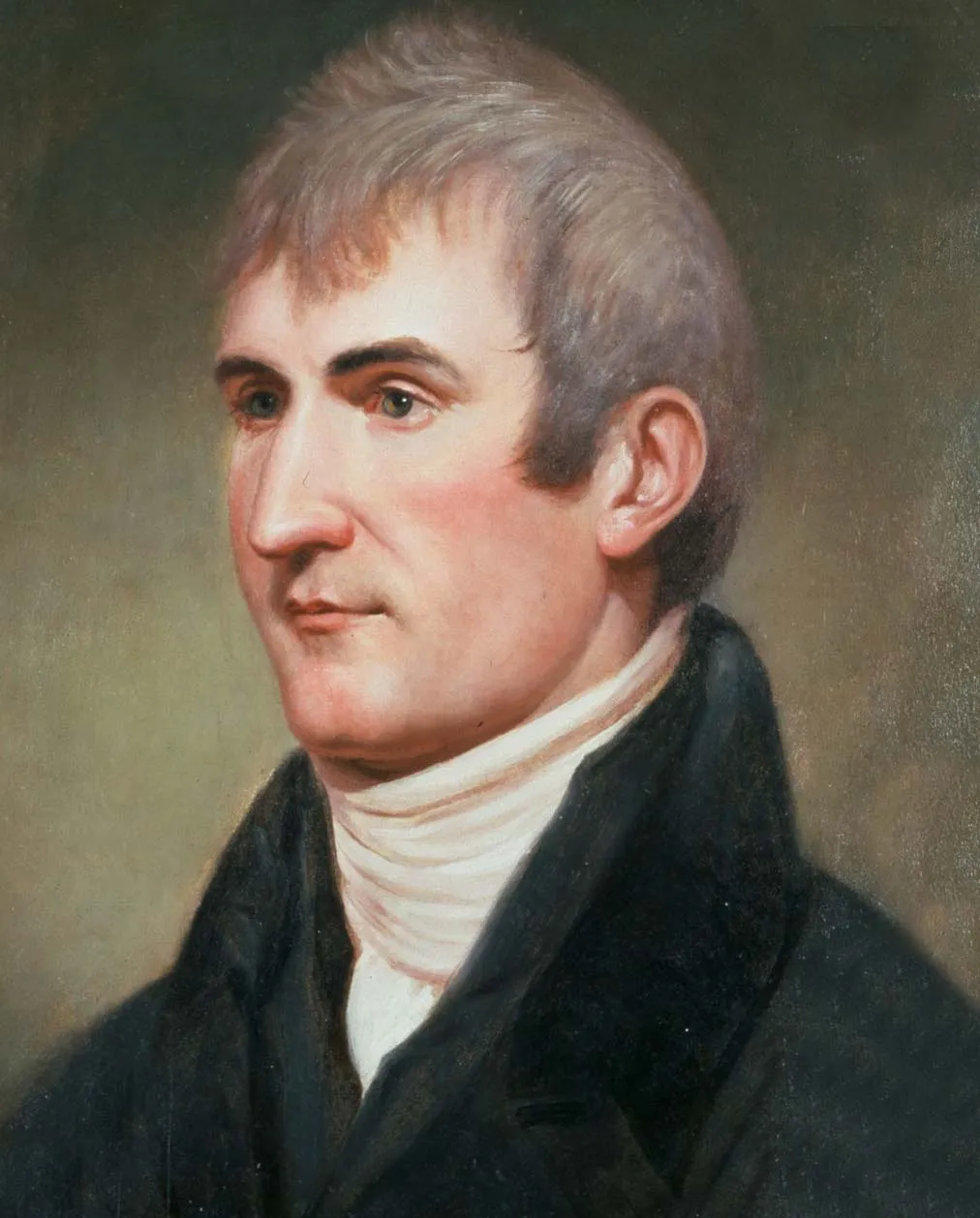
Unexplained Deaths Case file
Grinder's Stand on the Natchez Trace: The Death of Meriwether Lewis, 1809
In the early hours of 11 October 1809, two pistol shots were heard at a small inn on the Natchez Trace. The most famous explorer in America died at sunrise, and the manner of his death was never officially established.
- Case type
- Unexplained death
- Status
- Unexplained
- Event date
- October 11, 1809
- Location
- Grinder's Stand, Natchez Trace, present-day Lewis County, Tennessee (now the Meriwether Lewis National Monument, Natchez Trace Parkway) - United States
- Evidence
-
- Official record
- Testimonial
The open question What killed Meriwether Lewis at Grinder's Stand in the early hours of 11 October 1809, when no autopsy was performed, no inquest was held, the body has never been examined, and the only witness told the story in at least three significantly different versions over thirty years?
On the evening of 10 October 1809, Meriwether Lewis rode up to a small log inn on the Natchez Trace and asked for lodging. He was thirty-five, the co-leader of the Corps of Discovery, the Governor of the Territory of Upper Louisiana, and Thomas Jefferson’s protege. He was also, by the time he reached the inn, a man whose government accounts had been refused, whose credit had collapsed, and whom two separate observers had described as deranged in mind on the journey south. In the early hours of 11 October, the hostess of the inn heard pistol shots from the cabin where Lewis was sleeping. He was found wounded at dawn, and he died shortly after sunrise. He was buried near where he died. There was no inquest. There was no autopsy. The body has never been examined.
What killed Meriwether Lewis at Grinder’s Stand is one of the longest-running open questions in American history, and it remains, on the documented evidence, genuinely unresolved 216 years on. The internet sells you a verdict: it was suicide, it was a bandit, it was the corrupt general he was about to expose, it was the innkeeper, it was the servant. We are going to do something harder and duller. We are going to separate the thin documented record from two centuries of competing theory, and show why the file cannot be closed. We keep three things apart throughout, as always: what is documented, what the evidence can and cannot show, and what is only hypothesis.
The single fact that governs everything else, and that belongs at the top rather than buried at the end: no contemporaneous inquest was held, no autopsy was performed, no formal cause of death was ever entered in any judicial or coronial record in 1809, and the body has never been exhumed. Lewis’s two closest associates, Thomas Jefferson and William Clark, accepted suicide on the basis of a secondhand letter from a man who had not been at the inn that night. That reading has been the majority view among biographers ever since. It has also been contested continuously, and in 1996 a coroner’s jury in Lewis County, Tennessee, declined to rule between murder and suicide and unanimously recommended exhumation. Most historians lean suicide. No version is proven. That is the honest core, and we will not move from it.
The documented account
The defensible core is spare, and it is worth stating how spare.
Meriwether Lewis was born on 18 August 1774 at Locust Hill, in Albemarle County, Virginia. He served as private secretary to President Jefferson from 1801 to 1803. From 1804 to 1806 he co-led the Corps of Discovery with William Clark across the continent to the Pacific and back. In 1807 he was appointed Governor of the Territory of Upper Louisiana, succeeding General James Wilkinson. By 1809 his governorship was in serious trouble. The War Department had refused to honor several financial drafts he had drawn against the government for territorial expenses, including the cost of returning the Mandan chief Sheheke-shote to his village. His personal credit collapsed. He had also failed, despite three years of Jeffersonian pressure, to deliver the expedition journals to a publisher. He was travelling to Washington in person to defend his accounts and, by Jefferson’s expectation, to deliver the journals.
He left St. Louis on or about 4 September 1809, by flatboat down the Mississippi. At New Madrid on 11 September he wrote a will, leaving his estate to his mother after debts were paid. He reached Fort Pickering, on the site of present-day Memphis, on 15 September. The post commander, Captain Gilbert Russell, observed Lewis to be in a state of mental disturbance and placed him under friendly house arrest in the captain’s quarters for roughly two weeks, restricting his access to alcohol. (One key document supporting that observation is contested in part of the murder-thesis literature; we treat the substance as documented and flag the contest below.) Lewis left Fort Pickering on 29 September, intending to travel overland on the Natchez Trace to Nashville and on to Washington. His party was three men besides himself: Major James Neelly, the U.S. agent to the Chickasaw Nation; Neelly’s servant; and Lewis’s own servant John Pernier, a free man of color who had been in Jefferson’s service in Washington before entering Lewis’s employ.
The party reached the Chickasaw Agency around 5 or 6 October. According to Neelly, Lewis there again appeared at times deranged in mind. They rested two days and proceeded onto the Natchez Trace. On the night of 9 to 10 October, two of the party’s horses strayed from camp. Neelly stayed behind to recover them. Lewis rode ahead with the two servants, telling Neelly he would stop at the first inhabited house. He arrived at Grinder’s Stand, an inn on the Trace in present-day Lewis County, Tennessee, near present-day Hohenwald and roughly seventy miles southwest of Nashville, around sunset on 10 October 1809.
The inn was a two-cabin log structure with a covered breezeway. It was operated by Robert and Priscilla Grinder. Robert Grinder was not present that night, reportedly at the family’s Duck River settlement some twenty miles away. Priscilla Grinder, then about thirty-five, was the adult present, with two or three of her young children and an enslaved girl. Lewis dismounted, brought his saddle into the cabin assigned to him, ate only a few mouthfuls of supper, and (per Mrs. Grinder’s later account to the ornithologist Alexander Wilson, in spring 1811) paced the floor and spoke aloud to himself before requesting bear skins and buffalo robes to make up a place to sleep on the cabin floor.
During the early hours of 11 October 1809, Mrs. Grinder heard pistol shots from Lewis’s cabin. He was found alive but mortally wounded, with two gunshot wounds, one to the head and one to the chest or upper body. He died shortly after sunrise on 11 October 1809. He was thirty-five. Neelly arrived later that day, having recovered the horses, took charge of Lewis’s effects and papers, including the expedition journals, and arranged for Lewis to be buried near where he died.
What followed in the official record is almost nothing. No coroner attended. No inquest was held at the time. No contemporaneous record of cause of death was entered in any judicial or coronial document. On 18 October 1809, Neelly wrote from Nashville to Jefferson reporting the death and attributing it to suicide. Jefferson accepted that reading. So did Clark, who first learned of Lewis’s death from a Kentucky newspaper and, in a private letter, expressed his fear that the weight of Lewis’s mind had overcome him. (The phrase as commonly quoted is attributed to Clark across multiple secondary sources; we report it as attributed.) Jefferson’s most authoritative public statement of acceptance came in his 18 August 1813 biographical memoir of Lewis, prefixed to the first published edition of the expedition journals, in which he wrote of Lewis’s “sensible depressions of mind” and of an underlying “constitutional” disposition to such episodes within the Lewis family. Those phrases are well anchored to the 1813 memoir and used here as attributed.
The grave is today part of the Meriwether Lewis National Monument, a unit of the Natchez Trace Parkway administered by the National Park Service. In 1848 the State of Tennessee erected a broken-column monument there, a form the period used to symbolize a life cut short. More than a century later, the case re-opened administratively. In June 1996, a coroner’s inquest was convened in Hohenwald, Lewis County, at the instigation of the GW law professor and forensic scientist James E. Starrs and the former Tennessee district attorney Joe Baugh. The jury unanimously recommended exhumation. The National Park Service formally refused in the federal litigation that followed. The Department of the Interior approved an exhumation in 2008, then rescinded the approval in 2010. A coalition of roughly 160 to 200 collateral descendants of Lewis (traced through his siblings, as Lewis himself had no children) campaigned publicly across these years for the grave to be opened. The grave has not been opened. Their public spokespeople in the press coverage of the campaign appear here only as the public advocates they made themselves: Howell Lewis Bowen and Colonel Thomas McSwain among them.
The evidence
The defining feature of this case is how little there is to weigh, and that the little there is rests on one woman’s testimony, a secondhand letter, and a grave that has never been opened. There is no physical evidence in any modern sense: no autopsy, no contemporaneous coronial finding, no forensic examination, no surviving recovered remains examined by anyone. Every theory below is an inference from a small set of documents and from Lewis’s documented condition in the months before his death.
Mrs. Grinder’s testimony. Priscilla Grinder is the load-bearing eyewitness for everything that happened at the inn that night, and her account is the central evidentiary problem in the case. She did not see the shots fired. She heard them, through the unchinked logs of a separate cabin, and she did not go to Lewis after she heard them. She told the story of the night to at least three different listeners across roughly thirty years: as relayed to Jefferson in Neelly’s letter of 18 October 1809; in a direct interview with Alexander Wilson in May 1811; and in an account collected by an anonymous schoolteacher around 1839, when she was approximately sixty. The three versions conflict on critical points. They differ on whether mysterious men arrived at the inn earlier in the evening; on how long elapsed between the shots and the summoning of help; on whether she watched Lewis through the cabin wall; and on what she said the servants found in the morning. The Wilson narrative is the most detailed and the closest in time. The 1839 account is the most dramatic and the most distant. Murder readings draw on details that appear only in the 1839 version. Suicide readings tend to discount that version as embroidered. The honest course is to report the conflict and not to pick the most exciting version as the truth. Every theory of what happened in that cabin, whatever its other strengths, runs through her testimony.
The Neelly letter. Major James Neelly’s letter to Jefferson, written from Nashville on 18 October 1809, is the closest contemporaneous document on the death and the firmest single anchor for date, place, the wound pattern as Neelly understood it, and the prompt acceptance of suicide by the man closest to the scene. Neelly was not at the inn during the night. He had stayed back on the Trace to recover the strayed horses and arrived the next day. His account is therefore secondhand, drawn from Mrs. Grinder, from the servants, and from his own observation of the scene the following morning. It is the load-bearing source for Jefferson’s and Clark’s acceptance of suicide. It is also the document on which one strand of the modern murder literature, principally Starrs and Gale (2009), advances a contested authenticity claim, arguing that the surviving letter was physically written by another hand. We report Neelly’s letter as the closest contemporaneous record of the death, attribute its content, and treat the disputed-authorship thesis as an attributed Starrs/Gale claim that has not been independently adopted by the mainstream editorial scholarship at Founders Online or the Lewis & Clark Trail Heritage Foundation. We do not treat the letter as written-in-Neelly’s-own-hand, and we do not adopt the forgery claim.
The wound pattern. Two pistols had been fired. Lewis was reported to have been wounded once in the head and once in the chest or lower torso. We state that once, plainly, as the evidentiary fact, because the two separate wounds in two separate locations are part of what has kept the case open: some commentators have pressed the question of whether the documented wound pattern is unequivocally self-inflicted, and others have pressed the contrary case that Lewis lived long enough after the shots to be consistent with self-infliction at frontier distances. We are not going to elaborate the wounds beyond what is needed for the evidentiary point. The body itself was never examined by a physician then or since, and so every description of the wounds is itself secondhand, from Mrs. Grinder through Neelly and Wilson. Some later popular accounts add further detail about the death scene that we cannot anchor to the contemporaneous record, and we do not include it.
The documented mental and financial collapse. The strongest documented circumstance pointing toward suicide is that Lewis was in serious mental and financial difficulty in the months before his death. His War Department drafts were refused. His personal credit was at risk; he acknowledged the danger in writing in July 1809. He wrote a will at New Madrid in September. He was placed under friendly house arrest at Fort Pickering for two weeks, during which the post commander observed him to be deranged in mind, with Russell later reporting two earlier attempts on himself during the river passage (Russell’s later affidavit is itself contested in the murder-thesis literature, as noted above; the underlying observation of Lewis’s mental state is anchored by Neelly’s independent observation on the Trace as well). He had failed for three years to deliver the journals. Jefferson, who knew him better than almost anyone, would later describe him as long subject to depressions of mind. This is the strongest single argument for the suicide reading, and it is the part of the record that the contemporary acceptance by Jefferson and Clark rests on. It establishes a documented context for despair. It does not establish that he died by his own hand.
The 1996 coroner’s inquest. A coroner’s jury sitting in Hohenwald in June 1996 considered the case and declined to rule between murder and suicide. The coroner, Richard Tate, stated for the record that there was “very little tangible evidence for this jury to base a credible ruling as to the matter of murder or suicide.” The jury’s unanimous operative finding was that “because of the importance of the person in question to the history of Lewis County, we feel exhumation is necessary for closure of this matter.” This is a documented modern event of legal significance, and we report it precisely. It was not a murder verdict. It was a finding that the evidence available without opening the grave is insufficient, and a recommendation that the grave be opened.
The decisive absence. No autopsy, no contemporaneous inquest, no forensic examination, no recovered remains examined by any physician then or since. Two centuries of historical argument run through one woman’s varying testimony, one secondhand letter, and a wound pattern described only through that letter and that testimony. This is not a gap that better research will close. It was already a blank in 1809. It is the reason the case is genuinely unresolved, and it is the spine of any honest account of it.
Hypotheses and open questions
Everything in this section is a hypothesis. None is established, and none is endorsed. They are laid out roughly most-favored first, which is not the same as most-likely. The honest position, stated again, is that the manner of death is unestablished.
Suicide. This is the most commonly favored reading. It was accepted at the time by the men closest to Lewis (Jefferson, Clark, Neelly, and Wilson), and it is the majority view among the major modern biographers, including Stephen Ambrose in his 1996 Undaunted Courage, Donald Jackson, Paul Russell Cutright, and Clay Jenkinson. In its favor: a documented financial collapse with the War Department drafts refused; the will at New Madrid; two independent observers (Russell at Fort Pickering, Neelly on the Trace) reporting Lewis as deranged in mind during the journey; Jefferson’s later testimony of long-standing depressions of mind in Lewis; Clark’s reaction; and the convergence of multiple contemporaneous documents on the same explanation. Against it, or in caution: no autopsy, no inquest, no examination of the body; the entire account of the shooting rests on one woman’s testimony, told in at least three significantly different versions over thirty years; the wound pattern as described raises the question some commentators have pressed about Lewis’s reported survival after the shots; and at least one of the documents that anchors the contemporary observation (Russell’s later affidavit) is contested in part of the literature. We report that most historians lean suicide and that suicide was never formally established. We report the lean as a finding about the state of historical opinion. We do not assert it as fact.
Murder by robbery on the Trace. The Natchez Trace was a notoriously dangerous road in 1809, with a documented traveler economy of bandits and predatory innkeepers. The theory holds that one or more outsiders robbed and killed Lewis at the inn. In its favor: Lewis was reportedly carrying money and a fine watch; the wound pattern is not unequivocally self-inflicted; Mrs. Grinder’s late (1839) account introduces strangers who arrived at the inn earlier in the evening. Against it: no identified perpetrator, no contemporaneous report of robbery, no recovered stolen property, and Lewis’s expedition journals were preserved and delivered to Jefferson, which is not the behavior of a Trace bandit. We present this as attributed historical speculation, plausible in light of the Trace’s reputation and unsupported in the documentary record.
Murder by people in or near the house. A second cluster of murder readings names persons who were in the orbit of the inn that night, principally the innkeeper Robert Grinder, whose absence is asserted only on his wife’s word, and Lewis’s servant John Pernier. Pernier reportedly travelled to Monticello and to Washington seeking his back wages after Lewis’s death, was refused by Jefferson in Washington, by Clark, by President Madison, and by the Lewis family, and died of a laudanum overdose in Washington on or about late April 1810; whether that death was suicide is not established in the record, and we do not assert it. The late (1839) version of Mrs. Grinder’s account includes a detail in which Pernier is found the next morning wearing some of Lewis’s clothes. Suicide proponents discount the 1839 version. Murder proponents emphasize it. We treat both possibilities strictly as attributed speculation. None of the named men was ever charged with anything. We name them here only because particular theories invoke them by name; we accuse no one. The do-no-harm rule applies even to long-dead historical actors who were never charged or tried.
Murder by James Neelly. A further branch of the murder literature implicates Major Neelly himself, on the strength of his subsequent custody of Lewis’s papers and his role as the messenger who delivered the suicide reading to Jefferson. Against this reading: Neelly is documented as not at the cabin when the shots were fired (he was on the Trace recovering the strayed horses). The most defensible characterization of his role on the documented record is that he was the man who delivered the secondhand news to Jefferson, not a man placed at the scene. We attribute the Neelly-as-killer reading to its modern proponents and do not adopt it.
Political murder, in the orbit of General James Wilkinson. The most-elaborated modern murder thesis, advanced by James E. Starrs and Kira Gale in their 2009 The Death of Meriwether Lewis: A Historic Crime Scene Investigation, holds that Lewis was killed to prevent him from exposing the corruption of General James Wilkinson, his predecessor as Governor of Upper Louisiana, the commanding general of the U.S. Army, and a documented paid agent of Spain whose covert career was exposed in Spanish archives by the historian Isaac J. Cox in 1913. In its favor: Wilkinson’s documented criminality is real and considerable; Lewis was travelling to Washington with his books; Starrs and Gale press a chain of post-death documentary anomalies. Against it: there is no documented chain of command from Wilkinson to anyone at Grinder’s Stand; the forgery claims that the thesis rests on at key points have not been independently adopted by the mainstream editorial scholarship; and the mainstream Lewis biographers (Ambrose, Cutright, Jenkinson) do not endorse the thesis. We present it strictly as Starrs and Gale’s attributed reading. We name Wilkinson here only as the named historical actor whose documented record of corruption a particular theory invokes, never as a man shown to have ordered or arranged Lewis’s death.
Accident. Lewis handled firearms expertly and constantly; frontier firearm accidents were common. Against the accident reading: two separate shots, from two pistols, to two different parts of the body, is a poor accidental scenario, and nothing in Mrs. Grinder’s account points toward accident. It is rarely seriously advanced, and we note it only for completeness.
Underlying medical condition. A separate set of readings asks not how Lewis died but why he was in crisis at all. The epidemiologist Reimert T. Ravenholt proposed in 1994 that Lewis had contracted neurosyphilis on the expedition and was deep into its late-stage neurological decline by 1809. Others have proposed bipolar disorder, chronic alcoholism with possible opiate use, or mercury toxicity from contemporary medical treatment. None of these is provable without remains. Ambrose called the syphilis hypothesis “more intriguing and speculative than convincing.” These are causal readings of Lewis’s documented collapse, not alternative manners of death, and they sit here as attributed competing medical hypotheses.
What remains unknown
Set the readings side by side and the same hard kernel survives all of them: there is not enough left to choose. No one saw the shots fired. The only witness to the surrounding hours was Priscilla Grinder, and she told the story in at least three significantly different versions over thirty years. The closest contemporaneous document, Neelly’s letter to Jefferson, is itself secondhand and is the subject of an unresolved authenticity question in part of the literature. No coroner attended in 1809. No inquest was held at the time. No autopsy was performed. The body has never been examined. A 1996 coroner’s jury could not rule between murder and suicide on the surviving evidence and unanimously recommended that the grave be opened. The Park Service has refused. The Interior Department approved an exhumation in 2008 and rescinded the approval in 2010. A coalition of Lewis’s collateral descendants has petitioned publicly for nearly thirty years for an examination of the remains. They have not had one.
So we will not tell you Meriwether Lewis killed himself, because the cause was never established, and because the contemporaneous acceptance of suicide by Jefferson and Clark rested on a secondhand letter from a man who was not at the inn. We will not tell you he was murdered, because nothing in the record documents a crime or identifies a perpetrator, and we will name no one as a killer. We will not tell you a Trace bandit took him, or that a corrupt general ordered it, or that his servant turned on him, because the evidence for each of these is attributed historical speculation and not a finding. And we will not characterize the 1996 inquest as a murder verdict, because it expressly was not.
What we can tell you is the documented blank itself, which is the real and permanent mystery. A famous explorer and a sitting territorial governor, observed deranged in mind by two independent men over the preceding weeks, arrived at a small inn on the Natchez Trace at sunset on 10 October 1809. The husband of the house was conveniently elsewhere. Lewis stayed in a cabin under the eye of one woman whose account would change substantially each time she told it. Two pistol shots in the night. Two wounds in the dawn. A grave near the cabin. A letter to Jefferson written a week later from Nashville. A 1996 coroner’s jury that could not rule. A National Park Service refusal that has held for nearly thirty years. Most historians lean suicide. No version is proven. The file is thin, it is contested, and on the present record it is not going to close.
Sources
Primary / authoritative archival
- Founders Online (National Archives), “James Neelly to Thomas Jefferson, 18 October 1809”
- Library of Congress, Thomas Jefferson Papers, “James Neelly to Thomas Jefferson, October 18, 1809”
- Deseret News (5 June 1996), “Inquest: Meriwether Lewis’ body should be exhumed”
- UPI Archives (3 June 1996), “Inquest into Meriwether Lewis death”
- Justia, In Re Exhumation of Lewis, 999 F. Supp. 1066 (M.D. Tenn. 1998)
Secondary / contextual
- Encyclopaedia Britannica, “Meriwether Lewis”
- Lewis & Clark Trail Heritage Foundation, Discovering Lewis & Clark, “The Last Journey of Meriwether Lewis”
- U.S. National Park Service, “Meriwether Lewis”
- U.S. National Park Service, “John Pernia”
- Wikipedia, “Meriwether Lewis”
- Wikipedia, “Grinder’s Stand”
- Nashville Scene, “The Strange Death of an American Hero”
- JSTOR Daily, “The Mysterious Death of Meriwether Lewis”
- Salon (March 1999), “Who killed Meriwether Lewis?”
- HeraldNet / Associated Press (8 July 2009), “Kin want Meriwether Lewis’ body exhumed to learn how he died”
- American Heritage, “The Perilous Afterlife of the Lewis and Clark Expedition”
- History News Network, Kira Gale, “Why I Believe Meriwether Lewis Was Assassinated”
- Oregon Encyclopedia, “Meriwether Lewis (1774-1809)”